

Megaprojects
California High-Speed Rail: Investing in the Track-Laying Milestone

Securities.io maintains rigorous editorial standards and may receive compensation from reviewed links. We are not a registered investment adviser and this is not investment advice. Please view our affiliate disclosure.

North America and the USA have not been very favorable to high-speed railroad projects, which makes it somewhat of an exception among developed countries, with Europe and Japan having long-established large networks of high-speed rail. And of course, China is today famous for having built the world’s most extensive high-speed railroad network, with way more total length than the rest of the world’s combined.

Source: Reddit
This might, however, soon change partially, as the California High-Speed Rail (CAHSR) has officially transitioned from civil work to the track-laying and electrification phase. This is a major turning point for a project that has long been criticized for massive delays, and sometimes joked that it would never get finished.
So it is a sign that the project is now on the right track, and what does it say about the future of high-speed railroads in North America?
Summary:
- Building A New Way of Traveling in California: This high-speed rail is designed to replace cars and plane travel in California. It will be the longest and quickest railroad in the USA.
- Troubled Execution: Costs have doubled and many years of delays accumulated.
- Finally Getting Done: Construction progressed to the stage of laying track and electrification.
- Investment Angle: Exposure is indirect—through contractors and infrastructure operators (e.g., Parsons) providing important technology to the project.
California High-Speed Rail (CAHSR) Overview
The California High-Speed Rail (CAHSR) is a publicly funded high-speed rail system under construction, which will ultimately connect San Francisco to San Diego.
The project was initiated in 2008, after approval through a statewide ballot. The project is divided into two stages.
- Stage 1 will connect San Francisco and Los Angeles through a 494-mile (795 km) long railroad track. It aims to connect the two cities in just two hours and 40 minutes. Phase 1 is now expected to be finished by 2032-2033.
- Stage 2 will expand the network southward to connect to San Diego and northward to Sacramento. This extension would bring the total network to 776 miles (1,249 km). No completion date has been set for Phase 2.
A separate project, Brightline West, privately funded, is expected to connect the CAHSR to Las Vegas, Nevada, and have further high-speed railroad connectivity to the region.

Source: Wikipedia
While not the largest, the project would have a remarkable top speed of 220 mph (350 km/h). This would make it the fastest train in the USA and among the fastest in the world.
In total, the project construction is creating 16,000 jobs, relies on more than 900 small businesses, and is expected to have $24.6B in economic impact. The Central Valley has seen the greatest impact, with around $11B in total economic activity since 2006.
Why California High-Speed Rail Was Approved
Shifting Traffic
The key reason for the project is to replace parts of the very heavy passenger traffic by cars and planes in the area, by connecting the main economic center of California, itself a state with a GDP equivalent to countries like Japan or Germany.
Currently, driving or using an intercity bus between San Francisco and Los Angeles takes 6-8 hours. There is also no direct rail connection between the two cities, either slow or high-speed. A similar situation exists for the Los Angeles-Oakland rail track, which takes 11 hours and runs only once daily.
The San Francisco-Los Angeles short-haul air routes are averaging 132 scheduled flights daily, so even just a fraction of this traffic moving to high-speed railroad could help a lot to reduce flight congestion in what is one of the busiest domestic air routes in the US.
Helping The Housing Crisis
A secondary objective will be to provide an easy commuting option between job-rich urban regions like the Bay Area and areas with cheaper housing in the Central Valley.
Considering hybrid remote work schedules are becoming increasingly common in white-collar jobs, high-speed trains could become the favorite option for traveling just a few times a week for many workers who could relocate to an area with cheaper housing costs.
A third target is that by using electricity in a state that pushed heavily into renewable capacity, the project should help strongly reduce CO2 emissions. Just phase 1 of high-speed rail is projected to reduce annual statewide CO2 emissions by about 600,000 tons, or 0.2% of the total emissions of the region.
Not Just The CAHSR
The building of the California High-Speed Rail is not planned in isolation. The California State Rail Plan, a $310B, is looking to expand the state’s rail network so it increases its share of passenger travel from 2% to 20% by 2050.
“Our vision is simple: by 2050, every Californian should be able to choose rail as a way to get to their destination, near or far.”
California Governor Gavin Newsom
The plan includes new railroads, a wider electrified network moving from the current 50 electrified miles to 1500 electrified miles. It should have seamless transfer between services in key transfer hubs, integrate with the express bus network, and a modern contactless payment system.

Source: Trains.com
Cost Overruns and Delays: The CAHSR Controversy
A Difficult Start
The ambition of the California High-Speed Rail project, in a country and state unused to building this sort of infrastructure, was maybe dooming it to suffer a troubled development.
The first issue it met was the difficulty of acquiring the land parcels necessary for the construction. By January 2013, five years after approval, California had not acquired a single parcel. Ultimately, construction would start on partially purchased land, but the necessary acquisitions would happen only slowly and piecemeal.
Another issue was the issuance of rushed construction contracts, even before the designs of bridges, overpasses, etc, were completed, in part to match deadlines for public funding.
Lastly, legal challenges from citizen groups, opposition politicians, and numerous design iterations ordered by rail freight companies further delayed the project.
Excessive Costs
Another major problem that has affected the project’s image was poor planning of actual costs and rising expenses.
The initial cost presented to voters was $45B for phase 1 (in 2008 dollars). As every element of the project proved to be more costly than planned, combined with delays, the whole of phase 1 of the project is now expected to cost as much as $126.1B in 2026 dollars. This is still double what was expected, even taking inflation into account.
It is unclear how expensive phase 2 will turn out to be, but it is likely that the actual costs will be much higher than the optimistic initial estimates made in the mid-2000s.
Swipe to scroll →
| Metric | Original Projection (2008) | Latest Estimate (2026) |
|---|---|---|
| Phase 1 Cost | $45B | $126.1B |
| Length | 494 miles | 494 miles |
| Top Speed | 220 mph | 220 mph |
| Completion Target | ~2020s | 2032–2033 |
Construction Milestones and 2026 Track-Laying Update
Latest Developments
As mentioned, the California High-Speed Rail project is moving forward as the Southern Railhead Facility in Kern County is finally completed. This 150-acre facility will operate as a central logistics hub for the delivery, storage, and deployment of critical materials needed to electrify and operate the system.
“With procurements underway on laying of electrified track and systems, including new and innovative pathways opening for private sector investment, we’re building the foundation for long-term success and continued momentum.”
CEO Ian Choudri – California High-Speed Rail Authority
This is not the only milestone reached, as 119 miles are under active construction, over 80 miles of guideway are already finished, and 58 structures, like bridges, overpasses, and viaducts, are completed as well.
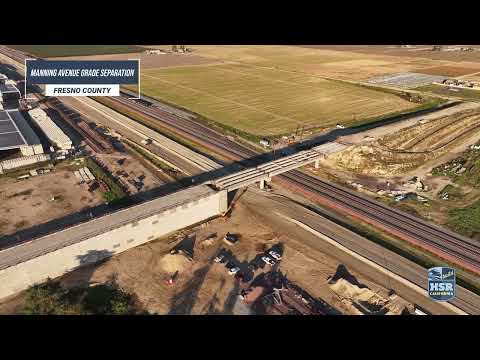
So even with all the delays and additional costs, it appears that the project is now moving forward.
“California is building the nation’s first high-speed rail system, and we’re proving it can be done. We’re laying the foundation for cleaner, faster, and more connected transportation while investing in communities and creating good-paying jobs. California isn’t waiting for the future. We’re building it.”
Governor Gavin Newsom
Getting Cheaper?
Even better, the Draft 2026 Business Plan issued by the California High-Speed Rail Authority estimates that the cost of delivering Phase 1 has fallen by $1.7B.
A key reason for the future declining costs is the decision to complete the initial operating segment between Merced and Bakersfield before extending services to larger population centers. This way, some of the rail network can already start operating and generating revenue.
California High-Speed Rail’s Unique Technologies
The complex geology of California has made this project more complex than an equivalent in the US East Coast would have been.
The first technology required was advanced seismic engineering, required to deal with California’s high risk of earthquakes and overall high levels of geological activity. This is likely one of the most active regions on Earth, only on par with places like Japan.
So specialized designs and earthquake-resistant structures were required for bridges and elevated guideways.
An Earthquake Early Warning System (EEWS) will also use seismic stations to warn the train network of an upcoming earthquake before the strongest shakes arrive, helping it perform an emergency slowdown safely before a major earthquake could cause a derailment. This technology proved reliable and vital to Japan during the Tohoku earthquake of 2011, a country very familiar with both earthquake risks and operating an extensive high-speed rail network.
The high speeds planned for this project also required advanced locomotives and rolling stock. The final choice on which model to use has not been made yet, but the French Alstom (ALO.PA) and the German Siemens Mobility (SIE.DE), both experts in high-speed trains, have been shortlisted.
The project is also a very complex one, with advanced cloud-based IT systems used, for example, ArcGIS, created by Esri used to track lands, environmental compliance, etc.
Lastly, advanced tunnel technology needed to be deployed to manage the Californian mountains, as high-speed trains cannot easily slow down, or take sharp turns and inclinations. This included the 28 miles of tunneling in the Palmdale to Burbank segment and required large-diameter Tunnel Boring Machines (TBMs).

Source: California State
Why California Rejected Hyperloop and Maglev Alternatives
Traditional high-speed railroads are not the only type of rail project that could be created.
Maglev (magnetic levitation) trains are notably being operated in Japan and China, and hypothetically go even quicker, putting them even more in a direct competition with short-distance air travel. The highest speed achieved by a maglev was achieved by Japanese JR Central’s L0 superconducting maglev, which reached a top speed of 603 kilometers per hour (375 mph) in 2015.
But considering that most of the issues experienced by the CAHSR project came from inexperience in building such a project, moving directly to even more demanding and complex maglev could have been a serious mistake.
In the same way, Elon Musk was proposing as far back as 2013 to replace the CAHSR with his Hyperloop concept.
However, it is only in the past few years that Hyperloop prototypes have finally made some progress, with no project to build a commercial one even in plan, which shows that this could not have formed a viable alternative either.
What California High-Speed Rail Means for Investors
The California High-Speed Rail is one of the largest ongoing infrastructure projects in the USA, and definitely the largest one in California, especially when considered as a section of the even larger $310B electrification program of the state railroad.
This has unfortunately not been a smoothly going project, with many years of delays and massive cost overruns having become its defining characteristics in the public’s eyes.
Nevertheless, when finished, it will be a revolution in how long-distance transport is handled in the USA, with massive ramifications for the Californian economy. Not only could it prove a viable alternative to congested air and road traffic, but it could help redistribute housing pressure out of Los Angeles and San Francisco, and bring extra connectivity to secondary urban centers. It could also reduce carbon emissions and save countless productive hours for Californians.
Investing in the California High-Speed Rail
Parsons Corporation
Parsons Corporation (PSN -2.2%)
Parsons is a company founded in 1944, initially as a development company for electronics, design, and engineering for aircraft, missiles, and rocket facilities. It later expanded into the oil & petrochemical sectors in the 1950s.
This is in the 1980s onward that the company expanded into bridges and other logistical infrastructure projects. It was publicly listed on the NYSE through an IPO in 2019. Today, the company is still involved in both national security and infrastructure projects.
Transportation is the largest segment of the company, making up more than a quarter of all revenues.
The defense activity is mostly centered around C5ISR (Command, Control, Communications, Computers, Cyber, Intelligence, Surveillance, and Reconnaissance): cyberdefense, electronic warfare, and missile defense.

Source: Parsons
In the California High-Speed Rail project, it is in charge of deploying its proprietary Positive Train Control (PTC) framework. The system uses both cloud-based and onboard systems to detect any anomaly and stop any train that might be going too fast or be at risk of collision, a must-have for the speed expected of the CAHSR.
It is the first deployment at this scale of this technology, although the company already has it functioning in New Jersey.
“We are a recognized leader in the application of communications-based train control systems and the technical lead on multiple installations worldwide.”
The company is mostly active in the USA (3/4th of revenues), with a 50/50 split between revenues from infrastructure and from the federal government (mostly defense-related).

Source: Parsons
The company is today somewhat of a large conglomerate, created from a series of mergers and acquisitions over the years.
As such, Parsons is a solid company for investors looking for exposure to US public spending. This is true in defense, especially cyberdefense of both military and civilian infrastructures (water, power, transportation) in an increasingly unstable global context. But this is also true in the context of the US looking to re-industrialize and improve its domestic capacities, and states building new projects like the California High-Speed Rail.

Source: Parsons
(You can also read about similar companies in our article “Top Industrial Stocks to Buy for an Expansion“)
Investor Takeaways:
- Theme to watch: North American re-shoring + infrastructure modernization supports technology providers for complex projects.
- What matters financially: prestigious project case studies like the CAHSR raise the company profile on top of being profitable.
- Key risk: further delays or political shifts can postpone the application of rail traffic solutions.
- Optional add: Parsons’ other activities in cyberdefense and missile defense are extra relevant in the global geopolitical context.
Latest Parsons (PSN) Stock News and Developments
Bastion Bets on Government Spending with $8 Million New Stake in Parsons
fool.com
•
February 27, 2026
Artisan Partners Limited Partnership Has $193.36 Million Position in Parsons Corporation $PSN
defenseworld.net
•
February 27, 2026
Bear Of The Day: Parsons (PSN)
zacks.com
•
February 20, 2026
Parsons Corporation (PSN) Presents at Barclays 43rd Annual Industrial Select Conference Transcript
seekingalpha.com
•
February 18, 2026
Parsons (NYSE:PSN) Shares Gap Down After Earnings Miss
defenseworld.net
•
February 12, 2026
Why Parsons Stock Plummeted Today
fool.com
•
February 11, 2026



