

Artificial Intelligence
Autodesk (ADSK): The CAD Giant’s Physical AI Push

Securities.io maintains rigorous editorial standards and may receive compensation from reviewed links. We are not a registered investment adviser and this is not investment advice. Please view our affiliate disclosure.
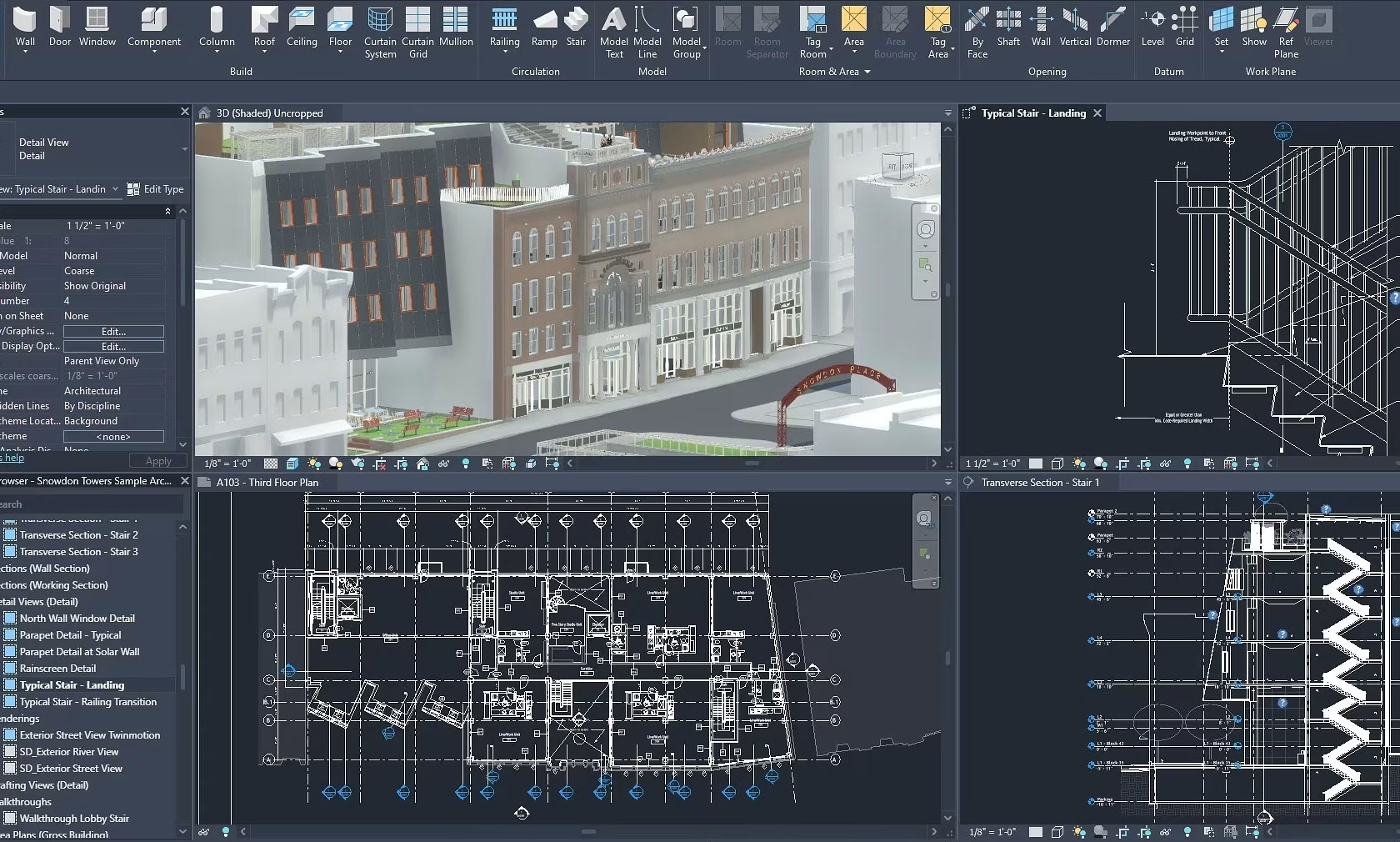
The design of new products used to be done manually, with handcrafted prototypes and one-time-use molds, until a final version was chosen. As computers got progressively more powerful, the drawing desks of engineers changed into increasingly more realistic virtual 3D models.
This evolution was progressively democratized, with computing capacity moving from a few industrial mainframe computers to any reasonably priced desktop machine.
And the files progressively moved from a local hosting to a cloud-based database that let multiple designers and engineers visualize and edit the same design, add new parts, etc.

Source: Autodesk
At the center of many of these evolutions was the market leader for 3D design in manufacturing, engineering, and other industrial applications: Autodesk.
Autodesk, Inc. (ADSK +0.14%)
The company is most famous for its AutoCAD software, but this is just one of the many specialized software programs the company accumulated from a mix of internal development and serial acquisitions. Today, it is moving beyond just industrial applications and is also active in entertainment and media production.
Autodesk has also been embracing AI very early, with its own AI labs founded as early as 2018, making it one of the most “AI-ready” software companies, even as the whole sector of SaaS stocks has been recently clobbered by markets for the potential AI could disrupt some or many of them.
Autodesk (ADSK) Overview: Revenue, Segments, Business Model
Autodesk is the creator and provider of many professional 3D software programs, of which the most famous is probably AutoCAD. They are used worldwide by professionals like engineers and architects for designing industrial components, buildings, and 3D models.
The company operates virtually everywhere, with 190 countries covered through 1,260 providers and distributors managing the local sales of Autodesk’s various software.
In fiscal 2025 (year ended January 31, 2025), the company generated $6.131B in total net revenue (+12% YoY). Operating margin was 22% on a GAAP basis and 36% on a non-GAAP basis.
This represents a massive jump from the company’s activity 10 years ago, where revenues and free cash flow were approximately one third of 2025’s.

Source: Autodesk
These revenues mostly come from subscriptions ($5.717B).
The company split its operations into 4 categories:
- Architecture, Engineering, Construction, and Operations (“AECO”).
- AutoCAD and AutoCAD LT.
- Manufacturing (“MFG”).
- Media and Entertainment (“M&E”).
By product family (FY2025 net revenue): AECO $2.937B, AutoCAD & AutoCAD LT $1.572B, Manufacturing $1.189B, and Media & Entertainment $315M. The main customers of Autodesk are large and medium-sized companies, with America and Europe the largest markets by far.

Source: Autodesk
Swipe to scroll → (table scrolls horizontally)
| Metric | FY2025 | YoY | Why it matters |
|---|---|---|---|
| Total net revenue | $6.131B | +12% | Scale + durable renewals support AI/consumption transition. |
| Subscription net revenue | $5.717B | +12% | Recurrence underpins margin and funds AI productization. |
| GAAP operating margin | 22% | — | Baseline profitability after stock comp + amortization. |
| Non-GAAP operating margin | 36% | — | Shows operating leverage potential investors often model. |
| Largest product families | AECO $2.937B; AutoCAD $1.572B | AECO +14%; AutoCAD +8% | AECO is the growth engine; AutoCAD is the cash anchor. |
Over time, the company’s business model has evolved, from one-time sale of software licenses + updates to the current subscription model.

Source: Autodesk
It is now moving toward AI tokenization and outcome-based billing, as the company’s legacy software progressively merges with its AI tools.

Source: Autodesk
Autodesk Products: AutoCAD, Revit, Fusion 360, Maya
While AutoCAD 3D model capacities are the core of the company’s offering, it is complemented by many more specialized offerings and modules that are dedicated to specific industries or engineering requirements.

Source: Autodesk
Architecture, Engineering, Construction, and Operations (AECO)
By far the largest segment for the company, it is a $51B total addressable market. Autodesk offers the top-end-to-end cloud software for all steps and workers of a construction project: engineers, operators, and contractors.
The company has started activity in this segment in 16 new countries, reaching 57 different countries. The area with the most untapped potential is the Asia Pacific, as well as South America.

Source: Autodesk
Autodesk sees a growing opportunity in large infrastructure projects, both in transportation and water. This includes not just the 3D design of new infrastructure, but also the AI-powered scan of construction sites and advanced reporting and design review tools.
Notably, it managed to get integrated into no less than 20 US States Department of Transportation (DOTs), as well as the US Army Corps of Engineers.

Source: Autodesk
Manufacturing
The manufacturing segment is another large one and a significant growth opportunity for Autodesk, as production processes increasingly digitize and integrate new technologies like 3D printing.
It is currently a $58B total addressable market, with the design of products and operating the manufacturing facility. The company’s main target is midsize manufacturers, more than ultra-large companies more targeted by the competitors’ software made by companies like Siemens and Dassault.

Source: Autodesk
As such, the company should benefit greatly from the effort of re-industrializing North America and Europe, and be able to grow the accounts linked to new manufacturing as they ramp up capacity.
Media and Entertainment
While the smallest segment for the company, the production of VFX and other 3D modeling for both movies & TV series and high-budget video games has been a growing sector for Autodesk.
In total, the company judges this is a $8.5B total addressable market.
In this segment, Autodesk’s embrace of AI can be a major asset, as media companies can use it not just for the traditional concept work and motion capture, but also to clone voices, create digital doubles, age or de-age, animation, etc.

Source: Autodesk
More broadly, estimates for the creator economy vary widely depending on definitions, but multiple market trackers project the sector could reach roughly $528B by 2030 (often cited at ~22.5% CAGR). For Autodesk, the key takeaway is that high-volume content pipelines (video, VFX, games) are still expanding—and increasingly leaning into AI-driven workflows.
As such, Autodesk also positions itself to provide VFX systems to individual users or small media companies. In addition, it automatically provides IP protection and cybersecurity, including watermarks, MPAA compliance, multi-factor authentication, etc.

Source: Autodesk
So while AI is viewed as a potentially disruptive or destructive force by many in the industry, Autodesk is instead positioned to benefit greatly from media content embracing more AI cost-saving and efficiency.
Autodesk AI Strategy: Generative Design, Agents, Consumption Pricing
Generative AI in Autodesk: Assistant, Neural CAD, Automation
Historically, more powerful tools for manual creation of designs and cloud-based software have been the core of Autodesk software.
Today, generative AI is taking the front seat as a primary tool for new content creation as well as analysis and improvement of existing designs.

Source: Autodesk
To do so, the company introduced Autodesk Assistant, an AI agent for design and production. This is powered by custom AI systems like Neural CAD for geometry or building.
“We’re defining the AI revolution for design and make, empowering customers with new task, workflow and system automations, and capturing shared value through subscription, consumption, and outcomes-based business models that blend human and machine capabilities.”
Andrew Anagnost, Autodesk President and CEO (FY2025 Form 10-K)
These tools offer new insights into a design, with, for example, automated calculation or complex generation of details according to the massive database of existing designs fed into Autodesk’s AI from real-life examples of similar projects.

Source: Autodesk
This also includes the possibility to give plain text instructions to the AI in a natural language, and let it figure out what it concretely means in the modification of a part’s design. This is not only making the work of engineers and designers easier, but also quicker.

Source: Autodesk
Autodesk Fusion’s automated drawing tools are letting us create drawings in 50% of the previous time.
Karl Heydenrych – Director of Turnstone Guitar Company
The company is seeing a massive uptick in AI adoption, notably with +40% API usage growth year-to-year. The model, for now, is offering for free a moderate use of the API, letting users test the functions at no risk, while monetizing usage beyond a certain threshold.
“In fiscal 2025, we transitioned most of our indirect business to the new transaction model in our major markets. In this new transaction model, Solution Providers provide a quote to customers but the actual transaction occurs directly between Autodesk and the customer.”
Overall, AI is now integrated at every step of the company’s software and its clients’ work, from the generation of ideas to data collection and even factory planning of the production.

Source: Autodesk
Technology Center
Autodesk, being so involved with real construction and engineering, is also exploring how new materials can power new types of designs.
Its technology centers in Boston, San Francisco, Toronto, and Birmingham provide access to large-format fabrication equipment, a wide range of robotics, a composites lab, polymer and metal additive workshops, and project space to accommodate building-scale construction projects.
These spaces are designed to enable sustainable manufacturing, smart cities, and green buildings.
AR & VR
Autodesk is also very active in staying on top of the concept of “extended reality (XR), which merges together augmented reality (AR), virtual reality (VR), and “mixed reality,” treating them all in a continuum of blended digital and real experiences.
These can be used to design new things, share ideas and 3D models with colleagues, and include real-time collaboration on shared virtual items.
Safely protected by its firm grasp over the industries in which it operates, Autodesk is able to leverage partnerships with almost all the key actors of VR/AR technology development, including Unity, Unreal Engine, and NVIDIA.

Source: Autodesk
Over time, it is likely that generative AI will also play a part in this technology, as AI could suggest in real-time extra information or design possibilities.
Physical AI: Autodesk’s Role in Robotics + World Models
Autodesk’s experience with building, manufacturing, and 3D virtual space makes it a partner of choice for “physical AI” (follow the link for a full report on the topic), the next step of AI development, that try to make AI truly understand the physical world, moving beyond language.
The company is moving quickly in that space, including with a $200M investment in World Labs as part of a total $1B new funding into the physical AI-focused company.
“If AI is to be truly useful, it must understand worlds, not just words. Worlds are governed by geometry, physics, and dynamics, and reconciling the semantic, spatial, and physical is the next great frontier of AI.”
Dr. Fei-Fei Li, World Labs cofounder
One such step is for example how Cosmic Robotics is trying to automate solar farm installation.
“From our customer’s standpoint, they use software to design their projects and have GPS locations and drawings that they use. And now we can intake those. And the robot can intake it. Now, you can just upload that into the robot system. Everything stays digital.”
James Emerick, Co-Founder, CEO, Cosmic Robotics
Investor Takeaways:
- Clarify margins: FY2025 operating margin is 22% GAAP and 36% non-GAAP—labeling both boosts trust and prevents “fact-check lag.”
- AECO is the lever: It’s Autodesk’s largest product family and the most workflow-sticky across design + build + operations.
- Billing model shift matters: AI tokens / usage pricing can expand monetization, but investors should expect different revenue optics vs pure subscriptions.
- Physical AI optionality: World Labs positions Autodesk near “world model” infrastructure that can compound value in robotics/simulation workflows.
Conclusion: Autodesk as a “Hidden” Physical AI Enabler
Autodesk has been embedded into the very fabric of our cities, factories, consumer goods, and even media through AutoCAD as well as its other software solutions. From design to prototype to mass production, there are countless products and real-life sites that have been made possible thanks to the company.
The company’s 40+ years of experience in generating 3D models is now paying off in unexpected ways as AI progresses quickly. Used to disruption and embracing new technologies, Autodesk had moved very early in testing and then adopting AI.
This makes it one of the SaaS businesses the least likely to be disrupted by AI, as it can leverage its experience and tremendously large stockpile of data from both the virtual and physical world to connect AIs to physical applications.
This has not stopped the company’s stock price from crashing in early 2026, precisely because AI is starting to be seen as disruptive to SaaS stocks. And this is true that expensive enterprise software might indeed be threatened by AI powering a new wave of leaner, more efficient competitors.
But in the case of Autodesk, this is likely an overreaction driven by passive selling of software and SaaS-focused ETFs, ignoring the company’s actual competitive position, with increasing adoption of AI in designs and production actually a positive force for this particular company.
As such, Autodesk could be considered by contrarian investors as a “hidden” AI stock, selling at a discount while it should actually ride the AI wave of optimism with the likes of its partners, like Nvidia.
