Aerospace
Artemis II Mission: NASA’s Launch and Space Program Reset


On April 1st, the Artemis II mission is launching with 4 astronauts to orbit the Moon for 10 days. It follows the Artemis I mission, which tested the SLS (Space Launch System) launcher and the Orion spacecraft, so it is safe to perform a manned flight.
Artemis II is part of a larger program organizing not just the return of humankind to the Moon’s surface, but the establishment of a permanent Moon base with US astronauts (and US allies), trying to get ahead of similar plans by China & Russia in what is forming a new space race to the Moon and Mars.
However, the hopefully successful launch and conduct of the Artemis II mission comes a few days after NASA announced a full reset of the Artemis program. The long program has been troubled by delays and cost overruns, and this rest is looking to address the accumulated issues.
This makes Artemis II an essential stepping stone in what promises to become a more transformative phase of space exploration, with a Moon base more ambitious than initially planned, and even plans for nuclear propulsion to explore Mars in the future.

Overview Of The Artemis Program
Artemis is the overall program by NASA to get back on the Moon more than half a century after the last time any human stepped on our planet’s satellite.
While it is being redesigned, the core concept still stands: it is articulated around successive missions, each pushing NASA’s capability further on the Moon and both reestablishing lost capacities after 50 years with no Moon flight and creating entirely new technology and infrastructures for more advanced than ever exploration of the Moon, including utilization of local resources.
- Artemis I was essentially a flight test to check the central component of the launch rocket SLS and the deep space vehicle Orion.
- Artemis II will be the first manned flight of the Artemis program and will prepare the ground for future landings.
- Artemis III was planning to have a manned landing, but this might be changing and shifted to Artemis IV (see more explanations below).
- Artemis IV & V and later missions will see manned landing and the establishment of a permanently inhabited Moon base.
- Initially, this should be with a handful of astronauts, but could over time evolve into an even larger settlement more akin to an Antarctica space station than a small space mission.
Artemis II Explained
Artemis II Overview
Artemis II was initially imagined for a launch between 2019 and 2021, but massive delays to the overall program made that date unrealistic. It was rescheduled for 2023 and then 2025, but lingering concern about the ship heat shield and life support led to a cautious decision to delay the launch to 1st of April, 2026.
The launch will be visible from most of Florida, depending on sky conditions.

Source: NASA
The core mission of Artemis II is to validate all functions of the Orion spacecraft and its safety with astronauts on board, including crew interface, guidance, and navigation systems. Orion includes a launch-abort system that will allow the astronauts to go back to Earth in case something goes wrong during the flight to orbit of SLS.

Source: NASA
The trajectory used will fly 4,600 miles beyond the Moon before coming back to Earth, as this more complex path will save on fuel, using Earth’s gravity to pull it back. This trajectory, of course, also gives the mission more time to observe the Moon, test equipment, and perform scientific experiments.

Source: Explore Deep Space
The Astronauts
The Artemis II mission will be crewed by four astronauts with very experienced profiles:
- Reid Wiseman: the commander of the mission, was born in Baltimore, is a 27-year Navy veteran, a pilot, a father, and an engineer. He previously stayed in the ISS for a 165-day mission in 2014.
- Victor Glover: born in California and a test pilot for the F/A-18, he has more than 3,000 flight hours in more than 40 aircraft. He will be the mission’s pilot and was previously the pilot of NASA’s SpaceX Crew-1 mission to the ISS (expedition 64). He will be the first Black astronaut to fly around the Moon.
- Christina Koch: an engineer, is Artemis II’s Mission Specialist 1 and was born in Michigan. She became an astronaut in 2013 and set the record for the longest single spaceflight by a woman, with 328 days at the ISS. She also participated in the first all-female spacewalk.
- Jeremy Hansen: A Canadian with experience as a fighter pilot, he was raised on a farm in Ontario. He participated in several experiments simulating multiple-day-long flights underground and in an underwater habitat, and is the mission specialist 2 of Artemis II.

Source: NASA
The crew will wear new spacesuits, built to endure the higher radiation level of the cislunar environment. Actual exposure levels will be tested during this mission and help ensure the safety of future longer missions.
You can see the countdown to the Artemis II launch in these live feeds by NASA.
Artemis II Science
Health & Radiations
The first part of the scientific experiment conducted on Artemis II will be advanced monitoring of the astronaut’s health, as this is the farthest any human has gone from Earth in half a century.
This longer distance means the astronauts will no longer be protected by Earth’s magnetosphere, the giant magnetic field that protects us from cosmic and solar radiation.
So six radiation sensors inside Orion, collectively called the Hybrid Electronic Radiation Assessors and made in Czechia, are one of the most important aspects of the mission, with the data collected important to estimate risks of future longer missions, including stays on the Moon’s surface.
Radiation detection will also be improved compared to the preliminary results of Artemis I, thanks to an update of the German-made model M-42 sensor, which offers six times more resolution to distinguish between different types of energy.
“Together, these studies will allow scientists to better understand how the immune system performs in deep space, teach us more about astronauts’ overall well-being ahead of a Mars mission, and help scientists develop ways to ensure the health and success of crew members.”
The astronauts’ well-being, activity, sleep patterns, and interactions will be monitored by the wearable devices ARCHeR (Artemis Research for Crew Health and Readiness). Psychological assessments, and testing head, eye, and body movements will also be part of the analysis.
Immune biomarkers in blood and saliva will also be regularly collected from all four astronauts throughout the mission. Notably, this study will investigate how dormant viruses reawaken in astronauts’ bodies in space, a known problem for long-duration space flights and a concern for long-term colonization of space.

Lastly, Artemis II will carry AVATAR (A Virtual Astronaut Tissue Analog Response), an organ-on-a-chip device. The size of a USB drive, mimics how tissues, such as the brain, heart, liver, or dozens of other organs, work. It will help study the effects of increased radiation and microgravity on human tissues.
Lunar Observation
After a long time of few lunar missions, and none crewed in 50+ years, observation of the Moon will be another priority of the Artemis II mission, especially the far side of the Moon (sometimes mistakenly called the “dark side”), which is always invisible from Earth.
Depending on the exact mission launch time, it’s possible the crew could be the first humans to see certain areas of the Moon’s far side. From this distance, the Moon will appear to be the size of a basketball held at arm’s length.
“Artemis II is a chance for astronauts to implement the lunar science skills they’ve developed in training. It’s also an opportunity for scientists and the engineers in mission control to collaborate during real-time operations, building on the years of testing and simulations that our teams have done together.”
Kelsey Young, Artemis II lunar science lead at NASA, leading a team of scientists with expertise in impact cratering, volcanism, tectonism, and lunar ice.”
One particular point of interest in the lunar South Pole as all the historical Apollo missions were concentrated over the lunar equator. However, the poles are much more interesting sites for a permanent base, with more water resources and more small areas with permanent sunlight.

Artemis II Payload: CubeSats
Besides Orion, the Artemis II mission will also carry CubeSats, mini shoe-box-sized technology demonstrations, and scientific experiments. They were produced by NASA partners in Germany, South Korea, Saudi Arabia, and Argentina.
The experiment will help better understand the conditions and effects of missions beyond Earth’s magnetosphere:
- The effects on human tissues of radiation.
- How does the space environment affect electrical components for future lunar vehicles?
- Shielding methods and long-range comlink.
- Space weather observations.

Source: NASA
Space Weather
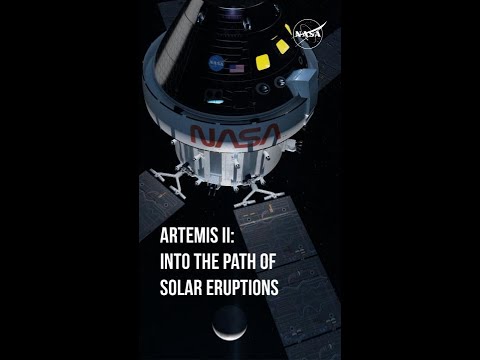
As Artemis II will fly outside of our planet’s protective magnetic field, it will also be in an ideal position to study space weather, or the conditions of particles and radiation emitted by our Sun.
So the team will be able to track coronal mass ejections and solar flares, violent phenomena that can cause radiation damage to both living tissues and electronics, especially electronics in orbit like GPS and Internet satellites like Starlink.
Artemis Reset By NASA
Redesigning Artemis
As mentioned, the Artemis program has suffered many delays, with Artemis II ultimately years later than initially planned.
A new revised plan revealed at the end of February 2026, part of a broader restructuring of NASA’s deep space program, is adding a new Artemis mission in 2027, and shifts the manned landing objective to Artemis IV instead of III.
In this new design, Artemis III will serve as a critical technology demonstration in low Earth orbit in 2027, testing docking operations with commercial lunar landers.
“Everything about this mission is in the direction of buying down risk before we put our astronauts on the surface. I would certainly much rather have astronauts testing the integrated systems of the lander and Orion in low-Earth orbit than on the Moon.”
After Artemis IV’s first landing in 2028, a second landing under Artemis V could follow later the same year, before the agency moves to a steady cadence of lunar missions. This should put the USA just ahead of China, which plans its own manned landing by 2030 at the latest.
Overall, the key concern is that the previous architecture attempted too much too quickly in space and on the Moon, while operating on a launch cadence that was too slow to sustain reliability.
“Launching a rocket as important and as complex as SLS every three years is not a path to success. When you are launching every three years, your skills atrophy, you lose muscle memory.”
So, after years where SLS was in question to be replaced by an eventual modified Starship by SpaceX, it seems the new plan is to standardize the configuration of the Space Launch System (SLS) and launch it more often, even if the rocket is not reusable and expensive.
SLS is, however, tested and proven reliable for manned flights, which is more than super-heavy rockets from private companies can say yet. This will also require a quicker preparation of launch pads as well.
The quicker launch schedule will imitate more closely how the first flight to the Moon was accomplished, with a launch almost every three months throughout Mercury, Gemini, and Apollo.
Lunar Gateway’s Uncertain Fate
A key part of the initial Artemis mission design was the Lunar Gateway, an ISS-like space station that would have been the first ever to orbit another celestial body than Earth, orbiting the Moon instead.
We presented in detail the project in “Lunar Gateway: Building The First Step To The Stars”.
However, the fate of Lunar Gateway is now uncertain. Instead, NASA is considering investing $20B to develop a much larger base on the Moon, and giving up on Gateway entirely.
In this new design, the astronauts will directly move from Orion to lunar landers.
“The agency intends to pause Gateway in its current form and shift focus to infrastructure that enables sustained surface operations. Despite challenges with some existing hardware, the agency will repurpose applicable equipment and leverage international partner commitments to support these objectives.”
Many of the equipment planned for the Gateway station, like living quarters, life supports, cargo space, and airlocks, could be repurposed for this larger Moon base, whose exact plans are still undetermined. But it is already decided that it should be located at the Moon’s South Pole.
Other equipment, like the Power and Propulsion Element (PPE), might be repurposed in other missions, especially as many of these elements are already designed or built, including by NASA partners like ESA (Europe), JAXA (Japan), and CSA (Canada).
This new plan, without Lunar Gateway, should unfold in three phases:
- Phase 1: Testing: frequent sending of rovers, instruments, and technology demonstrations that advance mobility, power generation (including nuclear), communications, navigation, and surface operations.
- Phase 2: EstablishingEarly Infrastructure: semi-habitable infrastructure for recurring astronaut operations on the surface, as well as a pressurized rover, and potentially other space agencies’ scientific payloads, rovers, and infrastructure/transportation capabilities.
- Phase 3: EnablingLong Duration Human Presence
- Leveraging cargo-capable human landing systems (HLS), potentially private ones, to deliver heavier infrastructure needed for a continuous human foothold on the Moonand a permanent base offworld.
Beyond The Moon
While Artemis and the Moon are the clear priority of NASA, the agency is, for maybe the first time in decades, looking at new ambitious targets at the scale of the Apollo program and beyond just the Moon.
“If we concentrate NASA’s extraordinary resources on the objectives of the National Space Policy, clear away needless obstacles that impede progress, and unleash the workforce and industrial might of our nation and partners, then returning to the Moon and building a base will seem pale in comparison to what we will be capable of accomplishing in the years ahead.”
One such element is the development of a nuclear-powered spacecraft mission to Mars, the Space Reactor‑1 Freedom. SR-1 would repurpose a nearly built, NASA-developed spacecraft bus, the Power and Propulsion Element.
Planned for a 2028 launch, the nuclear reactor will use nuclear energy to power high-efficiency electric ion thrusters. This will be used to deliver the Skyfall payload of three Ingenuity-class helicopters to Mars in a record time.
This is not the first attempt at deploying nuclear propulsion, but the first one that seems to be truly determined to make it happen.
“For six decades, the United States invested more than $20 billion across dozens of space nuclear programs and flew exactly one reactor — SNAP-10A, in 1965. It never left orbit. Billions spent, decades lost. SR-1 ends that pattern. A Mars launch window in December 2028 forces decisions that decades of study never did.”
Nuclear energy is also going to be used on the Moon, with Lunar Reactor-1 (LR-1), a fission surface-power system designed to keep the Moon Base operating through periods of darkness.
Lastly, besides the Moon and Mars, NASA will procure a government‑owned Core Module that attaches to the aging ISS. This will be followed by commercial modules that will be individually validated using International Space Station capabilities, and later detached into free flight.
Later on, the ISS will be finally abandoned, and NASA will use the accumulated experience and testing to pick the right technology for building the ISS successor in low-Earth orbit.
Beyond Artemis II
Assuming the Artemis II mission goes as planned, it is the stepping stone before the return of American and partner nations’ astronauts to the Moon.
But this time, the human presence on our satellite is not a short visit, and at the very end of our current technical capabilities, at the height of the Cold War with the USSR.
Instead, the first manned landing will be the first step of a cautious and deliberate strategy to establish mankind’s first-ever permanent offworld presence, leverage new materials, AI, and automation.
In the long run, the accumulated experience with this Moon base will be very valuable for other potential manned missions in deep space, especially Mars.
This is also the newly adopted strategy of SpaceX of putting the Moon ahead of Mars, ahead of its planned IPO, announced a few days before NASA’s public redesign of the Artemis mission, implying that the soon-to-be-public company is planning to be an integral part of this effort. Most likely, Starship HLS, a Starship rocket redesigned for lunar landing and refueled in low-Earth orbit, will be the main contribution of the company.

Investing In The Artemis Program
Lockheed Martin
Lockheed Martin Corporation (LMT +0.83%)
Lockheed Martin is one of the world’s largest aerospace & defense companies, which we covered in detail in November 2025 in “Lockheed Martin (LMT) Spotlight: A Leader In Defense and Aerospace”. Weapons are, however, not all that the company does.
Lockheed is the lead contractor for the design, development, testing, and production of the Orion spacecraft. This includes Callisto, a voice-controlled AI assistance system, in partnership with Amazon’s Alexa (AMZN -0.38%).
As the program should be scaled up thanks to cheaper and more frequent launches of first S, then Starship, this could boost the production of Orion as well.
Also related to Artemis, Lockheed has announced it has completed critical tests of a lunar solar array prototype that can function in the Moon’s South Pole.
The company is active in other space programs, like the GOES-R weather satellites, the collection of asteroid samples by OSIRIS-REx, the Jupiter probe JUNO, and a wearable radiation-shielding vest, AstroRad.
In short, this is a company deeply embedded in the NASA lunar program.
Beyond space activities, Lockheed is behind aircraft like the Black Hawk helicopters or the F-16, as well as advanced equipment like the F-35, flying radar planes, or logistical aircraft like the C-5 Galaxy & C-130J Super Hercules.

Source: Lockheed Martin
It is also the producer of some of the US military’s most important missile systems, like the JAASM, Javelin, ATACMS, and HIMARS, in extremely high demand following the depletion of stockpiles by the conflict in Ukraine.
It is also an important provider of anti-missile defense systems like the naval AEGIS and the THAAD (Terminal High Altitude Area Defense) against ballistic missiles.

Source: Lockheed Martin
As military activity and inventory of missiles are depleting quicker than planned, Lockheed is likely one of the beneficiaries of conflicts in Ukraine and Iran, in addition to the growing demand for the F-35 and other aircraft.
From space to defense, Lockheed Martin is at the forefront of American innovation and seems to have kept its edge a lot sharper than many of its large defense contractor competitors.
The company should benefit from later iterations of the Artemis program, as well as many other deep space and Mars-focused missions in the long term, with even a nuclear fusion-powered reactor in development in partnership with startup Helicity Space, in which Lockheed invested in 2024.
Latest Lockheed Martin (LMT) Stock News and Developments
The Defense Budget Request Is Here. It's Quite Something.
barrons.com
•
April 3, 2026
Where Will Lockheed Martin Stock Be in 5 Years?
fool.com
•
April 3, 2026
2 Industrial Stocks You'll Wish You Bought in 2026 a Decade From Now
fool.com
•
April 2, 2026
Here's Why Lockheed Martin (LMT) is a Strong Value Stock
zacks.com
•
April 2, 2026
Is Lockheed Martin Expanding Its Missile Production Capacity?
zacks.com
•
April 2, 2026
Lockheed Martin (NYSE:LMT) Shares Up 2.4% Following Analyst Upgrade
defenseworld.net
•
April 2, 2026