
Spotlights
GE Healthcare: Bringing Medical Imaging Into The AI Era

Securities.io maintains rigorous editorial standards and may receive compensation from reviewed links. We are not a registered investment adviser and this is not investment advice. Please view our affiliate disclosure.

General Electric, or GE, has been a powerhouse of American innovation since its inception in 1882, when it created some of the country’s first power stations, including breakthrough innovations like the massive Niagara Falls’ generators in 1918. Later on, the company diversified its experience in building large rotating turbines into the aerospace sector, building America’s first jet engine, and becoming one of the largest suppliers of turbojets to both the civilian and military aerospace industries.
Today, the legacy of these activities is split between GE Vernova (GEV ), the energy segment, and GE Aerospace (GE ) (follow the links to find our related investment reports covering these two companies).
However, GE also evolved during the 20th century as a massive industrial conglomerate with many other activities. This includes its massive presence in healthcare-related machines, starting as early as the 1920s with X-ray machines.
When the conglomerate was split up into three parts, GE Healthcare was separated from GE Vernova and GE Aerospace, and listed under the ticker GEHC.
(GEHC )
Today, the independent GE Healthcare is a very important provider of medical imaging machinery, from CT-scan to X-ray, MRI, ultrasound, etc, as well as advanced medical software and AI solutions.
GE Healthcare Overview
GE Healthcare History
General Electric entered the medical equipment market when it acquired Victor Electric Company in 1920, a pioneer in X-ray machines, founded just a year after the discovery of X-rays by Wilhelm Röntgen.
This stayed a niche activity until the invention of the CT scanner in the 1970s and the MRI scanner in the 1980s, which created a much larger market for medical imaging. In addition to a growing market opportunity, the rotating of X-ray tubes in CT scans and the powerful magnets of MRI were a good match to the preexisting expertise of the GE conglomerate with power equipment and quickly spinning turbines.
The size of the company also helped it fund the necessary investment, for example, nearly $1B in 1982 for a new plant in Wisconsin for MRI technology. It also acquired Technicare from Johnson and Johnson and merged its European branch with the French Compagnie Générale de Radiologie (CGR).
Following a strategy of intense expansion at any cost that characterized the whole conglomerate in that period, GE Healthcare expanded quickly in the 1990s. In total, it acquired 94 various medtech businesses between 1995 and 2017.
This wave of acquisition included many CT scans, MRIs, and other medical imaging companies, but also anesthesia machines and mechanical ventilators, nuclear medicine, filtration products, etc.
In addition, this period marked a determined entry into the medical software sector:
- Billing and scheduling system for doctors’ offices Millbrook Corporation, in 2003.
- PACS (Picture Archiving and Communication Systems)software Dynamic Imaging in 2007
- Operating room management and analyticssoftware CHCA Computer Systems, in 2014.
- Electronic Medical Records (EMR) system from MeicaLogic in 2002, IDX Systems Corporation (a $1.2B acquisition) in 2006, and MedPlexus in 2010.
GE Healthcare By The Numbers
The company is a giant in medical imaging and medical software, with 1 billion patients served annually by its products, including a worldwide installed base of more than 5 million units of imaging, diagnostic, and monitoring devices.
GE Healthcare employs 54,000 people, of which 10,300 are engineers and scientists, and 3,000 are software engineers, in 160 countries, giving a truly global footprint. Its two major manufacturing hubs are in China and the USA (notably Wisconsin, South Carolina, Ohio, and Utah), even if it maintains a total of 43 facilities across 17 countries and has been localizing more production to India in the past few years.
GE Healthcare is also a large corporation, with $20.6B in revenues in 2025, up 4.8% year-to-year and forecasting an organic growth rate of 3.0%-4.0%. It is also a very profitable activity, with $1.5B in free cash flow the same year.
North America is the company’s most important market, with around half of its total revenues, followed by the EMEA and Asia Pacific regions, each around 1/4th of revenues.
The company is sustaining its growth and market position with significant investment in new technologies, as reflected by $1.2B in R&D spending in 2025 alone. It is also reinforcing its financial position by repaying debt from the large conglomerate era, having repaid $1.5B since the spin-off.
GE Healthcare’s Post-Spin Strategy
Since it became independent from the rest of the GE conglomerate, GE Healthcare has been freer to pursue its own strategic goals. Currently, it is following a strategy to move from being an imaging company to becoming a healthcare solutions company, which implies a growing presence in software and AI-driven products on top of the historical presence in imaging and medical devices.
This push toward a broader GE Healthcare has been supported by $3.5B in R&D spending since the separation from the other parts of GE.
This strategic focus is also reflected in the targets for acquisitions since 2023, mostly the acquisition of companies creating AI-powered image analysis in almost all medical fields (oncology, urology, neurology, OB/GYN, anesthesia, and cardiology).
GE Healthcare Businesses
Medical Imaging
Imaging and advanced visualization solutions are still today the core of the company, with respectively $9.1B and $5.3B in revenues. This is matching the company’s position in “precision care”, giving medical professionals the data they need to treat patients in the most efficient way.

Source: GE Healthcare
The company estimates that its total addressable market is around $90B, meaning that with $20B+ in revenue, it already owns more than 1/4th of market share. However, as this market is also expected to grow to $110B by 2028, this still leaves plenty of room to grow, both from growing market share and the overall growth of the sector.
The imaging segment is largely driven by high-end MRI (magnetic resonance imaging) and CT (computed tomography) scanners, as well as PET (positron emission tomography), where GE Healthcare is a technology leader.
While less expensive, ultrasound is another segment where GE Healthcare dominates, with more than 30% of the global market using the company’s equipment.
Each of these imaging segments is subdivided into many specialized applications, with, for example, ultrasound machines specialized for tasks specific to urology, breast, cardiovascular, surgery, etc.
Other Medical Services
Besides selling the imaging machines, GE Healthcare also sells related products and services.
For example, it sells the corresponding contrast media for imaging procedures, a product yielding high margins and categorized under the Pharmaceutical Diagnostics / PDx category.
The patient care solution, with $3.1B in revenues in 2025, includes monitoring, anesthesia delivery, and diagnostic cardiology platforms, maternal & infant care, etc. It also includes plenty of accessory equipment like cables, filters, etc, matching the medical devices from GE and other manufacturers.
This also means an efficient array of on-demand services like maintenance, repairs, spare parts & consumable ordering system.

Source: GE Healthcare
Lastly, the company also offers “pharma services“, helping with the design and operations of clinical trials by providing access to expertise, manufacturing, products, and services.
This way, the patients selected or the anonymized medical images chosen can be of the highest quality, and lead to improved clinical trial results. In total, GE Healthcare helped with 300+ large clinical trials in the past 15 years.
Medical Software
As its machines produce a massive volume of medical data, GE Healthcare also offers
PACS (Picture Archiving and Communication Systems), which process, distribute, and archive with an adequate level of security and anonymity medical images, from video of surgery to scanners and other visual medical records.
As early as the beginning of the 2000s, GE Healthcare also entered the medical software segment with a presence in Electronic Medical Records (EMR), the basis for digitalized medical patients, increasingly a must-have in all hospitals, replacing the outdated paper-based patient files, more prone to cause medical errors.
This presence in the software of the company extends to many other medical software applications, such as billing, scheduling, operating room software, etc.
Overall, this gives the company a presence in the medical data field, as strong as in the imaging field, but with a focus on precision care and niche applications related to imaging, more than generalist EMR, dominated by privately owned Epic Systems and Oracle-owned Cerner (ORCL ).
GE Healthcare is currently looking to speed up the adoption of cloud-based solutions for medical data, and has acquired Intelerad Medical Systems for $2.3B for this purpose. The company specializes in distributed radiology, specializing in Radiology Information System (RIS), PACS, and workflow solutions for healthcare organizations.
“Intelerad’s cloud-enabled software will support GE Healthcare’s imaging technologies and AI capabilities by simplifying complex workflows, and providing patients and customers with more precise, connected care across the continuum.”
Roland Rott – President and CEO of Imaging at GE Healthcare
AI
Medical AI Market
GE Healthcare considers that AI is potentially a massive market, with an expected growth rate of 22.4% CAGR until 2027, growing from just $22B I 2023 to $49B in 2027.
But the real market could be a lot larger, up to $1T, as the medical industry spending is mostly labor, and many tasks could be made more efficient or automated with powerful and smart enough AI systems.
To do so, full integration of medical data, both at the population and individual levels, will be required.
GE Healthcare is at the forefront of promoting AI-driven medical equipment and medical image analysis, with already 80 AI-enabled devices in 2024, up from only 42 pre-spin. In 2025, it hit the 100 listed authorizations to date, topping the FDA’s list of AI authorizations for the 4th year in a row.
“Our sustained leadership in AI-enabled medical devices reflects our commitment to research and development, which is powering the creation of next-generation solutions. These solutions are designed to address the toughest challenges our customers are facing including care team shortages and burnout, rising costs, and inefficient workflows.”
Dr. Taha Kass-Hout – GE HealthCare’s Global Chief Science and Technology Officer.
In the longer run, these AI-enabled devices will need to be integrated with custom AI agents for each medical application, built on dedicated models. This should integrate not just medical imaging or the usual data from patient files (medical history, past surgery, ongoing drugs, etc.) but also genetic data, comparison of records over time, etc, bringing AI along all the patient’s medical journey.

Source: GE Healthcare
GE Healthcare AI Activities
As in almost every field, medical imaging is now being transformed quickly by the emergence of new AI capacities.
The company’s acquisitions in the past few years have also been highly focused on AI capabilities and the integration of these systems into the broader data ecosystem of GE Healthcare. This includes:
- The 2021 acquisition of Spectronic Medical, which uses AI for planning of MRIs.
- The 2023 acquisition of Caption Healthfor AI-assisted ultrasound echocardiogram exams.
- The 2024 acquisition of Intelligent Ultrasound.
- It developed ScanNav Anatomy for anesthetists carrying out peripheral nerve blocks and ScanNav Assist, an AI-based, real-time image analysis software to support sonographers during OB-GYN ultrasound exams.
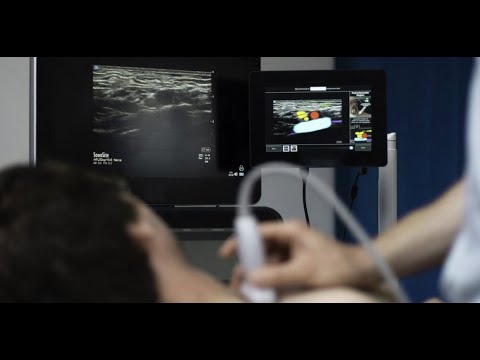
These acquisitions are to be put in the context of the 2025-2026 acquisition of Intelerad, which brings together even more medical data in real-time, thanks to the cloud-based capacity.
“Intelerad enhances our ability to deliver a cloud-first enterprise imaging platform at scale. Together, we are connecting imaging across care settings with interoperable, AI-enabled solutions that simplify operations, improve clinical insight, and help our customers deliver more precise, personalized care,”
Scott Miller, CEO, Solutions for Enterprise Imaging, GE HealthCare.
Intelerad’s revenues were already growing in the low-double-digit range annually, and are expected to keep growing now that it can benefit from GE Healthcare’s network. The end goal is to create a “cloud-first, AI-enabled imaging ecosystem across inpatient, outpatient, ambulatory, and teleradiology”.
In the future, GE Healthcare plans to expand further its medical SaaS offer, moving from its current 20 SaaS products to more than 40 by 2028, using a common cloud architecture and partnership with AWS (AMZN ) and NVidia (NVDA ).
“We are redefining diagnostic imaging by fusing GE HealthCare’s deep clinical expertise and imaging innovation with NVIDIA’s edge AI and accelerated computing platforms. With co-development efforts spanning simulation, segmentation, and real-time image reconstruction, and a joint go-to-market strategy underway, this alliance enables us to drive scalable innovation across the continuum of care.”
Roland Rott – President and CEO, Imaging, GE HealthCare.
Overall, AI is likely to completely transform the workflow of the medical profession, giving them actionable and plain language insight on a patient’s conditions, as well as highlighting important data in real time during examinations, scans, and surgeries.
AI systems will also likely be uncovering new optimal medical practices and therapeutic options from decades of accumulated images, videos, and pharmaceutical data, while boosting the speed of development for new drugs and biotechnology therapies.
GE Healthcare Investment Case
Since it was spun off from the rest of the GE conglomerate, GE Healthcare has shown healthy growth, steady or growing market share in its core markets, and a solid financial performance.
Currently, the company is a leader in essential imaging equipment like CT scanners, MRIs, and ultrasound, as well as the associated niche medical software like PACSs.
This very strong presence in both images and the handling of medical data gives GE Healthcare a unique position to leverage AI for guiding surgeons’ hands, detecting cancer automatically, systematically annotating medical images without human interventions, analyzing cloud-based patient files, and countless other applications of artificial intelligence to medical applications.
Together with the growing demand for high-end medical images, this should give the company a clear path to steady growth for the years and even decades to come.
It is also large enough to make an ideal partner for AI and cloud companies like Amazon and Nvidia, while being profitable enough to give it the financial firepower to keep acquiring valuable AI startups and smaller medical data companies.
So overall, GE Healthcare should be able to cement further its position as a crucial provider of both imaging and AI analysis to thousands of hospitals all over the world, with its international expansion likely to continue and help growth as well.
Latest GE Healthcare (GEHC) Stock News and Developments



