

Energy
Revolutionizing Lasers: Tunable Semiconductor Ring Tech


A team of scientists from the Vienna University of Technology (TU Wien) and Harvard John A. Paulson School of Engineering and Applied Sciences (SEAS) just unveiled a new method to fabricate tunable semiconductor ring lasers. These advanced lasers have the potential to provide high-powered communications, more advanced safety systems, and much more. Here’s what you need to know.
Types of Tunable Lasers and Their Advantages
It was only 6 years after Theodore H. Maiman demonstrated the first laser using a synthetic ruby rod that researchers began work on tunable lasers. Unlike their fixed wavelength predecessors, they can be set up to emit light across various wavelengths, making them ideal for use in precision applications like optical communications and microscopy. As such, tunable lasers have become a crucial component of today’s high-tech and medical fields.
Tunable Laser Categories: Gas, Fiber, OPOs & Semiconductor
Today, there are many different types of tunable lasers including gas lasers, fiber lasers, optical parametric oscillators (OPOs), and semiconductor lasers. Tunable semiconductor lasers are seen by many as the most advanced option. They offer a compact form factor, support a broad wavelength, and provide adequate power.
Drawbacks to Tunable Lasers
Tunable laser technology has seen massive leaps in capabilities. However, there are still many limitations that have hindered the technology from reaching its maximum potential. For example, tunable Lasers with wide wave ranges often provide less precision. Additionally, the manufacturing costs for these devices and their overall fragility have been seen as roadblocks to their advancement.
How to Tune Semiconductor Lasers
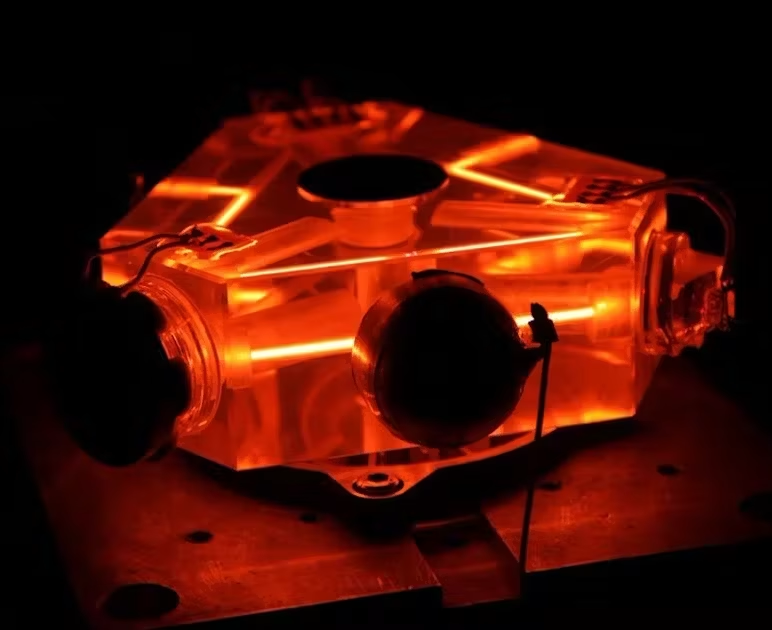
There are two main methods to create and tune semiconductor lasers. The first method required precise grating to be added to the laser ridge. This grating is cut at exact angles on a nano scale to create frequency-selective optical feedback. This setup allows engineers to amplify a particular wavelength and reduce interference from others by altering the laser’s current.
Source – Military Aerospace
The second method for tuning semiconductor lasers utilizes an external cavity. In this arrangement, a rotating diffraction grating reflects the exact wavelength into the cavity. The cavity, which excites the wavelength into a laser, can be adjusted by rotating it.
Problems with Today’s Semiconductor Lasers
The semiconductor laser field has some drawbacks that engineers have spent many years attempting to overcome. For one, there remains the balance of precision and range capabilities. Until now, you could either have a really precise device or one that could cover various wavelengths decently.
Another issue with semiconductor lasers is that they have a significant drop in performance as temperatures rise. When a semiconductor laser gets hot, it loses power, efficiency, and can even become damaged. As such, it’s been impossible to achieve long-term, continuous hop-free tuning across a broad spectrum.
Semiconductor Ring Lasers Study
Recognizing these limitations, Harvard engineers and scientists from other reputable institutions set out to create the first broad-spectrum, highly accurate semiconductor laser. They documented their journey in the study “Continuously and widely tunable semiconductor ring lasers” published in the scientific Journal Optica.
The paper reveals their work on a new type of tunable semiconductor laser that utilizes a ring-array quantum cascade laser (QCL) architecture to provide smooth tunability while supporting an extended spectral range. Notably, Quantum-cascade lasers are semiconductor lasers that create beams in the far-infrared spectrum.
Ring QCL Design: Independent, Addressable Arrays
The team began their work by creating multiple small, independently addressable ring QCLs. Notably, ring lasers feature two beams of light of the same polarization. These beams are aimed in opposite directions around a closed loop created by mirrors. This approach allows for accurate measurements of the slightest movement. As such, ring lasers are commonly found in use in navigation systems as gyroscopes.
In this instance, the scientist created the ring lasers using quantum cascade laser active material and a dry-etch process. Additionally, the rings each had electrical contacts added to them and a bus waveguide. The engineers noted that this approach provided enhanced performance, reducing optical loss of the bus waveguide.
Each ring was developed to have a distinct radius. The use of different size rings created distinct lasing frequencies for each space. This approach allowed the engineers to tune each ring separately without experiencing any drops in lasing.
Achieving Single-Mode Emission Using Ring Couplers
This unique approach enabled the engineers to utilize multiple rings together to create particular power and wavelengths. The system allowed the engineers to combine beams from each ring into a single waveguide via evanescent directional couplers along straight sections of the lasers. Keenly, the directional couplers prevented gain grating by ensuring that the light only traveled in one direction.
Waveguide Emission Through Facet-Based Design
The team noted that their laser utilizes a unique method of light emission. This system relies on a facet-emitting approach that goes through a bus waveguide. The waveguide can be used to tune and amplify the laser frequencies as needed at room temperature.
Modular Ring Laser Design Enables Scalability
The modular design of this laser setup means that engineers can scale it to fit any needs. Additionally, the ring lasers can be operated simultaneously or in single ring mode. As such, combining lasers produces a stronger and more intense beam, making it ideal for certain high-tech applications.
Semiconductor Ring Lasers Test
The engineers set off to test their theories at TU Wien’s Center for Micro and Nanostructures cleanroom facilities. Here they created a lasing device with 5 rings, each with a distinct radius. Specifically, the ring sizes varied from 220 to 260 µm.
Once created, the team then tested different laser setups and wavelengths. In one instance, they combined the tuning range of three different rings to test mode-hop-free tuning over broad bandwidths.
Semiconductor Ring Lasers Test Results
The test results corroborated the engineers’ models. The team noted that the single-ring QCL could emit up to 0.5 mW beam in continuous-wave operation at room temperature. The test also revealed that the laser chip maintained a stable wavelength output, despite intense optical injection onto the laser facet. These tests demonstrated that the new laser design is resilient under high levels of optical feedback.
Additionally, the engineers noted that the performance was comparable to multi-section DFB lasers. This discovery was a huge milestone as it means that these lasers can be made without the need to fabricate a unique grating along the active region of each laser.
Specifically, the team was able to utilize the three laser rings to smoothly sweep optical bandwidths ranging from 266 GHz to 395 GHz. The sweeping action was smooth, and there was minimal spectral overlap between each ring. Notably, the device created a remarkably stable beam production under high amounts of optical injection.
Semiconductor Ring Lasers Benefits
| Feature | Traditional Tunable Lasers | Ring-Array Semiconductor Lasers |
|---|---|---|
| Wavelength Tuning | Single wavelength at a time | Multi-wavelength simultaneous tuning |
| Form Factor | Bulky with external parts | Compact, chip-scale modular design |
| Manufacturing Complexity | Requires intricate gratings | No need for active-region gratings |
| Thermal Stability | Sensitive to heat; performance drops | Stable continuous-wave emission at room temp |
There are many benefits that this study will bring to the laser market. For one, this design has no moving parts and is much easier and affordable to manufacture. By reducing the costs of creating high-end lasers, it opens the door for more use case scenarios and further adoptions.
Small Size
The device has a small form factor that utilizes ring lasers which can be scaled up or down to meet specific needs. This strategy allows for the fine tuning of the wavelength and stable emission. Smaller lasers will help to propel future technologies and wearable devices.
Notably, traditional tunable lasers emit a single wavelength at a time. In contrast, the modularity of ring-array lasers enables multiple rings to operate simultaneously and target individual wavelengths using a different ring radius.
Reduced Feedback and Improved Beam Stability
The use of multiple ring lasers and unidirectional couplers helps to reduce back reflection, which had plagued previous laser designs. As such, this structure can support powerful lasers that can handle more energy to create stronger beams than their predecessor could produce.
Semiconductor Ring Lasers Real-World Applications
There are several real-world applications for this technology. For one, lasers are a crucial competition in many of today’s high-tech fields. Creating more powerful and useful devices will help to bring down the cost of today’s technologies while driving up the introduction of innovative products. Here are some other use cases for this tech.
Communications
The telecommunications industry is always seeking out more powerful lasers. This latest development could help to create super networks that are capable of high-speed data transmission on a level previously unimaginable. These devices could be used to transmit data across the universe one day, keeping space travelers in contact with Earth from millions of miles away.
Medical
The medical field uses lasers for many reasons. From scanning for ailments to correcting your vision, there are lots of ways these lasers will help to improve the health of millions in the future. The smaller size and increased flexibility and accuracy will help to power a new generation of automated medical services and procedures.
Safety
High-powered laser scanners are an essential component in multiple industries, including the gas and chemical sectors. These devices scan for the slightest issues to prevent catastrophic failures. This technology could help in the detection of leaks in gas pipelines, infrastructure decline, and other crucial tasks that keep the population safe.
Semiconductor Ring Lasers Timeline
Semiconductor ring lasers could hit the market in the next 5-7 years. There’s an immediate demand for this technology, and manufacturers will be eager to utilize it to create smaller and more advanced products. This timeline will be shorter for military integration, which could see expedited development to meet the growing demands of the future battlefields.
Semiconductor Ring Lasers Researchers
The Semiconductor ring laser study was a combined effort from Harvard John A. Paulson School of Engineering and Applied Sciences (SEAS) and the Vienna University of Technology (TU Wien). The research was co-led by Federico Capasso and Vinton Hayes. Additionally. The study lists Johannes Fuchsberger, Theodore P. Letsou, Dmitry Kazakov, Rolf Szedlak, and Benedikt Schwarz as crucial contributors. Notably, the Department of Defense and the National Science Foundation provided funding for the study via a grant.
What’s Next for Semiconductor Ring Lasers?
The researchers are in the middle of patenting their work. From there, they will seek out manufacturers to begin reducing production costs even further. Additionally, the team will research the effects of scaling the device with more rings.
Investing in the Laser Sector
Many companies in the laser sector have secured a reputation for quality and excellent service. These firms have spent millions researching how to create the most power-efficient and useful lasers over the decades. Here’s one company that has done its part to provide the market with reliable devices.
Laser Photonics Corporation
Laser Photonics Corporation
Laser Photonics Corporation (LASE -6.76%)
entered the market in 1981 to provide high-end industrial lasers to the market. The company is located in Orlando, Florida, and currently offers a range of products including laser cleaning, cutting, and defense systems. (LASE -6.76%)
Laser Photonics Corporation secured a reputation as an industry leader due to its solid business practices and reliable lasers. These devices offer maintenance-free high-performance solutions to the market. Additionally, the company focuses on making their products environmentally safe and sustainable.
In October 2022, Laser Photonics Corporation hosted an IPO that secured $55M in funding. Since that time, the company has continually expanded its offerings and clientele. Today, Laser Photonics Corporation services several Fortune 500 companies and is regarded as an industry leader.
Semiconductor Ring Lasers | Conclusion
There’s a lot to be excited about when discussing the tunable semiconductor laser study. These devices could reshape multiple industries and help or reduce the cost and size of future electronics. The fact that their device is easier to create than today’s options and offers broad and precise wavelength tuning in a compact, chip-sized format, makes it a win for the entire industry.
Learn about other cool breakthroughs here.
Studies Referenced:
1. Johannes Fuchsberger, Theodore P. Letsou, Dmitry Kazakov, Rolf Szedlak, Federico Capasso, and Benedikt Schwarz, “Continuously and widely tunable semiconductor ring lasers,” Optica 12, 985-990 (2025)



