

Robotics
The Humanoid Race: Bodies Built for a Human World (2026)

Securities.io maintains rigorous editorial standards and may receive compensation from reviewed links. We are not a registered investment adviser and this is not investment advice. Please view our affiliate disclosure.

Series Navigation: Part 1 of 6 in The Physical AI Handbook
Summary: The Humanoid Race
- 2026 is the “Year of Production,” with global manufacturers shifting from R&D prototypes to mass-production facilities capable of thousands of units per year.
- The “Labor Gap” is the primary catalyst; with a global shortfall of 85 million workers projected by 2030, humanoids are moving from “luxury tech” to “macro-necessity.”
- The industry has pivoted toward “Brownfield” automation—deploying robots that navigate existing human workspaces rather than requiring factory re-builds.
- Unit economics have reached a tipping point, with entry-level humanoid costs dropping toward the $30,000 range, challenging the hourly rate of traditional industrial labor.
The Humanoid Race: Bodies Built for a Human World
For decades, industrial automation was synonymous with robotic arms bolted to floors inside safety cages. These systems were efficient but brittle—if the task changed, the entire line had to be re-engineered. In 2026, the paradigm has shifted. Humanoid robots are being deployed not because they look like us, but because they move like us in a world built for humans.
The strategic advantage of the humanoid form factor is “Brownfield Compatibility.” These machines use the same stairs, doors, and workstations as human workers, allowing enterprises to automate existing facilities without the multi-million dollar costs of a total infrastructure overhaul.
The 2026 Production Landscape
The conversation in 2026 has moved from “Can it walk?” to “How many can you build?” Leading firms are now focused on scaling manufacturing and ensuring enterprise-grade reliability.
The Mass-Production Standard: Tesla Optimus (TSLA -3.24%)
Tesla has officially transitioned its Optimus Gen 3 into mass production in early 2026. Leveraging the same supply chain and “Cortex” AI training infrastructure as its automotive division, Tesla aims to produce tens of thousands of units for internal use across its Gigafactories. The goal is to “dogfood” the technology, proving that a humanoid can handle the repetitive, dangerous, and boring tasks of battery and vehicle assembly before opening sales to the broader market.
Tesla, Inc. (TSLA -3.24%)
The Industrial Specialist: Figure AI
Figure AI has set the gold standard for real-world validation. Following a landmark 1,250-hour pilot at BMW’s Spartanburg plant—where Figure 02 units successfully loaded over 90,000 sheet-metal parts with 99% accuracy—the company has moved into full deployment. Backed by NVIDIA and Microsoft, Figure represents the “Specialist” approach, focusing on deep integration with existing Manufacturing Execution Systems (MES).
The Logistics Pioneer: Agility Robotics
Agility’s Digit is currently the most deployed humanoid in the logistics sector. In 2026, the company signed a massive commercial agreement with Toyota Motor Manufacturing Canada to support assembly line logistics. Digit’s ability to work “cooperatively safe” alongside humans—without cages—has made it the preferred choice for high-traffic warehouse environments.
The Heavyweight: Boston Dynamics (Hyundai) (HYMTF -7.44%)
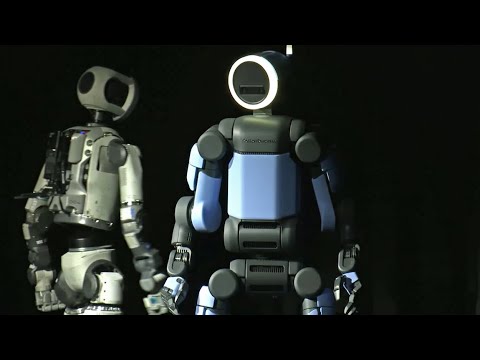
Unveiled at CES 2026, the production-ready Electric Atlas has moved from a YouTube viral sensation to a commercial workhorse. With 56 degrees of freedom and a payload capacity of 50 kg (110 lbs), Atlas is being deployed within Hyundai’s global “Metaplants” to handle parts sequencing and heavy material handling.
The Economic Mandate: Closing the Labor Gap
The shift to humanoids is driven by a structural shortfall in the global workforce. By 2026, American employers report an annual shortfall of 1.7 million qualified graduates for skilled trades. Humanoids provide a “release valve” for this pressure.
| Industrial Role | Human Labor Cost (Avg) | Humanoid TCO (2026) | Productivity Gain |
|---|---|---|---|
| Warehouse Logistics | $18 – $25 / hour | $6 – $12 / hour | +20-30% |
| Automotive Assembly | $22 – $35 / hour | $8 – $15 / hour | +15-25% |
| Machine Tending | $25 – $40 / hour | $10 – $18 / hour | +30% |
The Challenge: The Reliability Gap
While the unit economics are attractive, 2026 remains a transition year for hardware durability. Traditional robotic arms run for 50,000+ hours between major services; current humanoids typically require intervention every 500 hours. The “winners” of the humanoid race will not be the companies with the most agile robots, but those that can achieve enterprise-grade uptime and “self-swappable” battery systems.
To understand the “nervous system” that enables this physical reliability, see Part 2: The Edge Brain & VLA Models.
Conclusion
The “Humanoid Race” has moved from a technical curiosity to an economic imperative. As unit costs decline and reliability increases, the deployment of embodied AI in human forms will become the defining industrial trend of the late 2020s.
The Physical AI Handbook
This article is Part 1 of our comprehensive guide to the Physical AI revolution.
Explore the Full Series:
- 🌐 The Physical AI Handbook Hub
- 🤖 Part 1: The Humanoid Race (Current)
- 🧠 Part 2: The Edge Brain
- 👁️ Part 3: The Sensor Layer
- 🌐 Part 4: Digital Twins
- 📉 Part 5: RaaS & The Fleet Economy
- 💎 Part 6: The Investment Audit



