
Fintech
How Digital Finance Can Empower Women Entrepreneurs

 Add Securities.io to your preferred sources on Google

Access to financing and financial literacy are some of the most important factors in empowering marginalized groups, especially in developing economies. This is why financial literacy programs and innovative FinTech that can deliver access to finance are essential to boost the development of such economies and reduce social inequality.
However, access to finance and education is just one piece of the problem. How they fit into real entrepreneurs’ lives is often more complex, especially for women. Culture, family responsibilities, social structures, and access to digital infrastructure can all influence how people approach money, work, and finance.
To better understand such interplay between the social environment and financial literacy, researchers at Universitas Negeri Makassar (Indonesia) have conducted a study with female entrepreneurs in Indonesia. They found that women’s financial literacy in emerging economies is better understood as a relational and adaptive process of social learning. This emphasizes the importance of the connection between development policies, Fintech solutions, and social support systems.
They published their findings in Social Sciences & Humanities Open1, under the title “Reframing financial literacy as empowerment: Insights from multi-case narratives of women entrepreneurs in emerging economies”.
Development Through Finance
Inequalities & Financial Literacy
Gender disparities are considered a major factor in slowing down development, as they often leave half of the population of a given country much less productive than they could be.
This is despite the fact that women in emerging countries contribute substantially to micro and small enterprises while facing unequal access to formal finance, digital financial services, and decision-making resources. So while women sustain household and community economies, their financial autonomy remains constrained by socio-cultural, institutional, and digital barriers.
“Women with higher levels of financial literacy tend to have greater control over the use of business resources and household investment decisions. It is shaped through social negotiation, moral values, relational responsibilities, and cultural context”
And while digital technology can lower barriers to access to information and finance, it may reproduce unequal participation when women have lower levels of digital literacy, limited access to technology, or fewer opportunities to engage with digital financial ecosystems.
Collecting Relevant Testimonies
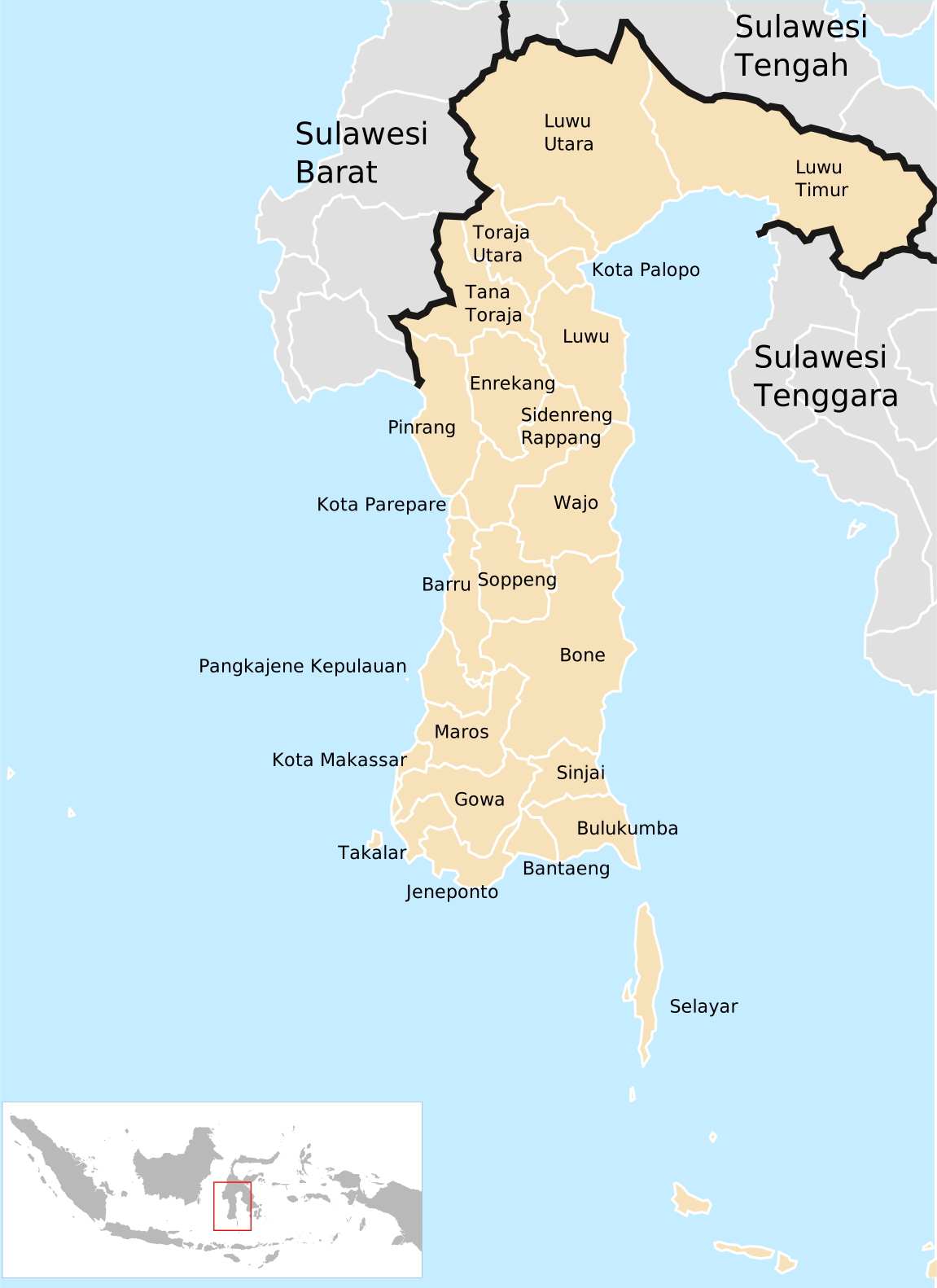
The researchers chose the Indonesian region of South Sulawesi as it offers variation in women’s entrepreneurial conditions:
- Makassar represents a more urban and digitally connected setting.
- Gowa reflects a semi-urban and community-based enterprise environment.
- Pangkep (Pangkajene and Islands Regency) represents a rural-maritime context shaped by infrastructural limitations and uneven digital access.
Source: Wikipedia
This way, the study can reflect the different socioeconomic and socio-digital settings within one similar provincial and national context.
The study involved sixty-six female small entrepreneurs, with each region represented by 22 individuals. The sample was selected for qualitative depth, contextual variation, and relevance rather than demographic or statistical representativeness.
After mapping the socioeconomic conditions of each sub-region, the researchers conducted in-depth interviews (45–90 minutes) and six focus group discussions (6–8 participants / 90–120 minutes).
The interview consisted of 15 open-ended questions organized into three thematic sections:
“Financial experiences, learning moments, and meaning-making processes”, or how lived experiences shaped their perception of money, risks, entrepreneurship, and finance.
“I used to think losses were normal. But after failing twice, I realized the importance of keeping records—not only of expenses but also of the mistakes I made.”
Role of family members, peers, community groups, and digital networks in financial decision-making.
“At first, we started the rotating savings group for household needs, but gradually we turned it into business savings. We help members who want to start a business. We learned to calculate and record transactions together.”
Strategies in navigating socio-digital and structural constraints.
“At first, my husband didn’t like me spending too much time on my phone. He said women shouldn’t be busy with online selling. But after I was able to help pay for our children’s school fees, he slowly became supportive.”
When needed, the standard questions were adapted to the respondents’ context.
Probes in Makassar focused more on e-commerce exposure and digital financial service use; probes in Gowa explored community-based financial practices and household-business negotiation, while probes in Pangkep addressed rural-maritime enterprise conditions, infrastructural limitations, and uneven digital access.
Financial Literacy & Women
A Learning Process
In the initial stage, women described financial practices that were largely oriented toward practical needs, day-to-day survival, and immediate business continuity. Only through this process did they gradually develop new awareness regarding the meanings of money, decision-making, and economic responsibility.
This suggests that, among the women included in the study, financial literacy developed not only through formal learning but also through lived entrepreneurial experience.
Most change and better understanding were triggered by losses, failures, or family pressures.
“I learned from my mistakes. If I miscalculate, it’s not just a loss—it’s also embarrassing in front of my group.”
This led to the development of adaptive strategies for navigating the realities of entrepreneurship, as well as dealing with the constraints and negative reactions of an often conservative social context.
“When I lose money, I don’t panic anymore. I try to find where I went wrong, recalculate, and change how I manage money.”
A Social Endeavour
Another element made clear during the interview is that the improvement of financial literacy is not just an individual process, but a social activity.
This passes by the establishment of networks of trust between women involved in entrepreneurship, and the solidarity they cultivate. It can also create a bottom-up form of financing for starting capital and an initial source of training and information.
“We meet every month and contribute small amounts of money. When someone wants to start a business, we use that fund to help her. We trust each other because everyone knows and looks after one another.”
The same network also provides the space for the exchange of services requiring specific equipment or skills, as well as help in marketing and promoting their businesses.
“We help each other promote on Instagram. Sometimes I take product photos for my friends, and next time they help deliver my orders. We learn while supporting each other.”
This social activity expands into business activities, with the common cases of bookkeeping, saving, and risk sharing being carried out collectively.
Dealing With Society & Families
In a relatively conservative culture, women’s independence and role in handling the family’s finances can be something needing constant negotiation, both at the household and community levels.
One way these women found to resist and deflect social pressure is to emphasize that their business activity is not selfish, but in the service of their family, a more socially acceptable framework.
“People often say women shouldn’t deal with money. But if not us, then who? I manage finances not for myself, but for my family.”
When the resistance is coming from closer to home, like convincing a husband, the extra income generated and the effect it has on supporting, for example, children’s education is often a major support. Here too, framing the business activity and independent income within the context of childcare helps overcome cultural resistance.
Managing Poor Infrastructure
In remote and rural regions, the possibilities created by digital technology can be constrained by poor public infrastructure.
For example, managing e-commerce sales can be blocked by the saturation or instability of local mobile networks.
“The signal often drops, so we send messages at night. We’re learning slowly so we can still sell online.”
Logistics is often another issue, with social networks and shared deals between multiple women and one logistical provider used to help boost business activity and efficiency.
Investors Takeaways
Investing in FinTech technologies tends to focus on the technical and knowledge side, assuming that a good solution will automatically deliver results and be adopted when properly marketed.
In practice, this study illustrates that it is often not so simple, especially in the case of underprivileged groups.
So fintech companies targeting underserved entrepreneurs may need to combine financial products with mentoring, peer networks, digital training, and context-sensitive onboarding.
They need to remember that financial inclusion is therefore not simply an access problem. It is a product-design and ecosystem challenge. So for fintech software companies, it is not so much a question of delivering a service, and more about providing assistance and inserting their offer inside an existing web of social networks and learning strategies.

They also should not overestimate their ability to train new users with abstract knowledge, and instead would be better off providing access to a network of previous users and more experienced entrepreneurs, facilitating the creation of formal and informal business networks.
From a marketing point of view, independence, money, and financial success should likely not directly be the promise of a fintech product. Instead, better care of family will be a more attractive proposition to female users and a more acceptable framing for society at large.
Investing In Financial Development
Mastercard Incorporated
MA Price Chart
While socio-cultural context matters for female empowerment and entrepreneurship, solid payment systems are also more important.
Mastercard is a global provider of commercial payment infrastructure, which has also implemented programs addressing the exact issues identified in the study and implemented matching solutions.
This includes, in the case of Indonesia, “Mastercard Strive Indonesia”, launched in 2023. The program was launched with the goal of empowering 300,000 Indonesian small businesses over three years by expanding digital adoption, improving access to capital, and strengthening business-support networks, with particular attention to women-led and women-owned businesses.
- Building demand and lowering barriers to technology adoption through peer mentoring and addressing the cost of digitalization.
- Working closely with bank and non-bank institutions to further democratize access to credit for small businesses, especially for women-led or owned businesses.
- Establishing a learning network and conducting research on small business digitization to share best practices and insights, address systemic bottlenecks, provide the ecosystem with rich quantitative data, and trigger positive shifts.
The initiative in Indonesia was built on a long experience of expanding into economies dominated by an underserved segment of the population and a large segment of economic activity from micro and small businesses.
This can represent a massive opportunity for established companies like Mastercard, which otherwise face conditions of relatively low growth in developed economies, where it already forms an oligopoly with its rivals like Visa.
It, however, should be noted that philanthropic activities like Mastercard Strive Indonesia are not directly contributing to growth, but provide the social foundation and public relations context, helping the company grow into emerging markets like Indonesia. Ultimately, actual revenue growth in the country will be driven by the nation’s overall digitalization and its economic growth.
Latest Mastercard Incorporated (MA) Stock News and Developments
Study Referenced
1. Nurjannah. Reframing financial literacy as empowerment: Insights from multi-case narratives of women entrepreneurs in emerging economies. Social Sciences & Humanities Open. Volume 14, December 2026, 103553. https://doi.org/10.1016/j.ssaho.2026.103553



