

Transportation
How the Czinger 21C Uses AI and 3D Printing to Win

Securities.io maintains rigorous editorial standards and may receive compensation from reviewed links. We are not a registered investment adviser and this is not investment advice. Please view our affiliate disclosure.

Czinger 21C hypercar set a new production car lap record at Laguna Seca, a racetrack on California’s Central Coast. Powered by two turbochargers and electric motors, Czinger 21C is able to produce 1,250-horsepower, helping it dominate California circuits and beat Koenigsegg Jesko, a limited-production mid-engine sports car produced by the Swedish automobile manufacturer Koenigsegg Automotive AB.
Czinger 21C completed the 2.238-mile track in one minute and 22.30 seconds, taking almost two seconds less than the previous record-holder.
“We knew that under ideal conditions the 21C was capable of earning a much faster lap than we had demonstrated in the past—this lap time now properly reflects its capability. We’ve built a tremendous road car that leads the pack on the track as well.”
– Lukas Czinger, founder and CEO
This record-setting car features a mid-mounted 2.88L twin-turbo V-8 engine, developed in-house, paired with an 800V electric system. This hybrid setup helps deliver extreme acceleration and track performance while maintaining road legality.
Driven by Joel Miller, the car had also set a production car lap record earlier this year. That 1:24.39 record was beaten by Koenigsegg Sadair’s Spear’s 1:24.16 last month, which was broken by Czinger’s 1:22.30 earlier this month.
The record reclaiming, according to Czinger, was aided by optimal track conditions, including warm weather and sunshine. Its previous summer record attempt was affected by a crash, but the nearly two-second gap has now given Czinger the edge over the Swedish manufacturer.
Unlike its Swedish counterpart, though, which has been producing high-performance cars for over three decades, Czinger is a relatively new company. The Los Angeles-based hypercar manufacturer is only six years old, which makes its record particularly noteworthy.
It actually solidifies the Czinger 21C as a high-quality hypercar, whose power and engineering make it capable of excelling on the street and the track.
Summary
Czinger’s 21C hypercar proves that the future of automotive performance is being shaped by AI-driven design and additive manufacturing. By combining generative engineering, 3D printing, and automated assembly, Czinger has delivered a road-legal vehicle that outperforms legacy hypercars while redefining how cars can be designed and built.
How the Czinger 21C Uses AI, 3D Printing, and Automation

In the world of automobiles, hypercars are gaining significant traction. These sleek, futuristic-looking machines are known for their cutting-edge technology, breathtaking speed, and extreme performance.
These vehicles can reach 300 mph and accelerate from 0 to 60 mph in less than 3 seconds.
Some prominent hypercars include the McLaren P1, capable of 903 horsepower and 0 to 60 mph in 2.8 seconds, and the Ferrari LaFerrari, which reaches 62 mph in 2.9 seconds. The Bugatti Chiron W16 boasts 304.77 mph with 1,578 horsepower. Porsche, meanwhile, is working on a new all-electric hypercar, targeting upwards of 1700 horsepower and a multi-million-dollar price tag.
The key to these magnificent pieces of machinery lies in their technology and engineering, which are simply revolutionary, enabling ultra-high-performance automobiles to push the boundaries of speed, acceleration, and aerodynamics.
To achieve that, they often use advanced materials such as titanium and carbon fiber to create lightweight yet strong structures.
Hypercars feature hybrid powertrains that combine internal combustion engines and electric motors for efficiency and strength. Their focus is also on optimizing design to reduce drag and increase downforce. Moreover, hypercars include driver-assistance systems such as cruise control, lane-keeping assist, and collision-avoidance systems to enhance safety and driving performance.
The buyers of hypercars are usually individuals who value prestige, performance, and exclusivity.
By producing a limited number of these vehicles, hypercar makers make them exclusive and costly. Scarcity, combined with brand reputation and technological innovation, gives hypercars strong investment potential, as their value increases over time.
As these icons of ultimate performance and innovation become increasingly powerful, Czinger has built the 21C for street use while delivering track-level performance. The hybrid hypercar has a top speed of 253 mph and revs past 11,000 RPM. It can go from 0 to 60 in less than 2 seconds.
What’s more, it has a crazy AI-designed chassis, and even crazier is its price tag, which starts at around $2.35 million.
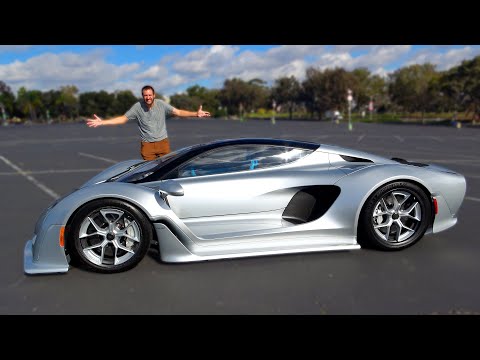
As YouTuber Doug Demuro shared with his 5 million followers, the chassis looks like organic material, one would see in the human body, and it is entirely designed through a complex AI process where engineers provide all of the important specs that a component needs in order for it to perform the way they want to.
While the AI algorithm generates the optimal structure for the precise component, the 3D printer builds the components using a bespoke aluminum alloy designed to achieve exact shapes that fit the size.
The use of human-AI design, 3D printing technology, automated assembly, and patented in-house-developed materials has enabled the company to build 21C for the 21st Century.
It is actually the first production car to be born from Divergent Technologies’ proprietary production system.
Swipe to scroll →
| Category | Traditional Manufacturing | Divergent DAPS |
|---|---|---|
| Design Method | CAD & manual optimization | AI-generated generative design |
| Tooling | Expensive molds & fixtures | Tool-less 3D printing |
| CapEx | High upfront investment | Near-zero design-specific CapEx |
| Customization | Limited | Rapid & scalable |
| Material Efficiency | High waste | Material-optimized, low waste |
Founded over a decade ago by Kevin Czinger to revolutionize the way automobiles are manufactured, Czinger’s parent company has developed the Divergent Adaptive Production System (DAPS) to optimize designs, dematerialize structures, and eliminate upfront capex.
It is an end-to-end software-defined production system that can create any structure, unconstrained by manufacturing technique.
Czinger 21C demonstrates how DAPS creates complex, lightweight, high-performance structures, reducing material waste and speeding up production for next-gen manufacturing across industries.
DAPS is actually a system-level replacement for traditional design, manufacturing, and assembly solutions. Using it, companies can build products that can be rapidly customized to meet customer- or mission-specific requirements. Furthermore, they are faster to market and scalable on demand to high-volume production.
The system, according to COO Lukas, allows “customers to develop higher performing products on faster timelines and with zero design-specific capex, freeing manufacturers from the burdens of legacy design decisions.”
DAPS is currently used to supply the automotive, defence, and aerospace industries with next-generation 3D printed components.
In the automotive sector, Divergent has seven blue-chip customers, including Aston Martin and Mercedes-AMG. Meanwhile, within the aerospace and defence industry, it is actively working with several US government contractors across a diverse range of applications.
As the parent company of Czinger Vehicles, it has developed the Czinger 21C hypercar, which features more than 350 AM components. Two years ago, the company raised $230 million in a Series D equity financing led by Sweden’s Hexagon AB.
“DAPS was created to serve as the foundation for a global system of regional manufacturing facilities that combine and fully exploit supercomputing, AI, robotics, and Additive Manufacturing in a novel way,” said Kevin, in a statement at the time. “We now have entered the ‘4D Age’ of fully digitised design-manufacturing-assembly as a service, dematerialised products using and requiring less material and energy, distributed regional production, and democratised access to the tools, data, and production assets necessary for innovation in our human-built world.”
How Divergent’s DAPS Is Changing Automotive Manufacturing
Divergent’s DAPS is an innovative system for manufacturing complex parts, with its key components including AI design, 3D printing, and robotic assembly, all seamlessly integrated for greater efficiency, sustainability, and adaptability.
The journey of manufacturing begins with the design phase, powered by AI-enabled engineering software that assesses structural requirements, performance goals, and manufacturing constraints to generate the most efficient design possible.
Rather than creating blueprints, as in traditional CAD systems, the AI software produces optimized geometries that require no manual intervention and are ready for manufacturing. The designs are lightweight yet strong and tailored to their specific use cases.
While AI is transforming the design phase at Divergent, it is reshaping the entire automotive sector, where machine learning, deep learning, and computer vision are improving how vehicles are designed, built, run, and supported.
In practice, the technology is accelerating battery development, enabling real-time quality control, optimizing thermal management in propulsion systems, and powering digital twins and generative simulations that significantly reduce development cycles. It is also enhancing infotainment and comfort systems, strengthening advanced driver-assistance systems (ADAS), and enabling more personalized in-vehicle experiences.
Moreover, turning real-time data into actionable insights enables manufacturers and suppliers to deliver vehicles and services that are safer, more efficient, and better aligned with evolving consumer expectations.
AI is basically redefining how vehicles are designed, built, and experienced, driving smarter decisions, faster cycles, and stronger outcomes for customers.
After design, Divergent’s DAPS system sends manufacturing instructions directly to industry-grade 3D printers that use alloys selected for specific qualities, such as strength, flexibility, or thermal performance.
Additive manufacturing (AM) or 3D printing is one of the most disruptive technologies of our age, which is predicted to be at the forefront of the fourth industrial revolution. In AM, three-dimensional objects are built layer by layer using digital design and a wide range of materials, including metal, plastic, and concrete. The technology allows for complex geometries, reduced waste, and on-demand production of functional end-use parts.
Its market size is projected to increase by $46.76 billion at a CAGR of 23.9% between 2024 and 2029.
In the last few years, AM has experienced significant growth, moving from hype to mainstream adoption across industries. This adoption is driven by benefits like cost efficiency, design freedom, and supply chain control, though challenges like initial costs and material limitations still persist.
In the automobile sector, the ability of AM to create complex structures is of significant importance.
Intricate structures can help reduce weight while maintaining or even improving mechanical strength, which is critical for enhancing fuel efficiency and vehicle performance. And AM enables designs that are extremely difficult or even impossible to achieve with traditional manufacturing methods.
For instance, the Czinger BrakeNode, an AI-designed, 3D-printed automotive component, has been created with geometries not possible through traditional manufacturing methods.
It is produced using Czinger’s patented Direct Metal Laser Sintering (DMLS) technology. Meanwhile, generation AI has been used to optimize design and achieve enhanced performance. BrakeNode combines almost every element of a traditional braking system into a single component, reducing the number of components required and potential failure points.
By integrating the suspension knuckle and brake caliper into a single part, it reduces both the weight and the complexity of the brake system. The direct integration of brake fluid channels into the structure of the Czinger 21C hypercar also increases stiffness and improves cooling, ensuring the brake system can withstand the extreme demands of high-performance driving.
Rapid prototyping is another great benefit of 3D printing. It allows designs to be updated without spending time and money on retooling.
The ability to test and refine advanced geometries quickly enables faster development cycles and more innovative solutions. It also speeds up the rate at which hypercars can be adapted to customer demand.
Faster development actually allows companies to deliver cars that better align with customer preferences, while avoiding large capital investments in uncertain projects.
“Ultimately, the shorter development time allows us to be able to not be getting on 10-year cycles of what we think a customer might want in that period of time […] but it also allows us to be able to develop and deliver cars that we’re much more certain that the customer is going to want,” said George Biggs, Chief Commercial Officer at Czinger Vehicles, in an interview earlier this year. “I think that that is a benefit for the entire industry, that we’re not making huge capital investments in things that we’re not quite sure of.”
When it comes to cost considerations, companies also save on salaries, rent, computing power, and other expenses, which means a quicker return on investment.
Once the parts are printed, they are moved to the assembly phase at Divergent, where robots assemble each component without tooling or jigs, enabling the construction of different vehicle models or structures in the same facility. The robots use controlled adhesives and laser-tracked positioning to connect parts, resulting in a single giant printed structure.
So, it is “not just the 3D printing in itself,” but the end-to-end manufacturing system of Divergent that sets them apart, said Biggs.
While many different players have 3D printers as part of their prototyping and development, he added that “there’s no one that has an end-to-end process line Divergence.” What it means is that not only do they produce the part, but also “help design, optimize, prototype, and move it in rapid form, and then produce it and hand it over as a completed part,” said Biggs.
Divergent’s specialization in the engineering of automotive components, offering a complete end-to-end solution, will enable those components to be utilized in the McLaren W1 and Bugatti Tourbillon. The number of OEMs that are interested in the company’s technology is in the “double digits,” per the CCO.
Investing in AI-Driven Manufacturing and Additive Tech
Now, if we look at an investable option in the automotive world, General Motors (GM -1.33%) offers an attractive choice. While Czinger proves what’s possible with advanced technologies, GM represents where the technology can realistically go next.
GM has one of the most advanced additive manufacturing programs among legacy automakers, with thousands of 3D-printed parts already deployed across prototyping, tooling, and end-use components. Last year, GM executed over 5,400 new AM projects, with even more expected this year.
It has also publicly showcased generative-designed seat brackets and structural components that reduce weight by up to 40%. GM uses AI to improve quality, enable efficiency, and enhance safety in its manufacturing facilities. A few months ago, GM stated that the conversational Google Gemini AI will also begin rolling out in its vehicles next year, and a new ADAS will be launched in the next three years to feature hands-free, “eyes-off” driving technology.
And as GM transitions toward electric and software-defined vehicles, lightweighting, rapid iteration, and digital manufacturing are critical to improving range, performance, and cost efficiency.
But more importantly, unlike hypercar manufacturers, GM operates at a massive scale, which means that applying end-to-end digital manufacturing systems could dramatically reshape the economics of high-volume automotive production.
General Motors is primarily involved in designing, building, and selling trucks, cars, crossovers, and automobile parts, as well as software-enabled services and subscriptions. It is most known for owning and manufacturing Chevrolet, Buick, GMC, and Cadillac.
The $76.8 billion market cap company’s shares are currently trading at $82.35, up 54.6% YTD. It has an EPS (TTM) of 5.20 and a P/E (TTM) of 15.84. GM pays a dividend yield of 0.73%.
General Motors Company (GM -1.33%)
As for its financial position, the company reported $48.59 billion as its third-quarter revenue, down less than 1% from the same period last year. “Thanks to the collective efforts of our team and our compelling vehicle portfolio, GM delivered another very good quarter of earnings and free cash flow,” said CEO Mary Barra.
The company reported $1.6 billion in special charges due to its pullback in all-electric vehicles, which wasn’t included in its adjusted results, and more than halved its net income attributable to stockholders to $1.3 billion. Its net income margin, meanwhile, dropped from 6.3% a year earlier to 2.7% in 3Q25.
At the time, CFO Paul Jacobson said only about 40% of their EVs were profitable on production and noted that due to an expected slowdown in adoption, they expect EVs to take longer than previously expected to become profitable. Still, they “continue to believe that there is a strong future for electric vehicles, and we’ve got a great portfolio to be competitive,” said Jacobson, adding that they need to make structural changes and lower the cost of producing those vehicles.
Investor Takeaway
While Czinger itself is private, its success highlights the growing investment opportunity in AI-driven manufacturing and additive technologies. Public companies like General Motors demonstrate how these tools could scale beyond hypercars into mass-market automotive production, potentially reshaping margins, speed to market, and long-term competitiveness.
Conclusion
The Czinger 21C is a record-setting hypercar that proves that the future of performance lies as much in how a vehicle is built as in how it drives. By replacing traditional manufacturing constraints with AI-driven design, additive manufacturing, and automated assembly, Czinger and its parent company Divergent Technologies have demonstrated a new industrial model, one that is lighter, faster, more efficient, and adaptable.
As hypercars continue to push the boundaries of speed and engineering, Czinger’s success suggests that competitive advantage will increasingly come from software, data, and manufacturing intelligence. In that sense, the 21st century is not just a milestone for automotive performance but a blueprint for how complex machines of the future will be conceived, engineered, and produced.
Click here to learn about the top five automotive innovations that changed the world beyond cars.
