
Energy
Can Biochar Cut the Cost of Green Hydrogen?

 Add Securities.io to your preferred sources on Google

Finding The Right Hydrogen Catalyst
Hydrogen could, in theory, be a perfect fuel to store energy and power applications that are hard to electrify. This is because it presents a few almost ideal characteristics:
– Fuel cells generate electricity without producing carbon dioxide at the point of use.
– Hydrogen can provide the high temperatures required by metallurgy and other difficult-to-electrify industrial processes.
– Electrolysis can produce hydrogen from water using renewable electricity.
– Hydrogen does not contain carbon, although its overall environmental impact depends on how it is produced and used.
However, the rise of a hydrogen-based economy has been hampered by the difficulty of producing hydrogen in a cost-effective manner. This is because green hydrogen is generally produced through electrolysis, a process whose cost and efficiency depend partly on its electrode materials. PEM electrolyzers rely on scarce and expensive platinum-group metals, particularly platinum and iridium, while alkaline systems can use more abundant nickel-based catalysts.
So as long as no better production method for hydrogen exists, it is unlikely that we will manage to see it replacing fossil fuels at scale.
Which is why many alternatives are being explored by scientists for catalyst materials, like iron nanorods, silicon carbide, or cobalt-tungsten.
Another option to produce green hydrogen could be carbon-based catalytic materials, which ironically could prove to be a solid solution to limit carbon emissions.
A new review by Indian researchers at Swami Rama Himalayan University and Graphic Era (Deemed to be University) examined the use of biochar-derived carbon nanomaterials for this purpose. Biochar is produced by thermally decomposing biomass under limited-oxygen conditions through processes such as pyrolysis. This is because biochar-derived carbon nanomaterials, including potentially carbon nanotubes (CNTs), graphene, and carbon quantum dots, nanosheets, and nanoflakes, offer high surface area, tunable structures, excellent electrical conductivity, and favourable electrocatalytic properties.
They published their findings in Next Energy1, under the title “Biochar-derived carbon nanomaterials for sustainable hydrogen production: Synthesis, electrocatalytic performance, and future perspective.”
Improving Hydrogen Production
If hydrogen atoms are the most abundant element in the Universe, on Earth they are generally bound to other elements. So pure H2 gas needs to be produced, with the generally preferred option being from the electrolysis of water (H2O). But it is limited by the high voltage required to overcome the kinetic barriers associated with water splitting.
Overcoming this voltage limitation is the primary role of electrocatalyst materials.
The scale of production required for a functional hydrogen economy requires such catalysts to be made from abundant and cheap elements. From that perspective, biomass-derived carbon nanomaterials are promising candidates because they can combine relatively abundant feedstocks with high surface area, electrical conductivity, chemical stability, and tunable electrochemical properties.
This is, however, not a straightforward process, with the turning of biomass into usable biochar and then catalysts not just a matter of using pyrolysis, but also extensive mechanical, thermal, and chemical treatments.

Source: Next Energy
Unfortunately, while progressing, how to consistently and at industrial scale turn raw biomass into carbon nanomaterials is still not fully understood.
“Despite increasing interest, there is still a lack of systematic understanding about how to engineer and optimize biochar-based carbon nanostructures as efficient, affordable electro-catalysts for hydrogen production. ”
Making Sense Of Biochar Research
Literature Review
The lack of systematized analysis on this topic is why the researchers gathered scientific literature published from January 2020 to February 2026, with an emphasis on a few themes:
- Biochar production and precursor properties.
- Synthesis and nanoscale processing of biochar-based carbon materials.
- Physical, chemical, and structural properties.
- Incorporation/hybridization with metal catalysts/other catalyst materials.
- Electrocatalytic process of Hydrogen evolution reaction (HER) and Oxygen evolution reaction (OER).
- Electrochemical performance.
- Stability, scalability, and future perspectives of environmentally-friendly hydrogen production
Biochar Production
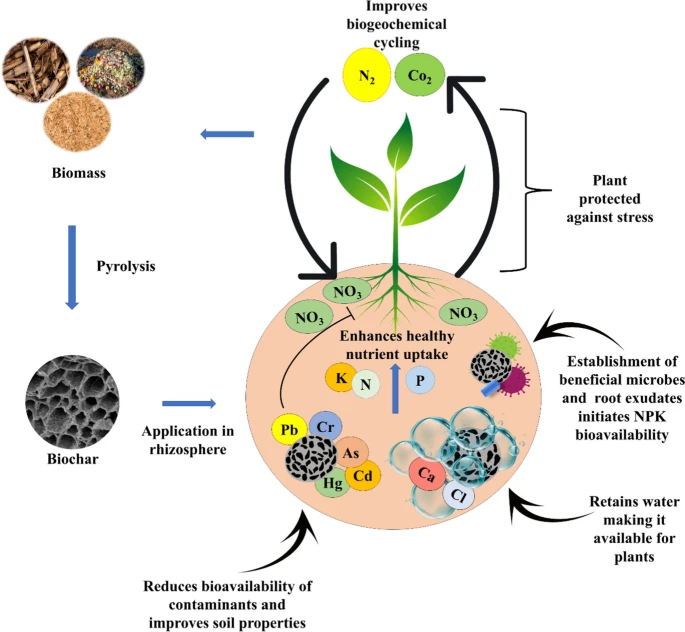
Biochar is a carbon-rich material produced by heating biomass, including agricultural residues, wood waste, and manure, under oxygen-limited conditions. Pyrolysis temperature varies according to the feedstock and desired properties, with the review describing processing conditions extending beyond a single temperature range.
In addition to pyrolysis, the process can also be used to turn plant biomass into biochar, such as through gasification and hydrothermal carbonization.
Besides its potential industrial applications, biochar is also increasingly used to improve soils for farming and capture carbon.
Source: Discover Soil
Biochar can be processed into carbon nanomaterials suitable for hydrogen-production research. Some proposed catalysts are metal-free, while others combine biochar-derived carbon with cobalt, iron, molybdenum, or other catalytic materials. The approach can convert low-value biomass into higher-value materials, although its overall carbon benefit depends on feedstock sourcing, processing energy, chemical treatments, and the material’s eventual lifecycle.

Source: Next Energy
Activation For Hydrogen Production
The first step in biochar treatment is physical methods. This is necessary to downsize the particle dimensions while enlarging the pore size and surface topography. This can rely on many different methods, like microwave, ultrasonic methods, and mechanical breakdown (compression, milling, grinding, chipping, and torrefaction).
Then, high-pressure steam at extremely high temperatures is used to break down the complex plant-based lignocellulosic matrix into a simpler structure.
Chemicals are also part of the process. Acid treatment can also be used to enhance the utility of the cellulose. These treatments can use acids including sulfuric, hydrochloric, nitric, acetic, oxalic, and phosphoric acid, with the selected reagent and concentration affecting the resulting material. On the other end of the pH spectrum, alkali compounds like ammonium hydroxide (NH4OH), Sodium hydroxide (NaOH), and calcium hydroxide (Ca(OH)2) are used to dissolve the chemical bonds between polymers and lignin.
These processes can also be coupled to modification of the chemical structure of the biochar or the addition of other elements to “dope” the electrochemical potential.
“Oxygen-containing surface functional groups such as hydroxyl, carbonyl, and carboxyl groups improve hydrophilicity, interfacial contact with electrolytes, and surface reactivity. These groups can also participate in redox reactions and facilitate charge transfer processes.”

Source: Next Energy
Boosting Hydrogen Production
The previous steps are all done so that the nanostructure of biochar is modified to contain much more carbon nanostructure: carbon nanofibers, graphene, carbon nanotubes, carbon dots, and carbon nanosheets.
This way, it is optimized for a few key features:
- High electrical conductivity, which allows the flow of free electrons
- Chemical stability and high porous surface area
- Suitable hydrogen adsorption and desorption characteristics, which influence the hydrogen evolution reaction.

Source: Next Energy
Making Biochar Hydrogen Profitable
A hurdle that has stopped hydrogen from becoming a commonly used fuel is cost. In part, this has long been due to expensive catalysts using rare and precious metals.
In the case of carbon-based catalysts, other costs are impacting the potential future economic viability of this process:
- Biomass cultivation, collection, transport, and storage
- Pyrolysis and steam treatment, which are very energy intensive.
- Biochar improvement with chemical and mechanical processes, with the cost of equipment and eventual pollution to be taken into account.
Another issue that current scientific literature, which focuses on results obtained in a laboratory environment, fails to properly address is biochar’s durability and regeneration capabilities.
Although some laboratory studies report promising electrochemical stability, the review finds that long-term durability, resistance to fouling, regeneration potential, and performance under realistic industrial conditions remain insufficiently studied.
Another unsolved concern is the lack of homogeneity in biochar characteristics. Almost countless variations exist, deriving from different biomass source material, pyrolysis conditions, and post-treatment of the biochar.
So while some formulas are promising, a clear testing method or certification process guaranteeing the quality of the final product is still missing and will be needed for industrial applications at a large scale.
“Overcoming these difficulties requires collaborative initiatives that include government legislation, industrial investment, and academic research. Policymakers should provide supporting frameworks that promote innovation, commercialization, and long-term use of biochar in the energy, environmental, and agricultural sectors.”
Still, the potential to all at once upscale low-value biomass, capture carbon, and reduce the cost of green hydrogen, while not requiring any rare elements, makes this technology very attractive.
Laboratory studies have demonstrated the technical potential of biochar-derived carbon nanomaterials, but their results cannot always be compared directly because testing conditions and reporting methods differ. The next steps are to standardize production and performance testing, validate long-term durability, complete lifecycle and techno-economic assessments, and advance the strongest candidates into industrial pilot projects.
Investing In Green Hydrogen
Plug Power
Plug Power (PLUG ) provides fuel cells, electrolyzers, hydrogen-storage equipment, fueling infrastructure, and hydrogen-production services. The company says it has deployed more than 74,000 fuel-cell systems and over 280 fueling stations, while its electrolyzers have been deployed across six continents.
Plug also remains a speculative investment. It has expanded its hydrogen-production and electrolyzer operations but continues to face financial, execution, funding, and commercialization risks. Advances that reduce hydrogen-production costs could support its addressable market, but they would not by themselves resolve the company’s financial challenges.

Source: Plug Power
Its relevance to this research comes primarily from its electrolyzer business. Plug manufactures proton-exchange membrane electrolyzers, a technology that currently depends on platinum-group metal catalysts. If biochar-derived materials or related carbon-metal hybrids eventually reduce catalyst requirements, improve electrode performance, or lower system costs, electrolyzer manufacturers could benefit from the resulting improvements.
However, the reviewed biochar materials remain at the laboratory stage, and there is no indication that Plug Power currently uses or plans to use them. The company should therefore be viewed as downstream exposure to the broader expansion of green hydrogen rather than direct exposure to biochar-derived catalysts.

Source: Plug Power
PLUG Price Chart
(You can read more about Plug Power in our dedicated investment report on the company.)
Latest Plug Power (PLUG) Stock News and Developments
Study Referenced
1. Vishal Rajput. Biochar-derived carbon nanomaterials for sustainable hydrogen production: Synthesis, electrocatalytic performance, and future perspective. Next Energy. Volume 13, October 2026, 100995. https://doi.org/10.1016/j.nxener.2026.100995



