
Best Of
10 Top Consumer Discretionary Stocks (2026)

 Add Securities.io to your preferred sources on Google
Securities.io may receive compensation when you use links to products we review. This does not influence our editorial evaluations. We are not a registered investment adviser; this is not investment advice. Read our affiliate disclosure.

Key PointsDiscretionary stocks depend on employment wage growth confidence and valuations not…
View more
- Discretionary stocks depend on employment wage growth confidence and valuations not just lower rates.
- Consumer trends shape discretionary winners as spending shifts toward e-commerce streaming travel and experiences.
- A strong consumer trend does not guarantee an attractively priced stock for investors.
Consumer Discretionary Stocks And Changing Spending Habits
Higher borrowing costs and the cumulative rise in prices since the pandemic have put pressure on household budgets. At the same time, enthusiasm for AI has drawn considerable investor attention toward technology companies.
The Federal Reserve began its recent rate-cutting cycle in September 2024. Lower borrowing costs can support consumer spending, but a comeback for discretionary stocks also depends on employment, wage growth, confidence, and company valuations.
Consumer discretionary stocks represent companies that sell non-essential goods and services. These are the things people tend to buy when they have extra disposable income.
Unlike consumer staples (such as groceries or household products), discretionary spending includes areas like entertainment, apparel, restaurants, travel, and luxury goods. People tend to spend more on these when they have spare cash, or when their investments and assets are growing in value.
This leads these stocks to be closely tied to economic cycles. They also follow consumer trends, reflecting shifts in behavior, preferences, and lifestyles that drive where and how people spend their money.
For example:
- The rise of e-commerce has created retail giants like Amazon and changed how established brands like Nike reach customers.
- Cars are becoming software and content platforms, while automated driving remains an important development area.
- Streaming, travel, and experiences compete with physical goods for consumers’ spending.
- Sustainability and value consciousness are reshaping product innovation and brand loyalty.
Investing in consumer companies that anticipate or align with these evolving trends can offer growth potential, especially when overall spending is growing. However, a strong consumer trend does not automatically make a stock attractively priced.
This list takes a broad view of discretionary spending rather than following a single stock-market sector. For example, Apple is classified as Information Technology, while Netflix is classified as Communication Services. Both still offer exposure to how consumers choose to spend. The order below is thematic, rather than a ranking by valuation or expected returns.
Swipe to scroll →
| Company (Ticker) | Consumer Trend Lever | Tech Edge | Key Risk |
|---|---|---|---|
| Amazon (NASDAQ: AMZN) | E-commerce share gains; Prime | AWS, AI logistics, Amazon Leo | Retail margins; regulatory |
| Tesla (NASDAQ: TSLA) | EV adoption; energy storage | FSD stack, battery scale, robotics | Autonomy timelines; competition |
| Apple (NASDAQ: AAPL) | Premium devices; services mix | Apple Intelligence, custom chips, ecosystem | Smartphone maturity; AI talent war |
| Marriott (NASDAQ: MAR) | Leisure & business travel demand | Cloud CRS, loyalty, AI agents | Macro/travel cycles |
| Netflix (NASDAQ: NFLX) | Streaming + ad-tier growth | AI VFX & personalization | Content costs; competition |
| Booking (NASDAQ: BKNG) | Global travel demand; connected trips | Search/price ML; superapp cross-sell | Ad mix vs. Google; FX |
| Flutter (NYSE: FLUT) | iGaming & sports betting shift online | Shared technology; finance automation | Regulation; taxes; betting outcomes |
| Home Depot (NYSE: HD) | Home improvement; Pro segment | AR tools; AI agents; HD Ventures | Housing cycle; theft shrink |
| Yum! Brands (NYSE: YUM) | Value & convenience dining | Voice AI ordering; computer vision | Food inflation; labor |
| Sony (NYSE: SONY) | Gaming & premium content | PlayStation, IP, image sensors | Console cycle; FX |
10 Consumer Stocks Following Changing Consumer Trends
1. Amazon.com Inc.— E-commerce, Cloud & AI Flywheel
Amazon.com, Inc. (AMZN) Price Chart
Amazon’s rise saw it transforming from an online bookstore to an “everything” retailer, to a tech giant.
So when consumers and investors think of Amazon, they should remember that not only is it one of the world’s largest retailers, but also a major force in cloud computing and AI.

Source: Statista. Historical cloud-market illustration.
This ability to create and handle advanced tech is giving Amazon a strong advantage over its competition.
For example, it has among the world’s most advanced warehouses, with robots working alongside employees to move, sort, and help fulfill customer orders.

The company is also experimenting with many other very innovative retail technologies:
- “Just Walk Out” checkout-free technology, using computer vision, sensors, or RFID to identify purchases.
- Autonomous logistics, with self-driving delivery vehicles.
- Drone deliveries.
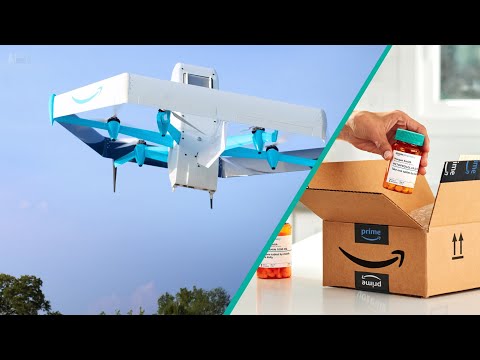
The company is also building a satellite internet constellation to compete with services like Starlink. Project Kuiper was renamed Amazon Leo in November 2025. Amazon also owns Zoox, its autonomous robotaxi business.

The strong commercial position of the company, as well as Prime subscriptions, also generates a flood of data that can be used to improve its offers, notably through AI-powered personalization and advertising tools.
Lastly, the company is also active in IoT (Internet of Things) with Alexa, FireTV, an AI and voice-driven smart TV system, and the smart speakers & display Echo.
Thanks to the connection of its retail and logistics empire with its cloud business, Amazon is evolving into a global infrastructure company for commerce and AI services. These opportunities also require substantial investment, so growth must be weighed against costs and returns on capital.
(You can read more about Amazon in its dedicated investment report.)
2. Tesla, Inc.— EVs, Energy Storage & Autonomy
Tesla, Inc. (TSLA) Price Chart
After helping turn electric cars into mainstream products and status symbols, Tesla has expanded into energy storage, robotics, and AI.
This makes Tesla the quintessential example of hardware and software convergence in a consumer product.
Nowhere is this as apparent as in its automated-driving program. Tesla uses a camera-based approach and real-world driving data, differing from competitors that also use LIDAR systems (a strategic difference we explored in “2025: The Year Self-Driving Cars Go Mainstream?”). However, its consumer Full Self-Driving (Supervised) system still requires active driver supervision and does not make a privately owned Tesla autonomous.

Source: ARK Invest. Historical illustration, not a current comparison of autonomous-driving performance.
The same expansion beyond EV is visible in energy, where Tesla is using its expertise in battery manufacturing to expand into fixed energy storage for both houses and utility-grid battery parks.
Lastly, its experience with robotics and advanced manufacturing has encouraged Tesla to develop humanoid robots through its Optimus program. The commercial scale and profitability of that effort remain uncertain.
Overall, investors would be short-sighted to see Tesla as just a car company. Energy storage and potential progress in autonomous driving could broaden its activities further, although their future contribution should not be treated as guaranteed.
At the same time, the company has long been controversial, in large part due to its association with Elon Musk. So volatility, politics, and intense debates over the company are as much a part of investing in Tesla as manufacturing and technological innovation.
(You can read more about Tesla in its dedicated investment report.)
3. Apple— iPhone Cash Machine, On-Device AI
Apple Inc. (AAPL) Price Chart
If technologies have changed our lives regularly for a century, each often stayed confined to a definite space. TVs in a living room, cars in a driveway, a computer at the office, or a home desk.
Apple changed that with the popularization of the concept of smartphones, making technology and software a much larger part of our daily lives, following us everywhere.
For a long time, Apple has been a device-centric company, with the Macintosh computer succeeded by the iPod, and then the iPhone.
To an extent, this is still true, with the iPhone remaining central to the company’s revenues and many App Store and other services purchases linked to its devices.

Source: Business of Apps. Historical revenue breakdown.
As the smartphone market is reaching maturity, this has prompted people to start worrying about what comes after the iPhone for Apple.
Over the years, the company’s management has explored many ideas, from spatial computing to connected tracking devices. Building another business with the iPhone’s scale, however, remains a substantial challenge.
One likely source of growth is AI, through Apple Intelligence and Siri. The company’s 2024 ReALM research reported strong results against GPT-4 on specific reference-resolution tasks, such as understanding which on-screen item a user means. That was a narrower finding than outperforming GPT-4 across its capabilities.
Apple is also developing AI hardware. For example, the M5 chip introduced in October 2025 featured a 10-core GPU architecture with a Neural Accelerator in each core.
The pace of new product releases, however, is only one part of Apple’s investment case.
The iPhone is still one of the world’s most recognizable smartphone brands, supporting premium pricing and a large services business. The company’s brand remains strong, while the convenience of its connected products gives customers a reason to stay within the Apple ecosystem.
This is reflected in the company’s financial performance. Apple (AAPL ) reported fiscal fourth-quarter 2026 revenue of $114.5 billion, up 12% year over year, with Services reaching a new revenue record. So as long as Apple’s core business remains healthy, it can continue to appeal as both a technology company and a consumer brand. The price investors pay for that strength still matters.
4. Marriott International— Asset-Light, Digital Loyalty
Marriott International (MAR) Price Chart
When looking for a premium travel experience, the accommodation is an essential part. For a long time, skilled personnel, high-quality construction, decor, and furniture were an essential part of a luxury hotel.
This is, of course, still true, but technology is increasingly important as well, something that a large group like Marriott is well positioned to develop and deploy at scale.
The company’s many brands include, for example, The Ritz-Carlton, Marriott, BVLGARI Hotels & Resorts, Sheraton, Residence Inn, etc.

Source: Marriott
The company has been undergoing a long process of “digital transformation,” including the adoption of cloud-based systems for reservations, property management, and loyalty. Its agreement with Amadeus is part of that effort to modernize booking and offer more personalized stays.
This digital integration is intended to give customers more control over room choices and additional services. In its November 2026 earnings discussion, Marriott described an in-app complimentary upgrade list still in beta, illustrating the distinction between a feature being tested and one available to every guest.
Marriott is also expanding its use of AI for customer interactions and internal processes, including its Ask Bonvoy conversational tools. These efforts include experimentation as well as deployment, as an earlier discussion of AI agents made clear:
“We’re in deep discovery with agents. We have an agentic mesh capability that we’re building in our horizontal AI architecture, and we’re looking at use cases.”
Naveen Manga – Global chief information officer at Marriott.

Finally, the company is also embracing practical technologies such as mobile check-in, mobile room keys, service requests, and hybrid meeting tools. Availability varies by hotel and brand. These features can improve convenience, although travel demand and hotel owners’ willingness to invest remain central to the business.
5. Netflix, Inc.— Streaming + AI-assisted Production
Netflix, Inc. (NFLX) Price Chart
Audiovisual content at the age of cinema and TV was a very heavily top-down structure, with the public a somewhat passive receiver whose appreciation was only possible to estimate through ticket sales or at times unreliable ratings.
Direct streaming has not only radically changed how we consume, but also how cinema/TV content is produced:
- Entire seasons can be released at once, although some series use split seasons or scheduled releases.
- Rewatching older content is just one click away.
- Viewers can choose between ad-free viewing and lower-priced advertising-supported plans, where available.
This back-and-forth between format and content is only going to get more intense in the future.
Netflix has experimented with greater viewer participation. For example, its 2018 interactive movie, Black Mirror: Bandersnatch, allowed viewers to make choices that changed the story’s outcome.

The company continues to develop recommendations, search, advertising, and new viewing experiences. In January 2026, it introduced real-time voting for selected live events, giving viewers another way to participate.
AI is also being used in production. In July 2025, Netflix said its science fiction series El Eternauta (The Eternaut) featured the first final generative-AI footage in a Netflix original series or film. The example involved a visual-effects sequence, rather than an entire AI-generated show.
“We remain convinced that AI represents an incredible opportunity to help creators make films and series better, not just cheaper.
“Using AI-powered tools, they were able to achieve an amazing result with remarkable speed and, in fact, that VFX sequence was completed 10 times faster than it could have been completed with traditional VFX tools and workflows.”
Ted Sarandos – Netflix co-chief executive, July 2025 earnings discussion
As both a content creator and distributor, Netflix could benefit from AI, provided the tools improve results without compromising quality or creating problems around rights and creative work.
On the content creation side, it could cut down production costs, allowing for more ambitious artistic visions to be realized on a smaller budget. On the distribution side, the massive database of its users’ tastes in movies and series should help recommend the best content and promote new videos to the right audience.
Overall, Netflix’s history of being technologically driven and adaptable may remain an important competitive advantage, especially as AI tools make it easier to produce more content than the public can ever watch.
If this rather dire prediction comes to pass, it might turn out that the best way to filter too much AI-created content is by using another AI to find which one was made just for you. And for that task, our Netflix viewing history might be the most valuable data.
6. Booking Holdings Inc.— Data-Driven Travel Superapp
Booking Holdings Inc. Common Stock (BKNG) Price Chart
As screens and algorithms are taking over our lives, politics, and even cars, humans are going to want even more authentic experiences and “real life” memories.
A good way to do so is through travelling. Tourism has been a major global industry, and could keep growing as more of the world’s population enters the middle class. The World Travel & Tourism Council estimates that travel and tourism contributed $11.6 trillion to global GDP in 2025, including direct, indirect, and induced effects. That is broader than the revenue earned by travel companies.
Booking Holdings, whose brands include Booking.com, Priceline, Agoda, KAYAK, and OpenTable, is a major global provider of online travel and related services.

Source: Booking Holdings. July 2025 investor presentation; historical figures.
Its platforms connect travelers with accommodation and other services around the world. In the third quarter of 2026, the group recorded 345 million room nights, up 7% year over year, and $54.5 billion in gross bookings, up 10%. Gross bookings measure the value of travel booked, rather than the company’s revenue.
The company has expanded substantially over the past decade, despite the pandemic disruption, but its revenues and earnings do not rise every quarter. In Q3 2026, reported revenue declined 1%, while adjusted revenue rose 9%; the difference included a $900 million revenue reduction related to an FTC matter.

Source: Booking Holdings. July 2025 investor presentation; historical figures.
The company has always been looking to optimize the travel experience for its users, while maximizing customer benefits through loyalty programs, mobile app, pre-filled payment data, easier additional services like car rental or plane/train ticket booking, etc.
This has created many new opportunities for the company, notably the ability to sell several parts of the same trip. In Q3 2026, approximately 21 million flight tickets were booked through its platforms, up 19% year over year.

Source: Booking Holdings. July 2025 investor presentation; historical figures.
Today, Booking is deploying machine learning and AI for:
- Pricing optimization.
- Recommendations of travel options, accommodation, restaurants, etc.
- Personalized travel experience.
For developing these tools, the wealth of data from past travel by Booking’s users could be highly valuable. The benefit depends on using that information responsibly and turning better recommendations into bookings, while competing with other travel platforms and AI-powered search services.
7. Flutter Entertainment— Leading Online Betting Platform
Flutter Entertainment plc (FLUT) Price Chart
Games, gambling, and betting on sports are activities as old as civilization, with dice found in Ancient Egyptian tombs, and betting on horse races or gladiator fights highly popular in the Roman Empire. The thrill and risks of trying to guess right, or just being lucky, seem to be a deep human instinct.
Flutter is a leading online sports betting and iGaming operator, with a major US presence through FanDuel and a portfolio of brands across other markets.
As such, it is positioned to benefit from the shift of betting and gaming online. However, the opportunity varies by country and state, with licensing rules, gambling taxes, and competition shaping the available market.
In Q3 2026, Flutter reported $1.455 billion in US revenue and $2.419 billion in International revenue. The US therefore represented approximately 38% of the quarterly total. The graphic below illustrates an earlier geographic mix.

Source: Flutter. Historical illustration.
It manages many brands, each specializing in a specific type of betting or online gambling.

Source: Flutter. Historical illustration.
A strong point of the company is its customer acquisition capability through advertising, sponsorships, and established brands. Cross-selling between products can create economies of scale, although promotional spending and competition can also weigh on margins.
Another strong point is its technology base, built to handle large traffic volumes and share capabilities across brands. The group is also using AI and automation to improve internal processes, with human oversight remaining important for financial controls.
In a 2025 interview, its finance automation lead described an internal language-model tool using company documentation and a process of checking automated outputs alongside existing workflows.
These advantages do not eliminate operating risk. In Q3 2026, group revenue rose 2%, but adjusted EBITDA fell 25%, with sports results, taxes, and investment affecting performance. Flutter also reported a substantial impairment linked to Brazil and lowered its full-year outlook. Investors should weigh the scale advantages against these pressures, rather than assuming they guarantee lower costs or better returns.
8. The Home Depot— Pro Customer & AI-Enabled Retail
Home Depot, Inc. (The) (HD) Price Chart
Not all discretionary spending is for entertainment or technology. A major budget item for households is their own home.
Home Depot (HD ) is the world’s largest home improvement specialty retailer. Like most other businesses, it is being transformed by new technologies:
- Augmented reality tools for visualizing paint colors and home projects.
- Sidekick, an employee app using machine learning to prioritize tasks such as restocking.
- Smart home products and connected devices.
- Digital tools that help professional customers plan and manage purchases.
- Magic Apron, an AI assistant offering product and project guidance, expanded in August 2026 with store-specific capabilities across its US stores.
The company has also been an investor in innovative home improvement and retail solutions through Home Depot Ventures. Announced in 2022, the fund built on earlier investments in companies such as connected-device platform Afero and freight technology company Loadsmart.
Home Depot’s “smart retail” approach aims to deploy technology where it is useful while keeping the purchase experience simple both online and in stores. The opportunity remains tied to housing activity, repair and renovation spending, and the needs of professional contractors.
9. Yum! Brands— QSR Automation & Voice AI
Yum! Brands, Inc. (YUM) Price Chart
Fast food is probably the part of the restaurant industry that has been most enthusiastic about standardizing and automating work. The sector is now looking for further ways to reduce the time and labor required to order, cook a meal, or clean facilities.
This can benefit companies like Yum! Brands, whose remaining restaurant brands include Taco Bell, KFC, and Habit Burger & Grill. Yum! completed its Pizza Hut divestitures in August and September 2026. Its subsidiaries and franchisees operated more than 44,000 restaurants across over 150 countries and territories following those sales.

Source: Yum! Brands. March 2025 presentation, before the Pizza Hut divestitures.
Yum! Brands and NVIDIA (NVDA ) announced a collaboration in March 2025 to develop and deploy restaurant AI through Byte by Yum!. The announced applications included:
- Generative AI-powered customer-facing experiences, like automated ordering.
- AI-accelerated voice ordering agents.
- Computer vision software to analyze drive-thru traffic and explore staffing improvements.
- AI-driven analytics and agents to assess restaurant performance, generating personalized action plans for restaurant managers based on best practices from top-performing locations.
“At Yum, we have a bold vision to deliver leading-edge, AI-powered technology capabilities to our customers and team members globally.”
Joe Park, chief digital and technology officer of Yum! Brands, Inc. (YUM )
“NVIDIA’s software makes it affordable for even the largest restaurant company to improve operations and customer experiences, proving AI can pay off at every location.”
Andrew Sun – Global Director of Retail, CPG and QSR Business Development, NVIDIA
These comments accompanied the 2025 announcement; they should not be read as confirmation that every location has deployed the technology. Yum! Brands’ adoption of AI is only one of the possible applications of technology to the highly optimized and standardized setup of fast food restaurants.
For example, robotics solutions for food preparation, digital twins for kitchen design, and predictive ordering analytics can all increase efficiency further.
Inflation and high labor costs have challenged fast food chains’ reputation as a cheap option for a meal. International expansion can support growth, but the performance of individual brands and markets still varies.
Increased productivity from AI and automation could help cut costs while personalizing customer experiences at scale. The payoff depends on reliable systems, customer acceptance, and franchisees finding the investment worthwhile.
10. Sony Group Corp.— PlayStation, IP, and Image Sensors
Sony Group Corporation (SONY) Price Chart
Not all tech companies are American, even if it can feel this way with the rise in stock markets of the so-called “Magnificent Seven”.
One such overseas tech leader is SONY, a Japanese company that has revolutionized several times entertainment, gaming, and hardware with products like the Walkman or the PlayStation.

Source: Sony
Today, Sony’s PlayStation remains one of the largest console platforms. Sony reported more than 100 million PlayStation 5 units shipped worldwide as of November 10, 2026. This figure measures shipments into distribution channels.
The company is also a major content producer, with video game IPs (Horizon, Ghost of Tsushima, or The Last of Us), a music label (Usher, Whitney Houston, Bob Dylan), and Sony Pictures Studios (Ghostbusters, Jumanji, Men in Black, Spider-Man).

Source: Sony
Less well-known to the general public is Sony’s strong presence in image sensors. Its semiconductor business supplies sensors for smartphones, cameras, vehicles, and other applications, giving the company exposure to spending beyond its own branded devices. The older market-share graphic below is historical context, rather than a current market estimate.

Source: Edge Vision. Historical market-share graphic from a July 2023 article.
The presence in sensors, combined with consumer hardware and content creation, could allow Sony to benefit from increases in discretionary spending, either directly or indirectly. Console cycles, content costs, competition, and currency movements can still affect the outcome.


