

Disruptive Tech
Banned: 5 Technologies Prohibited in the Olympic Games

Securities.io maintains rigorous editorial standards and may receive compensation from reviewed links. We are not a registered investment adviser and this is not investment advice. Please view our affiliate disclosure.

The Olympic Games have always been a proving ground for human excellence, but in the modern era, they’re also a showcase for technological innovation.
From high-definition cameras and advanced sensors to motion-tracking systems, artificial intelligence, and drones, technology is transforming the Olympic Games. While we recently explored the Top 5 Advanced Technologies Used at the Olympic Games to enhance performance, some innovations have been deemed too powerful, leading to strict regulations and outright bans. These advances offer greater accuracy, fairness, and safety across competitions and dramatically improve the fan experience.
At the same time, technological advances are giving new meaning to faster, stronger, and higher. But while scientific breakthroughs have elevated sports, they also undermine the principle of fair competition.
Not everyone can afford to take advantage of these innovations, and when technology creates disproportionate advantages, it challenges the integrity of sport. This makes it important to impose restrictions to level the playing field for all.
As the sports governing body of the modern Olympic Games emphasizes:
“The IOC has established a zero-tolerance policy to combat cheating and hold accountable anyone responsible for using or providing doping products.”
As a result, the International Olympic Committee (IOC), along with international federations such as World Athletics, World Aquatics, and the World Anti-Doping Agency (WADA), among others, regularly evaluates innovations to determine whether they uphold the sport’s ethical standards, preserve athlete primacy, and create a fair and competitive environment.
When technologies fail to do so, they are banned. So, let’s take a look at five of the most consequential technologies that were deemed too powerful, prompting major regulatory crackdowns.
| Technology | Primary Use | Tech Feature | Impact Area |
|---|---|---|---|
| Blood Doping (EPO) | Endurance Enhancement | Synthetic EPO, Blood Passport Evasion | Fairness & Athlete Health |
| Mechanical Doping (Hidden Motors) | Cycling Performance Boost | Concealed Electric Motors, Magnetic Induction Systems | Competition Integrity |
| Polyurethane “Super Suits” | Swimming Speed Optimization | Polyurethane Panels, Drag-Reducing Hydrodynamics | Record Legitimacy & Fair Play |
| Carbon-Plate Super Shoes (Oversized) | Running Efficiency Enhancement | Energy-Returning Foam, Carbon Fiber Plate Geometry | Technology Arms Race |
| Corked & Modified Equipment | Equipment Manipulation | Hollowed Bats, Fluorinated Waxes, Density Alteration | Rule Compliance & Environmental Safety |
1. Blood Doping via Erythropoietin (EPO)
A widely popular way to enhance performance is to augment the oxygen-carrying capacity of the blood through blood doping.
That’s because our ability to do strenuous exercise, for the most part, is dependent on the ability of our blood to deliver oxygen efficiently to muscles. And erythrocytes in our blood are responsible for this. Erythrocytes, or red blood cells (RBCs), are designed to transport oxygen throughout our bodies, and they are constantly regenerated through a process called erythropoiesis.
But sometimes our bodies need to produce less, and sometimes more, and when the latter happens, our kidneys release a hormone called erythropoietin (EPO). This naturally occurring hormone stimulates red blood cell production, increasing oxygen delivery to muscles and improving endurance performance.

Thanks to a genetic mutation, Finnish cross-country skier Eero Mäntyranta’s body naturally produced 25-50% more red blood cells, providing him with superior aerobic endurance and helping him win seven Olympic medals. But most don’t possess such a genetic advantage, leading some athletes to seek artificial methods to achieve this.
The identification of EPO as the hormone stimulating red blood cell production led to the development of synthetic EPO in the 1980s, and in the following decades, EPO abuse became widespread in endurance sports, so much so that it led to the infamous “EPO era”. While mostly popular in cycling, EPO’s effects have also been impactful in distance running, cross-country skiing, and rowing. In endurance athletes, blood doping is estimated to have a prevalence of 15% to 22%.
The most recent case of blood doping via EPO took place in the 2018 Seoul Olympics, where the entire Russian team was barred from participation due to systematic doping.
EPO has been banned by WADA since its first Prohibited List in 2004 due to offering artificial physiological enhancement. Besides fundamentally undermining human competition, blood doping also causes major health risks such as blood thickening, stroke, and cardiac arrest.
Since the release of the first synthetic EPO, several other derivative drugs have been created to increase erythropoiesis, which are also harder to detect. Even gene-editing technologies like CRISPR are being experimented with to enhance muscle growth or oxygen carriage, which is also banned by WADA.
2. Mechanical Doping (Hidden Motors)
Doping isn’t limited to the body; it also affects equipment. While performance-enhancing drugs alter an athlete’s physical abilities, mechanical doping enhances performance through hidden technology that can’t be detected easily, at least without specialized testing methods.
Motor doping has emerged as a serious issue, with bikes undergoing routine inspection at Olympic events. If an athlete is found guilty, it results not only in disqualification but also in multi-year bans.

In this type of technological fraud, hidden propulsion systems, typically small electric motors, are concealed inside bicycles to provide additional power and an unfair advantage during races without visible external assistance.
These illicit propulsion systems can take the form of small cylindrical motors installed in the frame, delivering about 200 watts of assistance for a few thousand dollars. The rider controls the system using discreet buttons hidden under handlebar tape. More sophisticated systems use magnets and induction coils that require custom frame building and are nearly undetectable, making them significantly more expensive.
Mechanical doping first gained attention more than a decade ago, leading the International Cycling Union (UCI) to explicitly ban the practice. However, it’s not easy to discover.
“It’s a bit of a technological arms race. Components are getting lighter (and) smaller. Easier to conceal, which is harder to detect,” Nick Raudenski, the UCI Head of the Fight Against Technological Fraud and a former criminal investigator with the U.S. Department of Homeland Security, told Reuters last year.
At the Paris Olympics, officials deployed electromagnetic scanners and X-ray imaging to combat motor doping.
Despite efforts to combat mechanical doping, the problem persists, with experts now calling for real-time monitoring systems that continuously verify a cyclist’s power output throughout races.
3. Polyurethane “Super Suits” (Speedo LZR Racer)
To protect the “spirit of the sport,” WADA not only fights drug cheats but also sports equipment, including swimsuits. That’s right, even swimwear is being utilized to boost performance by enhancing hydrodynamics and reducing energy expenditure.
In fact, one such swimmer broke 23 world records and won 94% of all swimming gold medals at the 2008 Beijing Olympics. The swimming costume in question was Speedo’s LZR Racer, developed with NASA’s assistance.

This body-length suit used polyurethane panels and compression technology to improve body position and reduce drag force, the hydrodynamic resistance a swimmer feels as they move through water. The fabric was tested using a wind tunnel and a water flume to reduce skin friction drag 24% more than the previous Speedo racing suit fabric, Fastskin, noted NASA at the time.
Meanwhile, the suit’s textures were based on shark skin to increase buoyancy. Even the seam placement was carefully engineered to help the swimmer spend significantly less energy and be faster.
After these suits helped athletes break over 130 world records, the swimming governing body FINA (now World Aquatics) banned Speedo’s LZR Racer, Arena X-Glide, and other similar suits in 2009. The agency ruled out full-body and polyurethane suits and now only allows textile materials and limited coverage.
4. Oversized Carbon-Plate Running Shoes
The running equivalent of the LZR Racer swimsuit gained spotlight a decade later, when Nike (NKE ) created a bespoke shoe for Kenyan long-distance runner Eliud Kipchoge that helped him become the first man to run a marathon in under 2 hours, albeit in an unofficial race.
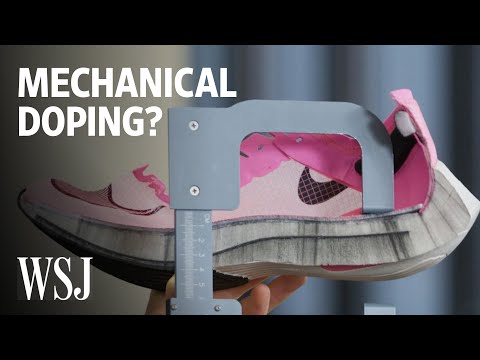
The technologically advanced super shoe, Nike Vaporfly, has been found to offer a 4% increase in running efficiency. Another research found the effect of Nike Vaporfly on different individuals to be highly variable, with some people “getting a 10 percent benefit.”
So, much like the LZR Racer suit broke several world records, the commercial versions of the show have also set several new long-distance running records.
What makes these shoes help runners break records is their lightweight, energy-returning midsole foam, multiple carbon fiber plates, and an overall curved shape that work together to improve an athlete’s running economy.
However, due to concerns over “technology arms race,” disproportionate mechanical energy return, and access inequality, World Athletics imposed restrictions on these super shoes. But unlike EPO and hidden motors, super shoes were regulated and not fully banned. They were actually widely used at Tokyo 2020 and Paris 2024.
As per the guidelines, these shoes can have a maximum thickness of 40mm and must contain only one carbon plate. They also need to be made available to the public for months in advance.
It was in line with these new regulations that Nike released Vaporfly, an altered version of its banned Alphaflys, which took several marathon podium spots at the Olympics.
5. Corked Equipment
Yet another way athletes have been enhancing their performance through illicit means is by corking their equipment. This practice appears in baseball, which has been featured intermittently in the Olympics.
Baseball was featured at Tokyo 2020 for the first time since the 2008 Summer Olympics. While not included in Paris 2024, the bat-and-ball sport will return for Los Angeles 2028.
In baseball, corking a bat involves drilling a hole through its center and filling it with a lighter material to reduce the bat’s weight and increase swing speed. This practice is strictly banned as it disrupts the physics of the swing and is considered cheating.
Under the World Baseball Softball Confederation (WBSC) and international standards, altered bats are illegal, and strict equipment certification is required.
Besides bat corking, other banned equipment modifications in Olympic sports include aerodynamic helmets in skeleton sports and wax fluorocarbons in elite ski and snowboard competitions. Recently, at Milano Cortina 2026, a South Korean cross-country ski pair was disqualified from the women’s sprint event after their skis were found to contain fluorinated wax, which was officially banned in 2023 due to its detrimental impact on both the environment and human health.
Click here to learn how AI is being used at the Olympics to stress-test infrastructure.
Investing in Advanced Olympic Tech
A prominent name in Olympic performance innovation is Nike, which developed the Vaporfly and Alphafly platforms and continues R&D in foam chemistry and plate geometry. The company pushes performance boundaries while adapting to evolving Olympic compliance rules.
Nike is also a major Olympic sponsor and the official outfitter for Team USA. While not an official top-tier IOC sponsor, Nike dominates the Olympic brand landscape by sponsoring individual athletes and numerous National Governing Bodies. It also provides gear for the Olympic Refugee Team.
In general, Nike designs, markets, and distributes athletic footwear, equipment, apparel, accessories, and services for sports and fitness activities.
(NKE )
Despite being a leader in performance footwear innovation, Nike shares are currently down 1.05% YTD and 11.63% over the past year, trading just above $63. While the broad stock market has been hitting new highs throughout last year, a trend continuing this year, Nike’s stock hit an all-time high of $180 in late 2021. Its 52-week range currently sits between $52.28 and $82.44.
The $93.3 billion market cap company has an EPS (TTM) of 1.71 and a P/E (TTM) of 36.96. Nike pays a dividend yield of 2.60% and has a strong track record of returns to shareholders, increasing dividend payouts for 24 consecutive years.
For its financial position, Nike reported revenue of $12.4 billion for the second quarter ended November 30, 2025. The following table breaks down the performance across key segments and regions:
| Segment / Region | Revenue | Growth (YoY) |
|---|---|---|
| Wholesale Revenue | $7.5 Billion | +8% |
| Direct Revenue | $4.6 Billion | -8% |
| North America | $5.63 Billion | +9% |
| Greater China | $1.42 Billion | -17% |
China remains one of Nike’s strongest long-term opportunities, but improvements there are “not happening at the level or the pace we need to drive wider change,” according to the company. For the current quarter, Nike anticipates modest growth in North America and a low single-digit decline in revenue in China.
China remains one of Nike’s strongest long-term opportunities, but improvements there are “not happening at the level or the pace we need to drive wider change,” according to the company. For the current quarter, Nike anticipates modest growth in North America and a low single-digit decline in revenue in China.
According to CEO Elliott Hill, Nike “is in the middle innings of our comeback. We are making progress in the areas we prioritized first and remain confident in the actions we’re taking to drive the long-term growth and profitability of our brands.”
The company is over a year into Hill’s turnaround strategy, focusing on clearing out old inventory, strengthening wholesale relationships, and regaining growth and market share.
Over the next two quarters, Nike will continue to realign its teams, strengthen partnerships, and rebalance the portfolio. Hill added:
“We’re finding our rhythm in our new sport offense, and setting ourselves up for the next phase of athlete-centered innovation in an elevated and integrated marketplace.”
As part of the strategy, Nike has gone through leadership changes, including the ousting of Chief Commercial Officer Craig Williams. “Collectively, these changes amount to us eliminating layers and better positioning Nike to continue to have an impact the way only Nike can,” Hill said in a statement at the time.
During the last quarter, Nike’s gross margin decreased 3% to 40.6%. Its net income was down 32% to $0.8 billion, while diluted earnings per share was $0.53, also down 32%.
Still, the modest top-line growth, CFO Matthew Friend noted, came while managing “headwinds from repositioning our business in a dynamic operating environment.” The company is currently making the necessary changes to support the long-term health of its brands and achieve a full recovery.
As of November 30, 2025, Nike reported $8.3 billion in cash and equivalents and short-term investments, down about $1.4 billion as dividends paid to shareholders increased 7% YoY to $598 million.
“Fiscal year ’26 continues to be a year of taking action to rightsize our classics business, return Nike digital to a premium experience, diversify our product portfolio, deepen our consumer connection, strengthen our partner relationships, and realign our teams and leadership,” Hill said on a call with analysts. “We’re nowhere near our potential,” he added.
Investor Takeaways
- Nike continues to lead in performance innovation and remains deeply embedded in the Olympic ecosystem through sponsorships and athlete partnerships.
- The company is in the “middle innings” of a multi-year turnaround under CEO Elliott Hill, focusing on clearing excess inventory, rebuilding partnerships, restructuring leadership, and repositioning its digital strategy.
- While the stock is down 65% from its ATH, the market is expecting recovery, provided it achieves stabilization in China, though near-term risk and valuation sensitivity remain.
Conclusion
The Olympic Games are a global symbol of human potential, and technological advances are further elevating this potential by enhancing training precision, improving athlete safety, and increasing fan engagement.
With technology and sport inextricably linked, controversy arises when that technology is used to inflate athletic performance. The narrowing line between excellent and exceptional performance has athletes and their trainers turning to technological doping to boost performance regardless of cost. And that’s when regulators have to intervene.
From EPO’s physiological manipulation to hidden motors, from polyurethane buoyancy to debates over shoe thickness, Olympic governance bodies have consistently acted to preserve fairness and athlete primacy.
But with the latest technological advances, the debate will only intensify. As biomaterials, smart wearables, and gene editing become more advanced, the boundaries between technology and potential will blur even more. Governing bodies have to strike a balance, embracing innovation while banning excess to defend the spirit of fair human competition.
Click here for a list of the top five advanced technologies actually used at the Olympic Games.



