

Aerospace
Space 2.0: The Rise of Autonomous Robots and AI

Securities.io maintains rigorous editorial standards and may receive compensation from reviewed links. We are not a registered investment adviser and this is not investment advice. Please view our affiliate disclosure.

The need for humans to better understand the world beyond the stars has led to groundbreaking achievements. This fascination with space helped us achieve milestones such as the Apollo 11 Moon Landing, marking humanity’s first steps beyond Earth. With this big step, we entered the era of ambitious and curiosity-driven space exploration.
The path to celestial exploration and understanding, however, wasn’t an easy one. In fact, it posed serious risks to humans due to exposure to space hazards, including high levels of radiation, extreme temperature fluctuations, vacuum conditions, mechanical failures, and the inherent uncertainty of unknown environments. There was a clear need for safer and more efficient systems, which led to the development and deployment of robotics and artificial intelligence.
These technological advancements provided us with better and more secure ways to explore the vast universe. As a result, robots have now become a vital part of space missions. These machines are actually fast becoming the primary explorers in environments that are simply too dangerous for humans.
Unlike us fragile humans, these robotic systems can easily endure the extreme conditions of space. More importantly, they can operate continuously without being tired or bored.
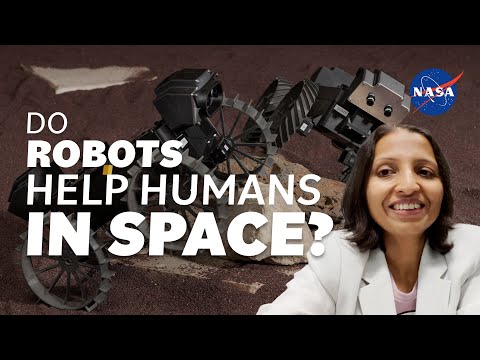
And that’s why NASA is making extensive use of robots. For instance, it is using Astrobee’s free-flying robots, named Bumble, Honey, and Queen, to assist crew members on the International Space Station (ISS). These cube-shaped robots assist astronauts with routine tasks, such as tracking supplies, operating systems, and documenting videos, while the astronauts focus on more crucial tasks.
But that’s not all. When integrated with AI, these machines can also process vast amounts of data in real time and make decisions autonomously, making them all the more powerful.
Ongoing innovations in the sector aim to take these capabilities even further. Recently, Chinese robotics firm Engine AI shared its ambitious plans to send the world’s first humanoid robot astronaut into space.
PM01 is the humanoid robot that’ll be sent into space. This lightweight, open-source intelligent humanoid platform merges human-like motion with advanced robotic intelligence. It has a bionic structure mimicking human movement and a highly interactive core display, in addition to ultra-fast motion response, high-precision environmental sensors, and autonomous decision-making capabilities. To manage complex perception, motion control, and real-time workloads, its dual-chip architecture combines an NVIDIA Jetson Orin module with an Intel N97 CPU to deliver high-performance computing.
So, as robots become more resilient, adaptable, and autonomous, they’ll be able to take on high-risk tasks such as external maintenance of space stations and long-term monitoring tasks that expose astronauts to significant danger.
The future of space exploration is clearly heading toward greater automation. Instead of placing astronauts in harm’s way, missions will simply replace them with networks of intelligent robots that can work collaboratively across vast distances.
Now, let’s take a look at how this transformation is taking place in practice through two key developments: autonomous robotics to explore underground lava tubes on the Moon and Mars, and AI-generated paths for rovers to travel safely across Martian terrain.
- Robotic Explorers: Autonomous robots and AI are becoming the primary explorers in space, capable of enduring extreme conditions and operating continuously in environments too dangerous for humans.
- AI-Driven Navigation: NASA’s Perseverance rover completed the first AI-planned drives on Mars, using generative AI to analyze terrain and plot safe routes without human intervention.
- Underground Exploration: Collaborative robot teams are being developed to autonomously map and explore lava tubes on the Moon and Mars, which could serve as future human habitats.
Mapping & Navigating Extraterrestrial Lava Tubes with Robots
It’s been close to two decades since pits were first discovered on the Moon and over half a century since the detection of massive lava tubes on Mars. These gargantuan caves are large enough to house towns.
Created by volcanic activity, these lava tubes are also found on Earth, including Iceland, Hawaii, Sicily, Australia, and the Galapagos Islands.
While these tubes on Mars and the Moon show potential as future human bases, as they are safer than their surfaces by offering protection from cosmic rays, solar radiation, and frequent meteorite impacts, they aren’t easily accessible. The interior of these lava tunnels is extremely sharp, and the terrain is uneven, requiring detailed studies. But gathering more information about these underground structures is challenging.
The skylights, which are collapsed sections of tube ceilings, and the long, winding channels spotted in orbital imagery suggest large underground voids; however, images can’t reveal which tubes are suitable for habitats.

To address the challenges of rocky landscapes, limited entry points, and hazardous conditions, researchers from the Space Robotics Laboratory at the University of Malaga (UMA) unveiled a new mission concept that uses a trio of smart robots to autonomously explore these underground environments.
The robots are currently being tested in the volcanic caves of Lanzarote, Spain, with the team aiming to use them for future missions to the Moon.
Published in the scientific journal Science Robotics1, the concept is based on three different types of robots, viz. SherpaTT, LUVMI-X, and Coyote III rover, which work together autonomously to explore the harsh underground spaces of Mars and the Moon.
The team’s proposed mission has four stages. It starts with robots mapping cave entrances and generating a detailed elevation model. Then, a sensorized payload cube is deployed into the cave to collect initial measurements. A scout rover is then lowered through the entrance to start the final stage, which involves traversing harsh terrain, collecting data, and creating detailed 3D maps of the interior.
The real-world field test on the volcanic island of Lanzarote, conducted in early 2023, demonstrated that the team’s approach works as planned. The German Research Center for Artificial Intelligence (DFKI) led the trial, with contributions from the Spanish university, UMA, and the company, GMV.
The focus of the Space Robotics Laboratory at the UMA is on developing new technologies and methods to increase autonomy in space robotics, covering both orbital and planetary missions. The laboratory has been working closely with the European Space Agency to develop algorithms that help rovers plan routes and operate more independently.
The trial confirmed that the four-phase mission approach is technically feasibility, highlighting the potential of collaborative robotic systems for future planetary exploration.
AI-Driven Navigation Systems for Planetary Rovers
In another major development, NASA’s Perseverance rover, a car-sized robotic scientist that has been searching for signs of ancient microbial life and collecting samples for future return to Earth, completed the first AI-planned drive on the “Red Planet.”
So, instead of using routes planned by human operators, the Mars explorer made history by utilizing those organized by the AI.
To create routes, a vision-enabled AI first analyzed images and terrain data used by human rover planners to identify hazards such as rocks and sand ripples, and then planned a safe path across the Martian surface.
But before actually using the AI-generated paths, the routes were first tested in the six-wheeled rover’s virtual replica, where Perseverance successfully followed them, autonomously traveling hundreds of feet.
Led by NASA’s Jet Propulsion Laboratory, which oversees the rover’s daily operations, Perseverance has now completed the first drives on another planet, with waypoints planned by generative AI.
“This demonstration shows how far our capabilities have advanced and broadens how we will explore other worlds,” said NASA Administrator Jared Isaacman. “Autonomous technologies like this can help missions to operate more efficiently, respond to challenging terrain, and increase science return as distance from Earth grows. It’s a strong example of teams applying new technology carefully and responsibly in real operations.”
For the milestone demonstration in early December last year, engineers used vision-language models to analyze existing data from JPL’s surface mission dataset. By analyzing the same information and images that human planners use, the system identified waypoint locations for Perseverance to travel safely across difficult Martian terrain.
The achievement was a coordinated effort between JPL’s Rover Operations Center (ROC) and Anthropic’s Claude AI models.
“Imagine intelligent systems not only on the ground at Earth, but also in edge applications in our rovers, helicopters, drones, and other surface elements trained with the collective wisdom of our NASA engineers, scientists, and astronauts,” said Matt Wallace, manager of JPL’s Exploration Systems Office. “That is the game-changing technology we need to establish the infrastructure and systems required for a permanent human presence on the Moon and take the U.S. to Mars and beyond.”
With Mars being 140 million miles away from Earth, communication delays make it impossible to control the rover in real time.
For a long time, rover navigation has relied on humans who diligently study terrain data and then plan routes in advance. These paths are composed of waypoints spaced approximately every 100 meters to reduce the risk of the rover encountering hazards. Once completed, the plans are sent through NASA’s Deep Space Network (DSN) telecommunications infrastructure, and the rover then executes the instructions.
But during Perseverance’s drives on the 1,707th and 1,709th Martian days, this responsibility was delegated to generative AI. The system analyzed high-resolution orbital images acquired by the HiRISE camera on the nadir side of the MRO spacecraft, along with terrain-slope data from digital elevation models.
The information helped the AI identify boulder fields, bedrock, sand ripples, outcrops, and other important surface features. Then, the AI developed a continuous driving path with all necessary waypoints. According to Vandi Verma, a space roboticist at JPL and a member of the Perseverance engineering team:
“The fundamental elements of generative AI are showing a lot of promise in streamlining the pillars of autonomous navigation for off-planet driving: perception (seeing the rocks and ripples), localization (knowing where we are), and planning and control (deciding and executing the safest path).”
These instructions were run through JPL’s digital twin (the virtual replica of the rover), which checked over 500,000 telemetry variables to ensure the plan would work safely with Perseverance’s flight software.
Using this AI-generated plan, NASA’s Perseverance traveled 210 meters on Dec. 8 and 246 meters on Dec. 10.
“We are moving towards a day where generative AI and other smart tools will help our surface rovers handle kilometer-scale drives while minimizing operator workload, and flag interesting surface features for our science team by scouring huge volumes of rover images.”
– Verma
Robotics and AI in Space Exploration
| Technology Component | How It Works | Role in Exploration | Expected Benefit |
|---|---|---|---|
| Autonomous Rovers | AI-powered vehicles navigate terrain using sensors and onboard processing. | Primary surface exploration on Mars and the Moon. | Reduced reliance on Earth-based commands. |
| AI-Planned Navigation | Vision-language models analyze terrain data to plot safe waypoints. | Replaces human-planned routes for rovers. | Faster decision-making across vast distances. |
| Collaborative Robot Teams | Multiple robots work together to map and explore environments. | Explores lava tubes and underground structures. | Comprehensive data collection in hazardous areas. |
| Humanoid Robots | Bionic structures mimic human movement with autonomous decision-making. | Performs tasks designed for human astronauts. | Handles high-risk maintenance and repairs. |
| Free-Flying Assistants | Cube-shaped robots navigate spacecraft interiors autonomously. | Assists astronauts on the ISS with routine tasks. | Frees crew for higher-priority work. |
Investing in Autonomous Space Exploration
In the world of autonomous space exploration, Intuitive Machines, Inc. (LUNR ) stands out as one of the few public companies actually building autonomous systems operating on another celestial body.
Besides developing self-driving vehicles for space that operate with minimal human intervention, Intuitive Machines has strong NASA integration, especially with the Artemis program. It is actually the first private company to soft-land a spacecraft, named Odysseus, on the Moon.
The space technology, infrastructure, and services company provides space products and services to enable sustained robotic and human exploration of the Moon, Mars, and beyond.
Services offered by Intuitive Machines include data transmission, delivery, and infrastructure-as-a-service.
Through its four business units, Orbital Services, Lunar Access Services, Lunar Data Services, and Space Products and Infrastructure, the company aims to enable access to the Moon in order to advance humanity.
Intuitive Machines is a relatively young company, founded in 2013, but it has already completed four NASA lunar missions.
That has been thanks to CEO and President Steve Altemus, who worked for NASA in the human spaceflight division. It was after leaving NASA that he co-founded Intuitive Machines, which was awarded one of TIME’s 100 Most Influential Companies of 2024. In an interview with TIME, Altemus revealed that “about 75% to 80% of our business is with the U.S. government.”
(LUNR )
With a market cap of $3.6 billion, LUNR shares are currently trading at $17.50, up 9% YTD and 123.64% in the past year. It has an EPS (TTM) of -2.11 and a P/E (TTM) of -8.40.
While its Q4 2025 results will be announced later this month, the company’s 3Q25 results show a net loss of $10 million. Its adjusted EBITDA was negative $13.2 million, indicating ongoing financial challenges, though it was an improvement of $12.2 million from the prior quarter.
The company had a backlog of $235.9 million at the end of Q3 2025 and a cash balance of $622 million.
Notably, the company acquired Lanteris Space Systems for $800 million, which includes $450 million in cash and $350 million in LUNR Class A common stock. Over the last 65 years, Lanteris has delivered more than 300 spacecraft and maintains 99.99% on-orbit availability.
The acquisition is projected to bring Intuitive Machines’ revenue to over $850 million and backlog to $920 million. The move is also expected to boost the company’s capabilities in communications, navigation, and space data networking services for civil, commercial, and defense markets.
With the acquisition, “Intuitive Machines is positioned to become the next-generation space prime,” said CEO Altemus at the 3Q25 earnings call in Nov. 2025.
The transaction, he noted, represents a path forward in the company’s evolution from a proven space infrastructure company to a vertically integrated space prime provider of choice, serving national security, civil, and commercial customers across ground, Earth orbit, and beyond.
“This acquisition marks a defining moment in the evolution of Intuitive Machines,” said Altemus. “We previously proved our ability to operate on the Moon. With Lanteris, we add flight-proven manufacturing at scale. Together, these strengths transform Intuitive Machines into a multi-domain, end-to-end solutions provider that can build spacecraft, connect resilient communications and navigation networks, and operate systems across LEO, MEO, GEO and cislunar space.”
The acquisition was completed earlier this year, strengthening the company’s ability to service not just NASA’s Artemis and Lunar Terrain Vehicle initiatives, but also future Mars telecommunications missions and the Golden Dome and Space Development Agency layered architectures.
In addition to finalizing the Lanteris acquisition, the company also announced a $175 million strategic equity investment to support revenue expansion and advance communications and data processing networks. It is also planning to invest in establishing an internet-independent solar system.
Additionally, it is engaging strategic partners to align space-based data centers with emerging enterprise demand. At the same time, it is anticipating receiving the next Commercial Lunar Payload Services award and NASA’s Lunar Terrain Vehicle Services.
Its wholly owned subsidiary, Lanteris Space Systems, was selected by L3Harris Technologies this month to design and build 18 advanced spacecraft platforms to help the Space Development Agency’s (SDA) mission to deliver real-time tracking of advanced missile threats, including hypersonic and ballistic systems.
Investor Takeaways
- Pioneering Lunar Access: Intuitive Machines became the first private company to soft-land a spacecraft on the Moon and has already completed four NASA lunar missions, making it a frontrunner in autonomous space exploration.
- Strategic Acquisition: The $800 million Lanteris deal brings 65 years of spacecraft manufacturing experience and over 300 delivered spacecraft, turning Intuitive Machines into a vertically integrated space prime across civil, commercial, and defense sectors.
- Growth Trajectory: Post-acquisition revenue is expected to exceed $850 million, with a $920 million backlog and $622 million in cash, supporting expansion into lunar infrastructure, Mars telecommunications, and national security contracts.
Latest Intuitive Machines, Inc. (LUNR) Stock News and Developments
Conclusion
Space exploration is going through a profound transformation. Once dependent almost entirely on human intelligence, endurance, and risk, it is now being reshaped by autonomous technologies that are capable of exploring farther, deeper, and more safely than ever before.
From robotic systems investigating hidden lava tubes to AI-guided rovers navigating distant planets, these advancements are expanding both the scope and efficiency of exploration.
As innovation in the sector continues, the human role will also evolve. Instead of being direct explorers, we will be designers, supervisors, and beneficiaries of intelligent systems operating across the solar system. More importantly, the shift from human explorers to robotics and AI minimizes risk while accelerating discovery and allowing for sustained presence on the Moon, Mars, and beyond.
References
1. Domínguez, R., Pérez-Del-Pulgar, C., Paz-Delgado, G. J., Polisano, F., Babel, J., Germa, T., Dragomir, I., Ciarletti, V., Berthet, A.-C., Danter, L. C., & Kirchner, F. (2025). Cooperative robotic exploration of a planetary skylight surface and lava cave. Science Robotics, 10(105), eadj9699. https://doi.org/10.1126/scirobotics.adj9699



