

Aerospace
Laser Air Defense: How Iron Beam Changes Drone Warfare

Securities.io maintains rigorous editorial standards and may receive compensation from reviewed links. We are not a registered investment adviser and this is not investment advice. Please view our affiliate disclosure.

Iron Beam, the world’s first laser air defense system, has officially entered service.
The system was developed by Rafael Advanced Defense Systems, a major Israeli state-owned defense technology company known for developing the renowned Iron Dome and Spike missiles.
Now, it has successfully built an operational high-power laser air-defense system to counter drones of various sizes, artillery, and small-caliber mortars. This marks the beginning of the era of high-energy laser defense, said Rafael Chairman Dr. Yuval Steinitz.
Iron Beam is a directed-energy system that uses high-energy solid-state lasers to intercept aerial threats, such as drones, at short range at a fraction of the cost of traditional interceptors.
Rather than launching a missile, the system points a highly concentrated beam of light at its target and burns its structure, damages internal components, or causes an explosion. For target detection and tracking, it connects to existing radars and command centers, enabling the laser beam to be aimed with high precision.
[Diagram of Iron Beam laser defense system operational concept]
According to Rafael, Iron Beam engages “at the speed of light,” costing virtually nothing for every interception while causing minimal collateral damage. The High Energy Laser Weapon System (HELWS) is said to quickly and effectively engage and neutralize threats from a range of hundreds of meters to several kilometers.
The system spent over a decade in development and testing, including adjustments, before going into operation. It was also integrated into the sensor network that Israel uses to monitor its airspace.
Rafael has now delivered the system to the Israel Defense Forces. Rather than replacing current missile defenses, it will be integrated into Israel’s air-defense network alongside Iron Dome, David’s Sling, and Arrow to respond to new aerial threats.
Defense Minister Israel Katz called this a “historic occasion,” noting that this is the first time a high-power laser interception system has reached operational maturity. This certainly marks a new chapter in the history of anti-aircraft warfare, with Katz stating that the system “changes the rules of the game” by fundamentally altering the threat calculus.
Now that the system has been delivered, they will move on to serial production, with Iron Beam seen as the start of a technological transformation in air defense.
Defense Ministry Director General Amir Baram expects it “to dramatically improve both our capability against complex threats and the cost-effectiveness equation between interception and threat.”
During testing, Iron Beam successfully shot down drones, rockets, mortar shells, and other airborne threats.
Its performance in tests, which mimicked real combat situations, points to the system becoming a “vital component” in Israel’s air-defense battle, where it will complement missile-based interceptors that were used heavily in recent conflicts, said Israel Air Force commander Maj. Gen. Tomer Bar.
Iron Beam will add yet another layer to Israel’s multi-layered defense architecture. Currently, it utilizes Iron Dome and David’s Sling for short- and medium-range threats, respectively. Meanwhile, Arrow 2 and 3 help it catch ballistic missiles at different altitudes.
While Israeli systems have intercepted a vast majority of rockets and missiles, officials say these systems aren’t as effective against small drones and low-flying targets. Their current system intercepts only about half of them.
Iron Beam is designed to fulfill that specific need by engaging slow, small, and low-flying threats that may otherwise evade radar-guided interceptors. Meanwhile, missile interceptors can focus on larger and more complex threats.
“In a security environment where threats are evolving rapidly, Rafael has developed an unprecedented technological capability, transforming a visionary concept into an operational reality.”
– Yoav Tourgeman, President and CEO, Rafael
A great advantage of the 100-kilowatt Iron Beam system is its low cost, with each laser shot using only a few cents of electricity. In contrast, interceptor missiles are extremely expensive, with each shot costing between $10,000 and $100,000.
Furthermore, the system does not use physical ammunition; a stable power source is all that it needs. As long as there’s energy available and sufficient cooling, the system offers “infinite ammunition,” which is particularly crucial in long or repeated attacks.
The company says the system neutralizes threats with pinpoint accuracy, resulting in limited collateral damage and protecting military forces and civilian populations. The system can further be integrated with a variety of platforms and systems.
While highly capable, the system isn’t without its limitations, with the primary one being its reduced effectiveness in bad weather. Poor visibility due to dust, smoke, clouds, rain, or fog can negatively affect the system’s performance.
A robust power source is also needed to provide sustained electrical power and continuous cooling to prevent component overheating, potentially limiting the system’s use in remote locations or areas lacking adequate electrical infrastructure.
Yet another constraint of this system is that it can only handle one target at a time, making it incapable of withstanding swarms.
Despite the limitations, Iron Beam’s evolution from development to actual operation represents a major milestone, where a high-powered laser will be used in real combat. This also marks a key step in a new generation of defenses shaped by the changing nature of modern warfare, driven by the widespread use of drones.
Swipe to scroll →
| Metric | Iron Beam (Laser) | Missile Interceptors |
|---|---|---|
| Cost per Intercept | Pennies (electricity) | $10,000–$100,000+ |
| Reaction Time | Speed of light | Seconds |
| Weather Sensitivity | High | Low |
| Ammunition Limits | Effectively infinite | Finite stockpiles |
| Swarm Defense | Limited (single-target) | Strong (multi-target) |
The Drone Revolution & the Countermove

Unmanned Aerial Vehicles (UAVs), commonly known as drones, have become one of the key defining technologies of today’s military operations.
Unlike traditional aircraft, which need to be piloted by a human, drones can perform surveillance, reconnaissance, and targeted strikes without risking pilots’ lives. They also allow for constant monitoring, rapid response, and precision strikes that were previously far too costly, dangerous, or even impossible.
Thanks to their unique tactical advantages and enhanced operational efficiency, drone deployment, which ranges from tactical battlefield support to long-term missions miles away from home bases, has dramatically altered modern warfare.
But while modern UAV technology is seeing rapid advancement and adoption not just in the military but also in civilian life, drones aren’t a new development; they’ve been around for about a century.
Early drone experiments actually date back to World War I, when the earliest remotely controlled aircraft were developed for target practice or explosive delivery. Then, during World War II, both sides explored remote aerial platforms for surveillance and combat roles. These drones, however, had both limited range and capability.
The real transformation began in the late 20th and early 21st centuries, when more advanced systems shifted UAVs from mere observation tools to lethal precision-strike platforms.
Over time, technological developments made it possible not only to gather intelligence in real time but also to conduct highly precise attacks without using large manned aircraft or putting pilots at risk.
Some of the most prominent technological advancements that helped achieve this include improved propulsion systems to increase flight duration and range, the miniaturization of sensors and cameras for high-definition, real-time data transmission, and fiber-optic-guided drones to resist jamming.
Automation and artificial intelligence (AI), meanwhile, are providing these flying robots the ability to navigate complex environments with little or no human input at all.
Drone swarms are further enabling broad-area coverage or overwhelming enemy defenses. And this is why both state and non-state actors are increasingly using a large number of inexpensive drones.
Modern conflicts, particularly in Ukraine and the Middle East, are clear examples of how drones are being utilized as central elements of military strategy.
Colonel Vadym Sukharevskyi, head of Ukraine’s Unmanned Systems Forces, recently stated that, with thousands of unmanned ground vehicles operating on the front lines, fewer soldiers are needed to enter dangerous areas for logistics or combat.
“If it wasn’t for drones, everything would be a lot worse. Drones are the things which allow us to give an asymmetrical response (when) the enemy is larger, stronger and on the attack.”
– Col. Sukharevskyi told Reuters
But while drones offer the advantages of reduced risk, cost efficiency, precise strike capabilities, and scalability, they have limitations in endurance, payload capacity, and vulnerability to cyberattacks.
Not to mention, as drones become a key part of tactical strategy, companies and countries are now developing anti-drone technology.
For instance, late last year, European leaders agreed to build a ‘drone wall’ to counter increasing drone threats, primarily from Russia.
Just last week, Poland’s deputy defense minister, Cezary Tomczyk, shared plans for new anti-drone fortifications along its eastern borders within two years. The project is expected to cost more than €2 billion (£1.75 bn). The new air defence systems would involve different layers of defence, including drone-jamming systems, missiles, machine guns, and cannon.
As adoption grows, the global anti-drone market is rapidly expanding, projected to surpass $12 billion by 2032, with a CAGR of 23.55%.
Anti-drone, or counter-UAS (Unmanned Aircraft Systems), technologies employ a layered approach to detect and mitigate drones.
This includes radar, which sends out a signal and uses the reflection from an object to pinpoint its position. While good for long-range and continuous tracking, they are better suited to large objects.
Then there’s Radio Frequency (RF), which connects a drone’s receivers and transmitters. So, RF Analysers are used to detect communication between a drone and its controller, using antennas that receive radio waves and a processor to analyse the RF spectrum. RF jammers, meanwhile, transmit strong electromagnetic noise to disrupt the signal between the drone and its controller.
To effectively stop a drone within its range, High Power Microwave (HPM) devices are also used. They generate an Electromagnetic Pulse (EMP) that interferes with radio links, disrupting and potentially even destroying the circuitry inside drones.
When it comes to sensors, optical sensors gather both visible and infrared light, as well as thermal radiation, to provide visual data for UAVs; however, weather can affect their capabilities. Acoustic sensors use microphones to detect drone sound in their near field, but are adversely affected by noise pollution.
High-energy lasers offer yet another powerful solution. They generate a highly focused beam that destroys the drone’s structure and electronics. In the US, companies like Raytheon and Lockheed Martin are developing these systems. These high-energy laser systems use concentrated photon energy to defeat drones, rockets, artillery, and mortars.
Other effective counter-drone technologies include GNSS/GPS spoofing to disrupt a drone’s navigation, cyber takeover to seize control or force a landing, geofencing to trigger auto-land or return-to-home functions, and kinetic projectiles to physically destroy drones.
Click here for a list of top drones and drone warfare stocks.
Investing in Counter-Drone & Directed-Energy Defense
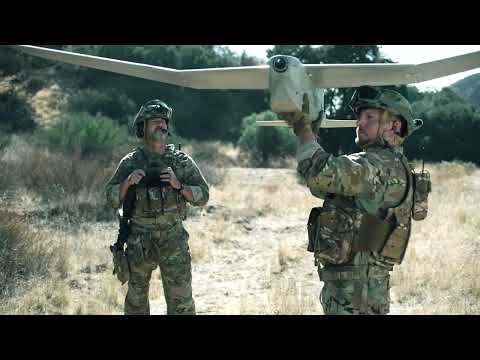
Now, if we look at a prominent anti-drone tech developer, AeroVironment (AVAV -1.09%) stands out for its innovative products, defense contracts, and strategic acquisitions, which are helping it expand its role in this growing sector.
The defense technology provider is known for delivering integrated capabilities across land, sea, air, space, and cyber. It develops autonomous, precision-strike systems and counter-UAS technologies used by the U.S. Department of Defense and allied militaries.
Its portfolio includes detection and defense solutions that help neutralize hostile drones and autonomous threats.
AeroVironment primarily operates through two key segments: the Autonomous Systems (AxS) segment, whose focus is on intelligent robotic systems, including UAS and ground robot systems, and the Space, Cyber, and Directed Energy (SCDE) segment, which provides space- and ground-based platforms, directed energy systems, and cyber capabilities.
With a market cap of $12 billion, the company’s shares are currently trading at $242, up 57.18% in the past year. It has an EPS (TTM) of -1.25 and a P/E (TTM) of -193.17.
AeroVironment, Inc. (AVAV -1.09%)
As for AeroVironment’s financial position, the company reported an increase of 151% YoY in revenue to $472.5 million for the fiscal second quarter ended Nov. 1, 2025, due to both higher product sales and service revenue. BlueHalo contributed $245.1 million in revenue this quarter.
AeroVironment completed the acquisition of BlueHalo last May for $4.1 billion. With BlueHalo’s expertise in directed-energy and counter-drone defense systems, AeroVironment aims to enhance its counter-UAS technology stack significantly. BlueHalo is also known for successfully operating field-directed energy (DE) laser weapon systems (LWS) with its LOCUST LWS. Last year, it delivered its 1000th system, with its Titan and Titan-SV systems.
In terms of segment, AxS recorded $301.6 million in revenue, and SCDE recorded $170.9 million.
During the last quarter, AeroVironment reported gross margin of $104.1 million, net loss of $(17.1) million, or $(0.34) per diluted share, and non-GAAP adjusted EBITDA of $45.0 million. Its funded backlog meanwhile reached $1.1 billion.
Talking about the “record” results, which include all-time high bookings and long-term contract wins, CEO Wahid Nawabi said, “AV is operating from a position of strength.”
“While we are pleased with our results for the quarter, we are just getting started. We are confident that our unmatched innovation, strategic partnerships and agility to expand our manufacturing capacity enable us to address evolving defense needs and lead the generational shift in defense over the longer-term.”
– Wahid Nawabi, CEO
Given the surge in demand for drone and counter-drone capabilities, AeroVironment stands to benefit from large, recurring government defense contracts. Just last month, the US Army awarded the company a $874 million five-year contract to support foreign military sales of UAS and counter-drone technology.
The contract covers several of its flagship platforms, including the JUMP 20 VTOL which provides multi-sensor intelligence, surveillance, and reconnaissance (ISR), the P550, which is the electric VTOL system offering payload swapping and target and strike options, the Puma, which supports both land and maritime missions, and the hand-launched small UAS, Raven, which provides infrared imagery or video streaming.
“AV’s platforms are deployed around the world, supporting the most important missions for our national security and the protection of our allies,” said Jason Hendrix, small uncrewed systems vice president for AeroVironment. “We’re continually looping frontline feedback into our platforms and scaling production to meet the mission, ensuring that our warfighters have the tools and technologies they need to stay ahead of evolving threats.”
Last year, AeroVironment also announced a strategic partnership with national security firm SNC to create a defense system to support Golden Dome. The solutions could include kinetic energy, directed energy, radio frequency technology, active and passive sensors, and cyber solutions.
Nawabi said at the time that they could produce “novel and affordable” defensive systems to protect critical U.S. infrastructure.
Why Anti-Drone Lasers Are Reshaping Modern Warfare
Drones have proliferated on the battlefield, altering modern warfare.
These flying robots offer significant benefits such as cost efficiency, ultra-high precision, and flexibility, which means both state and non-state actors are making extensive use of them. But as these systems become cheaper, smarter, and more widespread, the focus has turned to making air-defense architectures resilient against them.
Israel’s Iron Beam is one example of how militaries are adapting, shifting from expensive, finite missile interceptors to scalable, low-cost, energy-based solutions, though limitations such as weather dependence and swarm saturation still need to be addressed.
But one thing is clear: the greater the strategic importance of drones, the more critical anti-drone technology becomes, and together they are setting the next chapter of warfare.
Click here for a list of top drone companies leading the aerial revolution.



