
Artificial Intelligence
AI and Robotics Create Two Different Economic Futures

 Add Securities.io to your preferred sources on Google

The emergence of more and more competent AI has created massive, and justified, anxiety among many workers about being replaced by automation. This pressure is especially present in service jobs and white-collar jobs that have so far been mostly protected from pressure from automation (compared to manufacturing, for example).
Meanwhile, robotics, also sometimes merged with the concept of “physical AI”, is hailed as the next step in AI deployment.
But in practice, the effect on productivity and the job market of both “software AI” and “physical AI”, including industrial robots, could be very different from each other, and it might not be software AI that is the worst at creating inequalities.
A new study by researchers at the University of São Paulo in Brazil and the Vienna University of Economics and Business in Austria modeled these differences across 52 countries.
They found that while both robots and AI boost economic growth, robots raise wage inequality while AI reduces it. They published their findings in World Development1, under the title “The skill premium across countries in the era of industrial robots and artificial intelligence”.
Automation, AI, Robotics & Jobs
Just Another Step In Automation
Often forgotten by most people, the world has already undergone a first wave of AI/robotic revolution, with the number of operative industrial robots increasing by 689% worldwide between 1993 and 2023.
And a new wave of automation is about to hit the economy, as private investment in artificial intelligence (AI) increased by 1159% between 2013 and 2023 (and even more after that).
Historically, automation by means of industrial robots predominantly replaced low-skilled workers in routine tasks. This raised the “skill premium”, or the wage differential between high-skilled and low-skilled workers, leading to increased inequality.
So measuring this skill premium for ongoing AI deployment and new robotics technology is important to understand their effects on the economy at large and the job market & wages inequality in particular.
While robots can replace jobs, especially low-skilled jobs, they can also have wider effects on the workforce. For example, robot adoption in Brazil increased the ratio of female and skilled workers as compared to other parts of the workforce.
Meanwhile, another study about 453 college-educated professionals showed that access to ChatGPT leads to a productivity boost that is more pronounced among low-skilled workers than among high-skilled workers.
So ultimately, the effect of automation, be it robots or AI, is largely determined by which workers it replaces, and which workers it empowers.
Cross-Country Dataset
The researchers gathered data from 52 countries, of which 34 are considered high-income, 12 are upper-middle income, and 6 are lower-middle income. The sample covered data from 2019.
Low-income countries were not included, as industrial robot use and AI investment in these countries tend to be very low. Various sources were aggregated for the study.
The traditional physical capital stock was obtained from the International Monetary Fund (2025) database.
The data on low-skilled and high-skilled labor were obtained from the International Labour Organization (2025).
The stock of industrial robots was obtained from the International Federation of Robotics (2023), and the average price per robot was adjusted by purchasing power parity (PPP).
Investment in AI technologies as a proxy for AI deployment, with data from the Center for Security and Emerging Technology and the U.S. Bureau of Labor Statistics, processed by the platform Our World in Data.
Skill Premium Over The World
The average skill premium is 1.44, close to that observed in Belgium (BEL). The lowest estimated value is 0.68, close to those observed in Russia (RUS) and Iceland (ISL), while the highest value, 4.28, is observed in Japan (JPN).
The bigger picture points to the fact that countries with a greater stock of robots tend to have a higher skill premium. However, the link between the skill premium and AI investment is not significant.

Source: World Development
When analyzing the skill premium more deeply, the researchers found that:
- Economies with higher GDP tend to have a larger wage gap between high- and low-skilled workers.
- High-income countries generally have a greater share of high-skilled workers and a lower skill premium, while middle-income economies show greater variability.
- Countries with higher productivity (measured according to total factor productivity (TFP) tend to have a smaller wage gap between high-skilled and low-skilled workers.

Source: World Development
Another insight from these data, albeit an expected one, is that GDP and the stock of robots are linked positively. The same holds for GDP and AI investment.

Source: World Development
While the details depend on each country’s individual economic situation and the high/low skill mix of its workforce, on average, a 1% increase in the robot stock per worker is associated with an increase in GDP per worker by 0.29%. Less developed countries, with a lower stock of robots per worker, such as Pakistan (PAK), Peru (PER), Egypt (EGY), and Colombia (COL), benefit the most from an increase in robot use.

Source: World Development
Meanwhile, the increase in GDP per worker for each 1% increase in AI investment was almost insignificant, just 0.03%.
In terms of inequality, a 1% increase in the robot stock per worker is associated with an increase in the skill premium by 0.23% on average. Meanwhile, a 1% rise in AI investment is associated with a 0.018% reduction in the skill premium, showing that it seems that AI could be reducing inequality, especially in high-income countries.
| Technology Increase | Modeled Change in GDP Per Worker | Modeled Change in Skill Premium |
|---|---|---|
| 1% increase in robots per worker | +0.29% | +0.23% |
| 1% increase in AI investment per worker | +0.03% | -0.018% |
The Merging Of AI And Robotics?
In this study, robotics and AI are mostly considered as two entirely separate categories, as robots mostly mean industrial robots in settings like assembly lines.
However, in the near future, the next phase of automation will involve combining physical machines with AI systems that make workers and robots more capable.
Whether physical AI will preserve AI’s modeled inequality-reducing effect remains uncertain. Once AI is embedded inside machines that perform physical work, it could augment employees, replace them, or do both. The result will depend on which tasks are automated and whether workers are given new capabilities alongside the machines.
So the combined effect could be larger robotic deployment, all while reducing some of its pressure on wage inequality compared to the historical precedent.
So the hotly debated economic impact of automation will depend not only on how much companies invest, but on whether that investment substitutes for workers or expands what workers can accomplish.
Investing In Robotics And AI
NVIDIA Corporation
NVDA Price Chart
NVIDIA (NVDA ) is today no longer just a gaming graphics card maker, but the global leader in AI hardware, having adapted its pre-existing GPUs into new designs specifically made for AI compute workloads.
This has made it the prime beneficiary of the boom in investment in AI technology, and the world’s most valuable company. But NVIDIA is also evolving beyond just a compute hardware company.
The company itself has identified “physical AI”, or the deployment of AI in robotic bodies everywhere, as the next step in IT technology, and taken strong steps to solidify its leadership in this field as well.
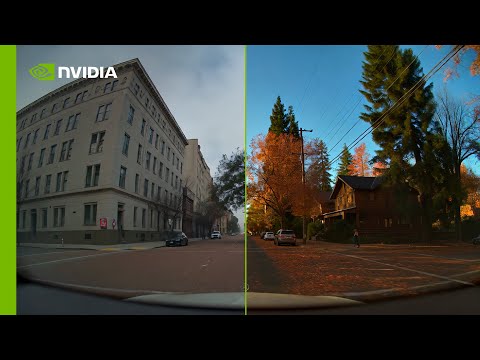
It starts with NVIDIA’s Cosmos framework, a “world foundation model” that uses neural networks to model not just text or numbers, but the real world with all its messiness and complex physics.
Cosmos is “a platform with open world foundation models (WFMs), guardrails, and data processing libraries to accelerate the development of physical AI for autonomous vehicles (AVs), robots, and video analytics AI agents.”
Several robotics and autonomous vehicles companies are already using Cosmos to accelerate the development of their physical AI.

Source: NVIDIA
The company sees such a model as the mark that 2026 is the ChatGPT Moment for Robotics, where the field moves from curiosity or research projects to exploding numbers of applications.
Then NVIDIA developed the Isaac-GROOT & IsaacLab Arena for training and deploying AI-powered robots. Issac is a vision-language-action model built specifically for humanoid robots, offering full-body control and contextual understanding.
Importantly, the Isaac model is relatively low in computing requirements, with a $3,500 NVIDIA robotics chip module, the Jetson AGX Thor, sufficient to run Isaac, bringing the compute hardware cost of a humanoid robot to a very small part of its total price. It also limits the power demand, which is important to ensure good autonomy of the robots using it.
NVIDIA® Jetson Thor™ series modules give you the ultimate platform for physical AI and robotics, delivering up to 2070 FP4 TFLOPS of AI compute and 128 GB of memory with power configurable between 40 W and 130 W. They deliver over 7.5x higher AI compute than NVIDIA AGX Orin™, with 3.5x better energy efficiency.
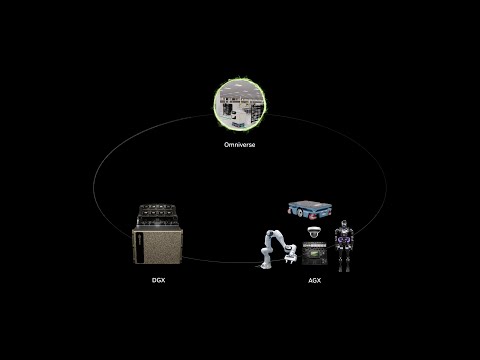
For industrial applications, there is NVIDIA’s Omniverse, a collection of libraries and microservices for developing physical AI applications such as industrial digital twins and robotics simulation.
Lastly, to coordinate all sorts of physical AI tools, robots, and tasks, there is NVIDIA OSMO, an “orchestrator” software, purpose-built for physical AI. It allows users to coordinate and combine multiple AI tools, including Isaac and Cosmos, at all stages of physical AI development: data generation, training, simulation, evaluation, and hardware-in-the-loop testing.
This diversity makes NVIDIA one of the best bets on the expansion of both AI and robotics into the new merged field of physical AI.
It puts it in a better spot than legacy industrial robot manufacturers, which can struggle to adapt to other applications. A good example of this is that even the best ones, like ABB Robotics, are now partnering with NVIDIA for the next generation of industrial robots.
“New RobotStudio HyperReality, available second half of 2026, will fundamentally change how quickly and reliably manufacturers can scale production, reducing costs by up to 40% and accelerating time-to-market by 50%.”

Altogether, this gives NVIDIA an enviable competitive position in navigating the shift to physical AI.
However, potential investors will also need to take into consideration other factors, notably NVIDIA’s already enormous market capitalization, before deciding if the potential growth in AI and robotics justifies the multiples at which the company was valued by markets in 2026.
(You can also read more on these topics in our complete investment reports on Physical AI and on Nvidia itself)
Latest NVIDIA Corporation (NVDA) Stock News and Developments
Study Referenced
1. Marcos J. Ribeiro and Klaus Prettner. The skill premium across countries in the era of industrial robots and artificial intelligence. World Development. Volume 208, December 2026, 107538. https://doi.org/10.1016/j.worlddev.2026.107538



