
Agriculture
Why Agriculture Could Be AI’s Biggest Productivity Winner

 Add Securities.io to your preferred sources on Google

When discussing AI’s impact on the economy, public discussion tends to focus on IT-related jobs (programming, digital artists, etc.), white-collar professions (lawyers, doctors), or scientific research. However, this might be missing important applications that will have transformative effects on entire industries.
In general, AI will likely improve productivity the most where it can directly optimize physical inputs, replace humans for repetitive decisions, and optimize resource allocation. It will also thrive in environments complex enough not to have been automated yet, but not so complex that a higher level of human intelligence will still be required.
A recent study by two researchers at Korea Advanced Institute of Science and Technology and the Hana Financial Group (South Korea) has investigated the relationship between AI penetration and industry-level performance.
It found that while AI significantly affects industry-level value-added performance in the production, manufacturing, and transport industries, it had the strongest positive impact on agriculture.
They published their findings in the journal International Review of Economics & Finance1, under the title “Artificial intelligence and productivity gains: An empirical analysis of industry heterogeneity”.
AI & Productivity
AI By Industry
Since the public release of ChatGPT, AI is being adopted by multiple industries in the hope it can help materialize productivity gains and create a competitive advantage for early adopters.
However, it can be difficult to exactly measure the rate of adoption and its impact. Historically, a 10% increase in information and communication technology investment is associated with a 0.5–0.6% increase in productivity. But the jury is still out on what the final number will be with AI specifically.
So far, AI has mostly been deployed in service roles: real-time customer assistance, healthcare diagnostics and monitoring, etc.
For physical roles, the main applications have been in manufacturing, where AI-enabled smart factories support predictive maintenance and operational optimization, driving cost reductions and efficiency gains.
In traditional industries like chemicals and paper, AI adoption is a lot slower so far. This can be blamed on the absence of clear digital strategies, skill shortages, cultural resistance, low consumer trust, and regulatory uncertainty.
AI Productivity Dataset
The researchers gathered data from a panel of 103 countries over 2010–2019, excluding countries mostly because of insufficient data.
Data on gross value added (GVA) by type of economic activity were obtained from UN Data and used as the main variable to capture economic performance across sectors and countries.
Data for foreign direct investment, gross national expenditure, inflation, labor force participation, and trade were obtained from the World Development Indicators (WDI). They also gathered human rights index scores from Our World in Data.
Data on the number of AI-related startups were collected from Crunchbase, and showed that the peak of AI startup foundations in this data set was hit in 2017, overall showing a broad acceleration of AI-related entrepreneurial activity during the mid-2010s.

AI-Driven Productivity By Industry
The researchers found that AI had the strongest positive relationship with performance in agriculture, while the relationship in construction was not statistically significant.
Other industries where AI had a measurable impact were manufacturing, production, and transport.
(It should also be noted that the same analysis with data covering the 2019-2025 period would be interesting, considering the quick progress of AI technology)
A likely reason for the impact on agriculture is that it is already, to an extent, a heavily automated industry. Compared with a century ago, agriculture is substantially more mechanized, with tractors, automated irrigation, milking systems, and other equipment reducing the amount of manual labour required.
At the same time, many of these agricultural tasks fall into categories AIs can already handle: driving, spraying, weeding, etc.
Another factor is that agriculture has spent the last two decades moving to new methods, generating much more data and learning to act on it: multispectral satellite images, soil chemical composition, pesticide and herbicide optimization, equipment utilization, labor management, etc.
So AI arrived just at the right time to use these data and leverage them further into action through 2 mechanisms:
- Helping farmers better understand their data and use it efficiently.
- Directly helping on farms through computer vision, autonomous driving, weed identification, drones, and robotic systems.
Investor Takeaways
Many investment strategies today need to account for the upcoming effects of the AI revolution. In many cases, this means being wary of the potential damage AI can do to a specific activity or business model, but it can also drastically boost productivity. And apparently, nowhere is it more true than in agriculture.
This gives a good example of an emerging physical AI investment thesis, where deploying AI into real-world applications has a direct effect on the productivity of an entire economic sector.
This means that investors should expect the entire sector to become more productive, and potentially more profitable, at least for the sellers of AI systems adapted to this industry and machines able to bring AI thinking to the fields.
This sort of application requires a deep domain-specific expertise, as well as a solid distribution network already in contact with farmers. So it is likely going to benefit equipment manufacturers able to integrate AI into their machines and make them efficient in real-world conditions, particularly when those actions reduce expensive inputs.
Investing In Agriculture AI
Deere & Company
DE Price Chart
John Deere is best known as the manufacturer of the iconic green and yellow tractors, combines, and other agricultural machinery.
Less known to the general public, John Deere is also a technology company, with a long history of investing in sensors and software, as well as running pilot programs to deploy AI, robotics, drones, and machine vision in agriculture.
Started almost two centuries ago (in 1837), the company has actually always pushed forward the latest innovation in agriculture, from the initial improved plow blade to the first tractors. Recently, the company has been ramping up its R&D expenditures with a focus on a few technological axes: sensors, connectivity, autonomy, and alternative energy.

Source: John Deere
For example, the See & Spray Ultimate system, launched in 2021, uses 36 cameras to distinguish crop plants from weeds and optimize herbicide use through computer vision and machine learning.
Or the John Deere Operations Center, a digital twin of a farm, allowing dealers to perform remote diagnostics, programming, and over-the-air updates.

Source: John Deere
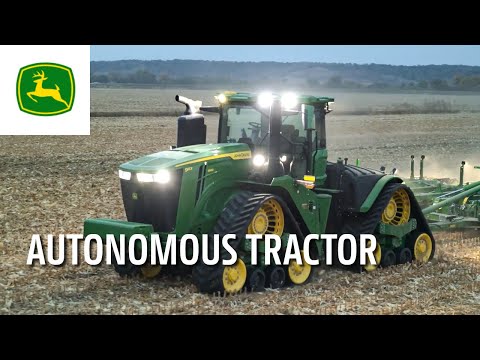
In the field of autonomy, John Deere is also working on making the automated combines in the science-fiction movie Interstellar a reality. John Deere launched in 2022 its first fully autonomous tractor, a driverless version of its 8R row crop tractor. It oriented itself thanks to GPS and six pairs of stereo cameras for 360-degree obstacle detection and navigation. This launch followed John Deere’s acquisition of startup Bear Flag Robotics for $250M.
Lastly, the company is also pushing electrification, notably by launching an electric excavator that uses a Kreisel battery, an Austrian company in which Deere acquired a majority stake in 2022. Deere is also working to develop an ethanol-burning 9-liter engine to use biofuel for heavy machinery like combines.
As AI and machine vision become ever more efficient and intelligent, companies like John Deere will be able to improve the efficiency of their camera- and sensor-heavy tractors even more.
John Deere’s advantage over generic AI companies is its dealership network and deep farming experience, which help it deploy this technology in useful, cost-efficient applications by leveraging existing relationships with farmers.
Still, investors should also remember that Deere remains a cyclical equipment manufacturer. AI adoption can strengthen its competitive position and increase technology-related revenues like software subscriptions, but farm income, crop prices, interest rates, and machinery replacement cycles will continue to influence results.
It is also possible that smaller, more nimble startups or overseas competition could use the ongoing AI & robotic revolution brewing in agriculture to challenge the position of well-established incumbents like John Deere.
Latest Deere & Company (DE) Stock News and Developments
Study Referenced
1. Eunjung Park and Sangyoon Yi. Artificial intelligence and productivity gains: An empirical analysis of industry heterogeneity. International Review of Economics & Finance. 22 August 2026. Article: 105726. 10.1016/j.iref.2026.105726



