
Artificial Intelligence
Can AI Bitcoin Trading Beat Buy and Hold?

 Add Securities.io to your preferred sources on Google

Key PointsLitecoin's 120-day model hit 79% accuracy yet returned only 8.4% annualized.
View more
- Litecoin's 120-day model hit 79% accuracy yet returned only 8.4% annualized.
- Bitcoin's 60-day model was right 56% of the time in 2024 but lost 8.1% annualized.
- Short horizons often beat buy-and-hold on risk-adjusted returns for Litecoin and ether.
For traders, including cryptocurrency traders, the ideal situation would be to be able to predict the future accurately enough. It is assumed that this would automatically generate consistent financial gains.
But this is not so simple in practice. For example, as Christopher Ailman, then chief investment officer of CalSTRS, put it, “Being right too early is indistinguishable from being wrong.” Timing can matter as much as accuracy, especially for traders using leverage.
Similarly, correctly predicting a decline in prices might not result in the same type of profit as predicting a rise in prices. Or accurately forecasting a small move will not have the same financial effect as accurately predicting a massive move.
A recent study by Wojciech Kuryłek, a researcher at the University of Warsaw in Poland, shows that these lessons from stock trading also apply to cryptocurrencies.
He found that in the 2024 backtest, a 120-day machine learning model correctly predicted Litecoin’s price direction 79% of the time and earned an annualized return of 8.4%. Meanwhile, the five-day model got only 53% right but earned 54.4% annualized.
He published his work in Computational Economics1 under the title “The Crypto Prediction Divergence: When Accuracy Doesn’t Equal Profit (DIVER ).”
Using AI For Financial Predictions
As machine learning and AI analysis are specialized in finding patterns in complex datasets, it makes sense that they can be applied to trading data.
This is an evolution of technical analysis, a long-established practice in the financial industry. In a survey of 692 fund managers in five countries, 87% gave technical analysis at least some weight, and 18% preferred it to other forms of analysis. The share who used it ranged from 68% to 94% across the five countries.
One more recent development has been the application of tree-based algorithms, in conjunction with technical indicators, to cryptocurrency prediction.
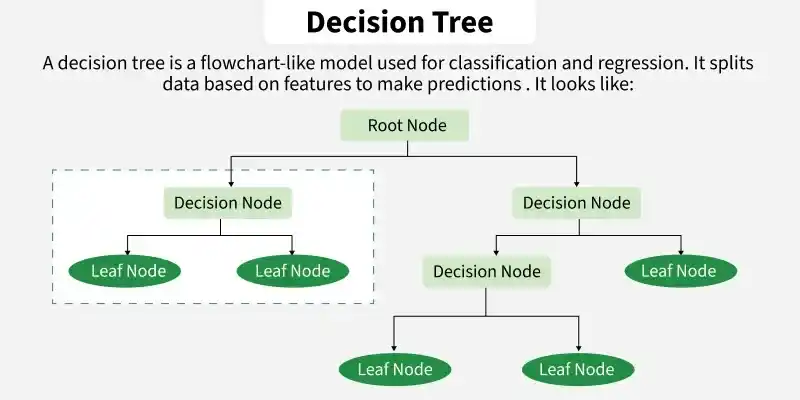
Source: GeeksforGeeks
The study used XGBoost (eXtreme Gradient Boosting), an open-source machine learning library that implements scalable, distributed gradient-boosted decision trees.
It covered four major cryptocurrencies over a seven-year timeframe, from 2018 to 2024. The cryptocurrencies analyzed were Bitcoin (BTC ) (BTC), ether (ETH), Litecoin (LTC ) (LTC), and XRP, using price data from the Bitstamp exchange supplied by LSEG.

Source: Computational Economics
Using XGBoost classifiers, the study evaluated 771 variables derived from technical indicators over prediction horizons ranging from 5 to 120 trading days.
The model was trained using two distinct five-year windows, one spanning 2018–2022 and one covering 2019–2023. The final two years of each window were used for model assessment and hyperparameter tuning. The trained models were then tested on 2023 and 2024, respectively.
The study investigated prediction intervals of 5, 10, 20, 60, and 120 trading days, matching the timeframes used by traders more than long-term investors.
Testing Trading
Can Machine Learning Predict Crypto Price Direction?
The study backtested trading strategies based on the machine learning algorithm’s predictions and evaluated how well they performed. Positions were closed after the forecast horizon, with an assumed trading cost of 0.1% each way.
“A long position is indicated when the predicted probability surpasses a predefined upper threshold, implying an expected price increase over the horizon (h), while a short position is suggested if the probability falls below a lower threshold, indicating a likely price decline.”
Performance was measured using both annualized returns and a risk-adjusted return metric, the Sharpe ratio.
One measure the study used was the area under the receiver operating characteristic curve (AUC). It measures how well the model ranked future price increases above future declines across different thresholds. An AUC of 0.80, for example, means that a randomly selected increase received a higher score than a randomly selected decline about 80% of the time.
At the 120-day horizon, Bitcoin and Litecoin had higher AUC scores than ether and XRP in both test years.
It was also the best horizon for distinguishing price increases from declines for both Bitcoin and Litecoin. In 2024, the more volatile of the two years, their 120-day AUC scores reached 0.92 and 0.90, respectively.

Source: Computational Economics
This pattern, however, was not universal. XRP’s AUC peaked at 60 days in 2023 and at 120 days in 2024. For ether, the highest 2024 score came at 60 days.
When measuring forecast accuracy directly, the pattern generally held for Bitcoin and Litecoin. The 120-day models got the direction right 81% and 79% of the time, respectively, in 2024.

Source: Computational Economics
Measuring Trading Profitability
Despite the more accurate predictions on some longer timeframes, this did not consistently translate into more profitable trading. The five-day horizon produced the highest annualized return for Bitcoin and Litecoin in both test years. For ether, the five-day strategy led in 2023 and the 20-day strategy led in 2024.

Source: Computational Economics
More of the strategies tested lost money in 2023, the less volatile of the two years.
But of course, returns need to be considered in relation to the risks taken. So measuring the risk-adjusted return is equally important.
Ether, Bitcoin, and Litecoin generally achieved their most favorable Sharpe ratios at the shorter horizons.

Source: Computational Economics
When analyzing the connection between accuracy and profitability, the author found that the more accurate models were generally more profitable on average. But this was still no guarantee. Bitcoin’s 60-day model got 56% of calls right in 2024 and lost 8.1% annualized.
In a separate backtest for 2021, Litecoin’s five-day strategy earned 105.4% annualized. XRP was an exception to the short-term pattern that year. Its 161.2% annualized return came at 120 days, while its five-day strategy lost 11.1%.
Trading Vs Holding
With most financial assets, there is the question of whether it is even worth taking the risk of trading, or whether holding steady is a better option. The study uses buy-and-hold as a benchmark and relates it to the weak form of the efficient market hypothesis:
“The buy-and-hold approach represents a passive investment philosophy that assumes markets efficiently incorporate all available historical information, rendering active trading strategies theoretically unable to generate systematic excess returns.”
In this study, the five-day strategy beat buying and holding Litecoin in both years. For ether, the same strategy beat holding in 2023 but fell short in 2024, returning 42.6% against 55.4% for holding.
It should, however, be noted that all four cryptocurrencies had positive buy-and-hold returns in both test years. Results might have been different over other periods.

Source: Computational Economics
When measuring risk-adjusted returns, Litecoin’s five- and 10-day models had higher Sharpe ratios than holding in both years. Bitcoin’s five-day model beat holding in 2023, but holding Bitcoin had a higher Sharpe ratio than any of the tested Bitcoin strategies in 2024.
For XRP, holding produced a higher Sharpe ratio than most of the trading strategies. The exception was the 20-day model in 2024, with a Sharpe ratio of 0.74 against 0.50 for holding.

Source: Computational Economics
AI vs Other Technical Analyses
Lastly, the study looks at other technical analysis options like MACD and RSI.
Both showed positive returns for Bitcoin and for ether during the 2023–2024 period.
Compared to machine learning, however, both underperformed the five-day strategies for ether and Litecoin in both years. Bitcoin was a more mixed case. The five-day model beat both indicators in 2023, but both indicators beat it in 2024.
Overall, while they offer simpler implementation and are easier to interpret, MACD and RSI were less profitable than the five-day machine learning model in most of the asset-year comparisons.

Source: Computational Economics
Investor Takeaways
Maybe the most important lesson from this study, one that carries beyond using AI in trading and crypto markets, is that accurate predictions are not always enough for traders to avoid losing money.
This is in large part because an accuracy score counts a correct call on a small move just as heavily as a correct call on a large one. But a wrong call on a large move can be much more costly. So being right often for small gains and wrong with big losses can destroy a trader’s returns.
From the point of view of AI models, this illustrates why accuracy alone can be a poor training objective for a trading strategy. A model that gives more weight to the size of a move might be worth testing.
Another possibility is that short-term horizons may capture brief but pronounced inefficiencies in cryptocurrency markets, generating larger profit opportunities when accurately anticipated.
Another interesting point is the possible impact of volatility. Some of the AI strategies were more profitable during the more volatile test periods. Kuryłek offers one possible explanation:
“Periods of heightened volatility tend to generate temporary market inefficiencies as investor sentiment shifts rapidly, providing XGBoost models with exploitable patterns that dissipate during stable market regimes.”
In any case, this study illustrates the importance of understanding the limits of specific trading tools. Even when a model gets the direction right more often than it gets it wrong, a buy-and-hold strategy can still come out ahead.
Investing In Cryptocurrency Trading
Coinbase Global
Coinbase Global, Inc. (COIN) Price Chart
As cryptocurrencies become more mainstream, more investors are gaining exposure to them or increasing their presence in cryptocurrency markets. The same is true as crypto projects multiply.
This can benefit companies like Coinbase, which are closely connected to cryptocurrency trading, asset prices, custody, and institutional participation.
Therefore, investing in crypto exchanges and technology platforms like Coinbase can be a way for investors to get exposure to the crypto market and to changes in trading volumes.
However, this does not mean that Coinbase will provide investors in its publicly traded stock the same kind of potential returns (and risks) that direct crypto investment can provide. Instead, it is an investment in crypto-market infrastructure, with Coinbase reporting $377 billion in assets on its platform as of September 30, 2026.
Today, besides Coinbase’s main app and crypto exchange, the company has a series of complementary offerings:
- Coinbase One, a premium membership service offering zero trading fees on eligible trades, boosted staking rewards, and partner deals. A spread still applies to simple trades, and fee waivers depend on the plan.
- Coinbase Advanced, for professional crypto traders.
- Coinbase Wallet, for self-custody of cryptocurrencies outside of exchanges, as well as supported NFTs.
- Coinbase Earn, through which eligible customers can stake supported cryptocurrencies to earn network rewards.
- Coinbase Card, a Visa debit card that can be used to spend cash or crypto at eligible merchants. U.S. cardholders can choose from rotating crypto reward offers.
- USDC, a stablecoin issued by Circle and available on Coinbase, is designed to track the U.S. dollar one-for-one.
As more and more advanced tools, including AI, get developed, they will complement existing crypto infrastructure. Now a more mature and dominant platform, Coinbase is well-positioned to capitalize on crypto becoming increasingly mainstream through the growing trends of Bitcoin ETFs, stablecoins, and stock tokenization.
(You can read more about Coinbase’s history, offerings, and investment potential in our dedicated report on the company.)
Bitcoin
Another way to get exposure to the Bitcoin network is, of course, direct ownership of Bitcoin.
To get started, you can read our guides on the topic:
- Investing in Bitcoin (BTC) – Everything You Need to Know
- 10 Reasons to Invest in Bitcoin
- What Is a Bitcoin ETF? How It Works and Why It Matters
Latest Coinbase (COIN) Stock News and Developments
Study Referenced
1 Wojciech Kuryłek. The Crypto Prediction Divergence: When Accuracy Doesn’t Equal Profit. Computational Economics. 17 November 2026. https://doi.org/10.1007/s10614-026-11467-9


