
Additive Manufacturing
What Is Holding Back 3D-Printed Construction?

 Add Securities.io to your preferred sources on Google
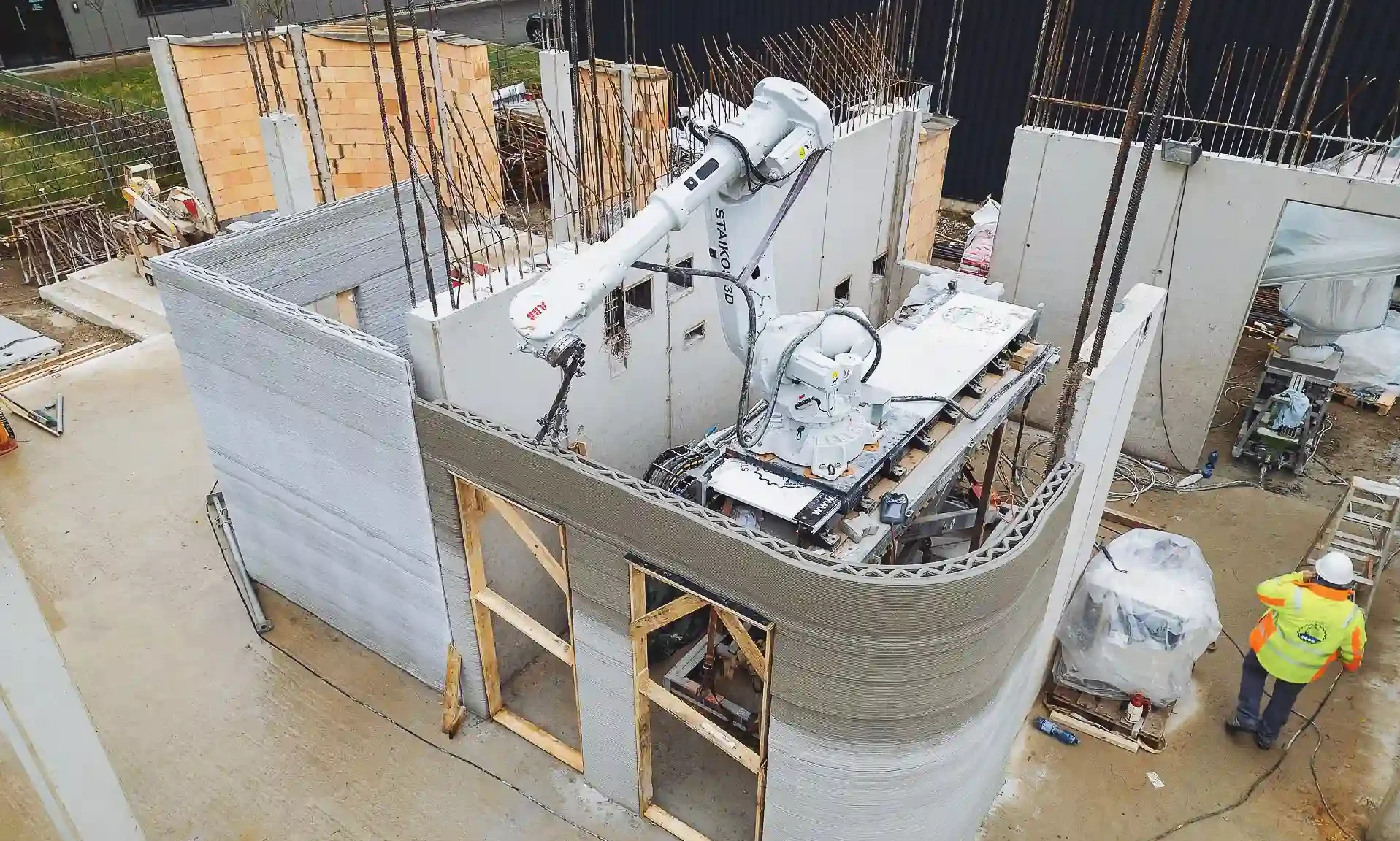
Recently, the idea emerged of using 3D printing principles to build houses, in a similar fashion to how mechanical parts are 3D-printed with plastic or metal. Instead of labor-intensive methods like bricklaying, an automated 3D printing machine can assemble concrete walls quickly.

Source: Cornell University
This has often been presented as the future of housing and construction. But in practice, 3D-printed buildings are still somewhat a curiosity and far from an emerging construction standard practice.
A new study by researchers at the British College of Applied Studies (Sri Lanka), Indian Institute of Science, University of Southern Queensland (Australia), and Northumbria University (UK) identified the remaining roadblock in broader adoption of this technology.
They found that advanced concretes specifically designed for 3D-printing are important, and that regulatory fragmentation is the single greatest impediment to scaled commercial deployment.
They published their findings in Next Materials1, under the title “3D printing in construction: A comprehensive review of materials, methods, applications, and SAFE performance criteria
3D Construction: From Prototype To Commercial-Scale
Until now, most reviews of the use of additive manufacturing (“3D printing”) in construction focused on materials or mechanical properties. But this neglects the broader habitability and safety characteristics that govern regulatory approval and occupant acceptance.
So a better evaluation is to use the SAFE performance criteria framework:
- (S) Structural Performance Indicators.
- (A) Acoustics.
- (F) Fire resistance.
- (E) Energy efficiency.
“This multi-hazard perspective aligns with the direction of emerging ISO, EN, and ASTM standards for novel construction technologies”

Source: Next Materials
To do so, the researchers compiled scientific literature covering construction 3D printing technology and cross-referenced it in secondary searches with each SAFE performance qualifier.
This is a quickly growing body of research, with each year seeing more research done in this field.

Source: Next Materials
Besides academic research, construction-scale 3D-printed projects are multiplying, albeit still in small pilot test numbers. The leading countries are the USA and China (30+ projects), with European countries (France, Germany, Netherlands), the UAE, Japan, and Australia next.

Source: Next Materials
The Many Concrete 3D-Printing Techs
While often discussed as a uniform set of technology, 3D printing for construction is actually a diverse array of technologies, each using different extrusion methods and materials.
The most common ones are extrusion-based systems, which dominate construction-scale additive manufacturing. A pumpable cementitious mix is extruded through a nozzle mounted on either a fixed frame (“Cartesian gantry”) or a multi-axis robotic arm. Contour crafting adds surface finish through a trowelling wing mounted beside the nozzle.

Source: Next Materials
Another method is powder bed–based systems, similar to powder bed for metal 3D printing. This allows construction without dedicated support structures, with loose powder providing the necessary support.

Source: Next Materials
Next comes injection concrete 3D printing, in which a fluid cementitious material is injected into a tailored support medium (a fluid or gel-like material), rather than being deposited layer-by-layer in air. This allows the use of highly flowable mixtures with improved pumpability and reduced extrusion pressure requirements.
Lastly, there are hybrid 3D construction methods, for example, using additional rebar insertion robots or multi-material printing.

Source: Next Materials
Each of these technologies is promising, but only a few are really ready for large-scale deployment. In general, cement-based systems are much more ready, as they can build upon the existing supply chain and experience of the construction industry.

Source: Next Materials
In comparison, other materials like geopolymers, clay composites, or hemp-lime composites are promising in terms of green profile or fast drying, but are still only in experimental phases. These materials might also be far from ideal in the SAFE framework, which then requires extra treatments.
“A key limitation in terms of fire performance is the combustibility and high heat release rate of most thermoplastics, necessitating flame-retardant coatings or inherently fire-resistant polymers such as PEEK”
SAFE Evaluation Of 3D Constructions
Structural Performances
Structural performance of 3D-built structures reveals that, contrary to traditional methods, very different performance exists depending on the type of structural stress.
“Unlike cast concrete, 3D-printed concrete (3DPC) exhibits inherent anisotropy arising from stratified deposition, manifesting as direction-dependent mechanical properties and inter-layer planes of weakness ”

Source: Next Materials
This drives a hard limit on the speed and maximum height of the construction. For this reason, it appears that combined steel-bar and nanomaterial reinforcement represents the most effective approach for achieving code-compliant ductility and tensile strength in printed elements.
Another criterion of structural performance is durability, with concrete buildings expected to last without significant weakening for decades. 3D printing risks introducing air gaps and porosity much more than traditional concrete construction.
“Inter-layer interfaces tend to exhibit higher void content and increased gas permeability relative to bulk zones, raising concerns regarding carbonation-induced corrosion, chloride ingress, and freeze-thaw susceptibility”
Several methods can be used to address this issue:
- Dense mix design, reducing porosity.
- Surface sealants in aggressive exposure conditions.
- Supplementary cementitious materials(for example, silica fume or metakaolin) to reduce pore connectivity.
Acoustic Performance
An important criterion for future users of the building, sound transmission is important in codes such as EN ISO 16283. But fewer than 20 dedicated publications were identified in the systematic literature search addressing this question, illustrating a relative disconnect between the development of 3D construction methods and real-life construction codes.
It appears that hemp-lime concrete or thinner Ordinary Portland cement (OPC) mortars significantly underperform traditional methods.

Source: Next Materials
Some of the options proposed to solve the issue include bio-based acoustic panels as printed infill layers, printing periodic resonant cavities inspired by acoustic metamaterials, or tetrakaidecahedron-cell and labyrinth-channel geometries, but all might increase the complexity of the printing task.
Fire Resistance
This criterion might be a death blow to polymer-based 3D-printing. Not only are they inherently more flammable, but smoke toxicity is also poorly understood.
“Unmodified 3D-printed PLA shows rapid ignition and sustained heat release under radiant heat flux, well in excess of the thresholds permissible for structural applications without flame-retardant formulation, intumescent coatings, or ceramic-filled alternatives”
However, with the exception of polymer-based 3D-printed components, other 3D printing methods perform remarkably well on fire resistance, including when compared to Ultra-High Performance Concrete (UHPC).

Source: Next Materials
The only real issue can be with hollow-section printed elements, which can increase vulnerability to fire. Filling hollow sections with lightweight insulating concrete, mineral wool, or intumescent foam can restore fire resistance to an acceptable rating.
Energy Efficiency
Existing literature shows that 3D-printed buildings outperform UHPC with regard to thermal insulation, and even substantially exceed the values required for energy-efficient wall assemblies under EN 12524 for some materials like hemp-lime mix, which even meet the typical national building regulation thermal requirements.

Source: Next Materials
With material-use reductions of 35–60% for 3D-printed structural elements relative to conventional cast-in-situ construction, the method is also more material- and energy-efficient during construction.
However, the printing process introduces additional energy demands from compressor systems, robotic drives, and heating equipment, reducing net life-cycle benefits by 10–25% depending on energy mix and print speed.
In addition, optimized 3D concrete printing with recycled aggregate reduces life-cycle carbon emissions by up to 53.1% compared to conventional formwork construction.
The Future Of 3D Construction
So far, residential housing, especially individual houses, is the best match for the current technology maturity of 3D construction with concrete or adjacent materials. Relatively close are also infrastructure works and disaster relief applications.
The biggest hindrance to deploying 3D printing at scale in construction is a lack of harmonized standards, codes, and regulatory frameworks. As the technique exists in a wide variety of sub-technologies and materials, it is hard to assess in advance the future performance in terms of comfort, safety, and structural integrity.
This is why the authors of the study consider that a coordinated, multi-body standards program targeting all four SAFE domains is urgently needed.
This need is especially acute regarding acoustic performance, as the topic has barely been studied at all.
Besides better determination of construction standards, the industry should also push in a few other directions:
- Multi-material printing, which offers the most promising route to simultaneously satisfying all four SAFE criteria within a single wall assembly. But process control for multi-material extrusion remains immature and will require further R&D.
- Circular economy integration at the mix design level, which is advancing rapidly, to use 100% industrial by-product substitution.
- Prediction of energy efficiency at the building design stage, which could prove a solid commercial argument.
Investing In 3D-Printed Construction
CEMEX
CEMEX is a Mexican multinational building materials company with a strong presence all over the Americas. Founded in 1906, it has grown into one of the largest building materials companies in the world, manufacturing and distributing cement, ready-mix concrete, aggregates, and urbanization solutions, notably being involved in the construction of Torres Rise, the tallest skyscraper in Latin America at 484 meters (1,588 feet).

Source: CEMEX
CEMEX’s core business is in the production of cement and ready-mix, with the USA and Mexico as its core markets. The EMEA region (Europe, Middle East, Africa) is also important, with the rest of Latin America and the Caribbean islands less so.

Source: CEMEX
From its strength in traditional cement, CEMEX is also preparing for the potential of 3D-printed construction. It notably invested in construction-printer manufacturer COBOD, a pioneer in 3D-printed buildings.
“Working with COBOD, CEMEX developed a customer experience in 3D printing construction that is superior to anything that has been provided in the past. Our innovation efforts position us at the forefront of new technologies that contribute to building a better future.”
Gonzalo Galindo, Head of CEMEX Ventures
COBOD and CEMEX also jointly developed D.fab, a proprietary admixtures family, which makes it possible for the concrete to gain shape instantaneously.
This makes CEMEX an option for investors to get listed-market exposure through a supported exchange and the strength of a multi-billion dollar company instead of a riskier 3D printing startup. In the long run, it is also possible that 3D printing construction technology becomes commoditized, but that proprietary special mixes, approved by regulations, will be the valuable piece of the supply chain.
Of course, this also means that the returns on the company’s stock will be tightly linked to the operational efficiency of its main business, which investors will want to understand in-depth.
CX Price Chart
Latest CEMEX (CX) Stock News and Developments
Study Referenced
1. Kajeenthan Kamalaseelan. 3D printing in construction: A comprehensive review of materials, methods, applications, and SAFE performance criteria. Next Materials. October 2026. Article: 103494. Volume 13. 10.1016/j.nxmate.2026.103494



