
Energy
Turning Night into Day: The Ambitious Gamble of Reflect Orbital


Solar power is the cleanest renewable energy source. What’s more is that just a few hours of sunlight hitting the Earth is more than enough to meet all of humanity’s energy needs for a year.
But, of course, the problem is that we can’t capture all of it. Not only does most sunlight hit oceans and deserts, but storing and distributing solar energy is also challenging. Moreover, solar panels aren’t very efficient, only about 15-25%.
More importantly, sunlight is not constant. It is affected by night, weather, and seasons. So, no matter how efficient photovoltaic systems become, solar power remains intermittent, which means energy can only be produced during daylight hours.
Now imagine a world where this limitation completely disappears. You get sunlight all the time, better yet, right when you need it. This is exactly what Reflect Orbital is aiming to achieve.
The California-based startup is proposing to beam sunlight to Earth on demand using 50,000 big orbital mirrors. The idea is to remove the constraint that solar energy is limited by daylight by enabling solar to produce energy at night.
“Our technology has the capacity to more than triple global solar output — unlocking a sustainable and energy-secure future,” states the company website.
If this becomes reality, it could fundamentally reshape solar energy economics and the broader energy grid. But at the same time, experts have warned of potential risks, including loss of clear night skies, disrupted wildlife behavior, and negative impact on our circadian rhythm. Furthermore, astronomers largely see Reflect Orbital’s plan to deliver a spot of sunlight on demand with a cluster of in-space mirrors as a major threat to observational astronomy.
To understand whether this is a breakthrough or a line we may regret crossing, let’s take a deeper look at Reflect Orbital.
Engineering Sunlight on Demand
| Key Area | Current Situation | System Focus | Why It Matters |
|---|---|---|---|
| Energy Availability | Solar output depends on daylight and weather. | Enable sunlight delivery beyond daytime limits. | Moves energy generation beyond Earth’s surface |
| Infrastructure Model | Solar relies on land-based panels and storage. | Use orbiting mirrors to reflect sunlight. | Creates a new layer of space-based energy infrastructure |
| Light Delivery | No sunlight during the night or seasonal shifts. | Direct light to selected areas at night. | Removes solar’s biggest limitation: intermittency |
| Environmental Impact | Natural cycles regulate ecosystems and behavior. | Study the effects on wildlife and human rhythms. | Risks disrupting natural biological cycles |
| Regulatory Oversight | Rules focus mainly on satellite communication systems. | Obtain approvals for launches and operations. | Raises questions over control of shared skies |
| Scientific Impact | Dark skies are essential for astronomy observations. | Assess interference from reflective satellites. | Threatens global astronomical observations |
For hundreds of millions of years, i.e., since our planet Earth has been spinning on its axis and orbiting the sun, we have experienced day and night. Under this natural rhythm of light and dark, created by Earth’s 24-hour rotation, life and ecosystems evolve. But Reflect Orbital wants to change this pattern.
The startup proposes a future in which light can be directed down to targeted areas. Such a future threatens natural darkness and fundamentally changes our environment. To make this happen, the company will launch thousands of satellites, each acting as a steerable “sunlight reflector” in low Earth orbit (LEO).
These satellites are equipped with large reflective panels or giant space mirrors. The mirrors the company is planning to use are square-shaped and made of mylar, a polyester film made from stretched polyethylene terephthalate (PET) that is used for its reflectivity, electrical insulation, high tensile strength, and chemical stability.
These proposed mirrors, which would be about 33 to 180 feet in size, would redirect sunlight from the day side of our planet to those who want it on the night side, essentially offering “sunlight-as-a-service.”
The extra sunlight, according to the company, can be used to power solar arrays at night, help with search-and-rescue operations, illuminate city streets, improve crop growth, and even curb seasonal depression.
“We’re trying to build something that could replace fossil fuels and really power everything.”
– Reflect Orbital’s chief executive, Ben Nowack, said in an interview
The beam of light from any of its many satellites will cast “a soft, moonlike glow” roughly three miles or about five kilometers across the ground. Meanwhile, its illumination intensity ranges between 0.8 and 2.3 lux. For context, moonlight intensity during a full moon is projected to be between 0.05 and 0.2 lux.
So, each satellite in Reflect Orbital’s system has the potential to provide light far brighter than a full moon. However, delivering this light would require multiple satellites targeting the same location, as satellites move rapidly across the sky and can only illuminate a specific area for a few minutes. Hence, the company is planning to deploy thousands of satellites in large mega-constellations to provide valuable illumination.
Reflect Orbital’s prototype mirror, Earendil-1, which is expected to be 60 feet long, is already nearly complete, and once in space, it will bounce sunlight to illuminate a circular patch on Earth’s surface.
While this one could launch into space this year, the company plans to launch two more prototypes within a year and dozens more over the next two years. Its goal is to put 1,000 larger satellites in orbit by 2028-end, about 5,000 by the end of this decade, and a full constellation of 50,000 satellites by 2035.
Inside Reflect Orbital’s Bold Business Model
Founded in 2021 by Ben Nowack and Tristan Semmelhack, Reflect Orbital is building an entirely new layer of energy infrastructure in space, having raised more than $35 million from investors.
Late in Sept. 2024, Reflect Orbital raised a $6.5 million seed round led by Sequoia Capital, with participation from Starship Ventures, Keenan Wyrobek, Keller Rinaudo Cliffton, and Baiju Bhatt. Within a year, it raised another $20 million in Series A funding, led by Lux Capital, with participation from Starship Ventures and Sequoia Capital.
“We believe their on-demand illumination technology has the potential to reshape how we solve problems on Earth–from critical operations to energy resilience.”
– Josh Wolfe, Managing Partner at Lux Capital, said at the time
It also won a $1.25 million Small Business Innovation Research (SBIR) contract from the U.S. Air Force last year.
According to its CEO, Reflect Orbital will help the world move from a Type 1 civilization, marked by digging up oil and burning it, to a Type 2 civilization, where, instead of damaging the Earth’s environment to extract materials, we get all the energy from the Sun.
“This is the first time that humanity is gaining control over the sun,” he said while addressing the World Governments Summit in the UAE. The advancement would be “like when we learned how to control water and move it around so we didn’t have to wait for it to rain. We’re doing that with sunlight.”
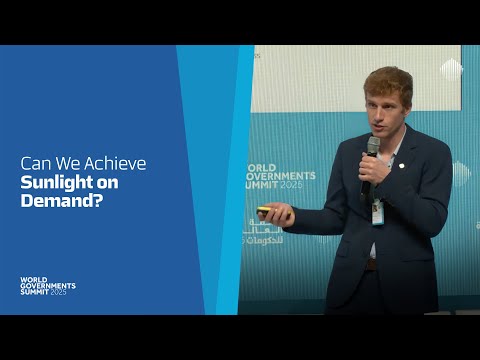
Solar, he noted, is the best form of energy, making 5,000 times more energy per second than humanity has ever consumed. And bouncing light off a mirror is incredibly efficient, “you lose almost no energy when you reflect sunlight off a mirror.” And that’s what they are doing with the orientation of satellites, which can be changed to direct the reflected light off into space if an area prefers to remain in darkness.
“So, we can operate a very large constellation of these satellites without bothering people, without blinding folks,” Nowack said. While the light would appear very bright to someone standing directly in the beam, to those outside of the spot, they’ll “just see the light on the ground, unless you’re looking directly at the satellite on purpose.”
Talking about the business model, Nowack shared that they’re simply “selling a resource,” and “not building the rockets. SpaceX handles that (and) they will launch our satellites, we go into orbit, and then we sell the sunlight to customers.”
But how much would this “sunlight-as-a-service” cost? Nowack told NYT that Reflect Orbital would charge about $5,000 an hour for the light of one mirror if the customer has an annual contract with the company for 1,000 hours or more.
One-time events and emergencies, however, would cost more, as they might require several satellites and more effort to coordinate. As for solar farms, the company plans to split revenue from the additional electricity generated during the additional hours of light.
Notably, Reflect Orbital has already applied to the U.S. Federal Communications Commission (FCC) for a license to “construct and launch an NGSO satellite.” The FCC issues the licenses needed to deploy satellites.
If the license applied for in July last year is approved, its prototype satellites may be launched as early as this summer. The public comment period on Reflect Orbital’s application has now been closed.
In its application, the firm stated that its proposition had “generated significant interest from commercial and government partners.” It has already secured full funding for its mission and has received over 260,000 applications for service, the company noted.
The Idea Returns with Higher Stakes
Reflect Orbital is fast closing on making its idea a reality, but it’s not the first time this has been thought of.
Almost half a century ago, in 1977, rocket engineer Krafft A. Ehricke floated the idea of space mirrors to illuminate disaster-struck areas and prevent crop freezes. Before that, in 1923, German rocket pioneer Hermann Oberth suggested the idea in his PhD thesis.
Then, in 1993, a Russian satellite called Znamya, carrying a mirror about 80 feet across, briefly reflected a beam of sunlight across Earth. After all this time, the idea remains controversial, with experts worried about the project’s side effects.
These mirrors not only could distract airplane pilots but also raise concerns about potential risks to human health, animal health, and ecosystems.
“The nighttime is supposed to be dark, and these satellites are designed to turn night into day,” James Lowenthal, an astronomer at Smith College, told Smithsonian. “It goes against every fiber of my existence to imagine that we could intentionally banish the night.”
After all, plants need both day and night to bloom and grow. It is these very cycles that also tell us when to wake up and sleep, while dictating the migration of birds and other creatures. Hibernating insects and animals can also get confused by the extra light.
“Circadian rhythms are present in all types of organisms, ranging from bacteria to plants to animals, including humans. These rhythms synchronize physiological function to the natural light-dark cycle, which is important for overall well-being. Light at night will disrupt these rhythms, which can impair health and well-being.”
– Kristen Knutson, associate professor of neurology and preventive medicine at Feinberg, told the University’s Northwestern Now
The implications are simply massive for all life on planet Earth. But for the FCC, none of this is a concern, as, in the agency’s view, activities in space are not subject to environmental review.
When reviewing satellite applications, the FCC ensures that a spacecraft’s radio communications do not interfere with those of others. It also ensures that at the end of a spacecraft’s operational lifetime, it will be safely disposed of. But that’s it.
So, “it’s wild that one little company in California, [with] permission from one agency that looks after radio transmissions, can change the sky for everyone in the world,” said Samantha Lawler, an astronomer at the University of Regina in Canada.
Illumination Becomes Interference

Reflect Orbital’s ambitions raises another question about preserving the night sky itself. Astronomers are concerned that its satellites will obstruct their view of celestial objects. That’s because anytime a space mirror is over the horizon, the sky gets too bright to perform astronomy research.
Already, the constellation of almost 10,000 Starlink satellites operated by SpaceX is affecting astronomers’ observatories by producing bright streaks across images captured by ground-based telescopes.
But while SpaceX and others have been working to minimize light pollution in the night sky by making their satellites less reflective, the entire point of the Reflect Orbital satellite is to be as bright as possible.
From a single satellite, the reflected sunlight would spread over about 18 square miles, reducing the number of photons reaching the solar panel to about 1/140,000 of its midday value.
Even with its larger mirrors, which are 180-foot-wide, “over 3,000 satellites would be required to produce the equivalent of just 20 percent of the midday sun at a single site,” wrote Dr. Michael Brown, an astronomer at Australia’s Monash University, in his comment to the F.C.C. about Reflect Orbital’s application.
Lawler has also shared doubts over the company’s aim of increasing solar power production, saying “when you do the calculation, it’s milliwatts,” so, “you’d need hundreds or thousands of mirrors pointed at the same spot on the ground to even activate a solar panel. It doesn’t make any sense.”
According to Brown, a network of mirror satellites is simply not an efficient means of increasing energy production.
“I think his idea keeps coming up because it has a certain simplicity and elegance,” Dr. Brown said in an interview. “But when you start crunching the numbers, and the numbers are pretty easy to crunch, then you find there’s a lot of serious issues with it.”
The company’s claim that the reflected light would be visible only in the targeted area has also been questioned, with Gaspar Bakos, an astronomer at Princeton University, saying that air particles would inevitably scatter light, and the beam’s glow could light up the night sky at much greater distances.
In response, the CEO has said they have studied the issue in simulations and that the effects aren’t as dire as critics paint. “We plan to show exactly what’s happening with real measurements in the real world from our actual satellite,” he said. “That’s going to help a ton. You can’t fake that.”
In a statement to Bloomberg, Reflect Orbital said it’s working with the astronomical community to minimize the potential impact of its project.
Space mirrors are better suited for the moon, noted Dr. Bakos, as it lacks an atmosphere. NASA is currently building lunar outposts and will spend $20 billion on this effort over the next decade.
“I’m also more concerned, oddly enough, I’d say from a sort of almost an aesthetic point of view. That I sort of like the sky being sort of this shared wilderness,” Brown told a media publication back in October. “If you go somewhere where it’s nice and dark and look at the night sky and have these constant reminders of technology, I think that’s a bit of a loss.”
In a blog post last month, the company shared that its two demonstration satellite launches this year will provide everyone, including scientists and the public, the opportunity to learn about the technology and shape this new tool at its earliest stages. It said:
“We’re eager to work with scientists to measure the precision of reflections, evaluate visibility, and test mitigation strategies.”
Reflect Orbital also reiterated its “goal to redirect precise sunlight from space to increase clean energy access” down here on Earth, which it said will help solve pressing challenges as well as create new opportunities. “We want to do that in a way that preserves the night sky.”
Regarding that, their service will be limited to a defined area for predetermined times, and they will avoid reflecting light near observatories. The company will further share its satellite positions in advance for researchers to plan around brief windows of operation.
Conclusion
Reflect Orbital is a bold but controversial idea that could change the future of energy. Notably, it could be a game-changer for solar. By eliminating intermittency, it can increase the operation capacity of solar farms without taking up ground space. If successful, it could make solar more consistent and valuable.
But these gains aren’t without trade-offs. While Reflect Orbital’s idea can help enable 24/7 renewable energy, it can potentially cause severe light pollution and cause ecological disruption. Astronomers are already struggling with constellations like Starlink; adding thousands of actively reflecting mirrors would further ruin dark-sky observations.
As the company faces major backlash from the scientific community, it remains to be seen whether Reflect Orbital becomes a foundational layer of future infrastructure or a cautionary tale of overreach.
Click here to learn more about space-based endless clean energy.



