
Επιστήμη υλικών
Ανακύκλωση Αποβλήτων Μετάλλων με το ‘ShAPE’ μπορεί να αλλάξει τις συνήθειες ανακύκλωσής μας

 Προσθέστε το Securities.io στις προτιμώμενες πηγές σας στο Google

Καλύτερη Ανακύκλωση
As industrial civilization progresses in time and scale, it becomes clear that we need to optimize our resource utilization. One such activity is metal recycling, with metal-based material, in theory, recyclable endlessly.
Στην πράξη, δεν είναι τόσο απλό, καθώς τα περισσότερα ρεύματα αποβλήτων με μεταλλικό υλικό περιέχουν ένα σύνθετο μείγμα διαφορετικών μετάλλων. Μερικές φορές, αυτό οφείλεται στο ότι τα απόβλητα είναι κράμα, και κάποιες φορές, η απλή ανάμειξη των διαφορετικών μετάλλων στο ανακυκλωμένο προϊόν και η διαλογή τους θα ήταν πολύπλοκη και/ή δαπανηρή.
Αυτό δημιουργεί ένα πρόβλημα· η απλή επαναχρησιμοποίηση αυτού του μείγματος μετάλλων θα παρήγαγε κατώτερα προϊόντα, πιο επιρρεπή στο κάμπτο ή το σπάσιμο σε σύγκριση με μέταλλο από φρέσκο ορυκτό, κάτι που μπορεί να είναι επικίνδυνο για τους τελικούς χρήστες.
Για παράδειγμα, για να ανακυκλωθεί, τα αλουμινένια υπολείμματα πρέπει να αναμειχθούν με 40% φρέσκο εξορυγμένο και επεξεργασμένο αλουμίνιο. Αυτό βοηθά, αλλά προφανώς δεν αποτελεί «αληθινή» ανακύκλωση.
This is why researchers at the Pacific Northwest National Laboratory (PNNL) have developed a new method, called ShAPE (Shear Assisted Processing and Extrusion). They published how it works and why it can allow for a 100% aluminum recycling rate in the journal Nature Communications, under the title “Upcycled high-strength aluminum alloys from scrap through solid-phase alloying1“.
Προβλήματα Ανακύκλωσης Αλουμινίου
When it comes to aluminum, most of the costs, both money and energy, as well as the assorted CO2 emissions, come from having to completely melt back aluminum, a metal with a high melting point.
This has to be done because recycled aluminum contains small impurities, like clumps of iron. These need to be diluted with fresh aluminum to create a satisfying product.
ShAPE
Instead of spending a lot of energy and additional fresh ore to just create a standard aluminum product, the PNNL researchers found a way to create a better aluminum alloy without all the intermediary steps.
This process directly skips the sorting, melting, and casting steps. Instead, it feeds the aluminum scraps directly into a process called “solid-phase extrusion”, developed in 1993 by the Welding Institute in the United Kingdom.
Solid-phase extrusion uses friction instead of heat to melt the metal, leading to a very homogeneous mix despite using a lot less energy. You can see it in action in the short video below:
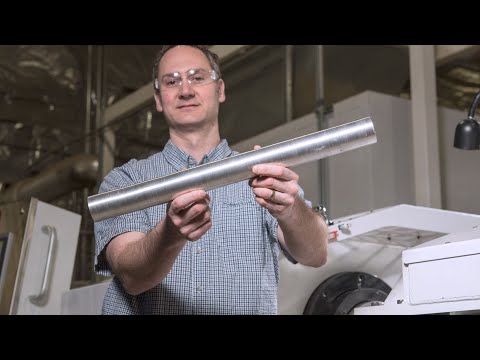
The machine has a rotating head that spins 500 times a minute with 2,200 foot-pounds of torque. The other end of the machine contains a hydraulic press capable of exerting 200,000 pounds of force against the rotating head.

Πηγή: Nature Communications
The aluminum scraps are mixed with copper (Cu) powder, zinc (Zn) powder, and ZK60 magnesium (Mg) ribbons. When uniformly mixed together, they form a high-strength aluminum alloy product in a matter of minutes. In comparison, the traditional aluminum recycling process takes days.
The whole method also consumes 50% less energy.

Πηγή: PNNL
Ανώτερη Δομή & Επιδόσεις
When analyzed under a microscope, the new method demonstrates a radically different metallic structure. The upcycled material displays much smaller grains (7.7 µm), compared to the traditionally recycled aluminum (43.1 µm).

Πηγή: Nature Communications
This proves that during ShAPE, atomic-scale features called Guinier-Preston zones form within the alloy. These features are well known to improve strength in metal alloys.
It directly leads to superior performance for the upcycled metal, with resistance to mechanical stress 200% higher than the normally recycled alloy.

Πηγή: Nature Communications
Another improvement brought by this method is that the production of aluminum profile, tubes, and other metal parts happens in solid-state, potentially helping to develop a new type of alloy that would not work with the traditional melting stages.
Η στερεά φάση αλληλοσύνθεσης είναι θεωρητικά εφαρμόσιμη σε οποιονδήποτε συνδυασμό μετάλλων που μπορείτε να φανταστείτε, και το γεγονός ότι η παραγωγή πραγματοποιείται εξ ολοκλήρου σε στερεή κατάσταση σημαίνει ότι μπορείτε να αρχίσετε να εξετάζετε εντελώς νέα κράματα που δεν ήμασταν σε θέση να κατασκευάσουμε προηγουμένως.
Cindy Powell – Chief science and technology officer for energy and environment at PNNL
Πέρα από το Ανακυκλωμένο Αλουμίνιο
This technique could be deployed for other metals that are hard to sort or recycle.
It could also be used to produce alloys that have superior performance, such as stronger, safer car structures, or to use less material for the same result.
The same method could also probably be expanded to other solid-phase manufacturing processes. , like cold spray or friction stir welding & processing.
Η ικανότητά μας να ανακυκλώνουμε τα απόβλητα είναι συναρπαστική, αλλά το πράγμα που με ενθουσιάζει περισσότερο σε αυτή την έρευνα είναι ότι η στερεά φάση αλληλοσύνθεσης δεν περιορίζεται μόνο σε αλουμινικά κράματα και ακατάλληλα πρώτες ύλες.
Cindy Powell – Chief science and technology officer for energy and environment at PNNL
Μεταλλική 3Δ Εκτύπωση
Lastly, this method could be used to create a high-quality feed for metal 3D printers.
Because the method adds a certain amount of extra metals in a precise way, it can be used to create tailored alloys for specific needs in additive manufacturing.
The improved 3D structure is also likely to help make the final 3D printed product extra-strong.
Είναι δύσκολο να αποκτηθούν νήματα τροφοδοσίας με προσαρμοσμένες συνθέσεις για την προσθετική κατασκευή με νήματα. Η στερεά φάση αλληλοσύνθεσης είναι ένας φανταστικός τρόπος για την παραγωγή προσαρμοσμένων κραμάτων με ακριβείς συνθέσεις, όπως 2 % χαλκό ή 5 % χαλκό.
Xiao Li – PNNL materials scientist
Εταιρεία Ανακύκλωσης Αλουμινίου
Radius Recycling
As new methods for improved recycling are being developed, established players in the industry stand to benefit by taking market share from primary producers.
As we recycle more and more material, as well as we turn toward electrification of heating and transport, the amount of work for recycling companies is poised to grow slowly but steadily. The metal recycling market is expected to grow from $915B in 2024 to $1.29T by 2033, or a 3.9% CAGR.
Radius Recycling was founded in 1906 and currently hires 3,500+ employees. It currently has 100+ sites for metal and automobile recycling all over Canada and the USA, as well as one steel manufacturing site, making it one of the region’s largest metal recyclers.

Πηγή: Radius Recycling
The company processes both:
- Σιδηρούχα μέταλλα, που περιέχουν σίδηρο, όπως καλώδια, τυμπάνια, μεταλλικές στέγες, ποδήλατα, αυτοκίνητα, οικιακές συσκευές κ.λπ.
- Μη σιδηρούχα μέταλλα: αλουμίνιο, χαλκός, ανοξείδωτος χάλυβας, ψευδάργυρος, μπαταρίες μολύβδου‑οξέος, σύρμα, πηνία, ηλεκτρικοί κινητήρες, ψυγεία κ.λπ.
In the nonferrous segment, the largest metals are copper and aluminum.

Πηγή: Radius Recycling
The company is balancing its capital allocation between shareholders (with a dividend paid every quarter since going public in 1993, – at a yield of 4.5% at the time of writing of this article), controlling debt costs, and reinvestment in growth (including 2 new recovery centers on the US West Coast).
Overall, the company is a good pick for investors looking for exposure to the recycling industry and overall circular economy, a stable dividend income, and activity focused on the North American market.
Αναφορά Μελέτης:
1. Wang, T., Li, X., Li, Z., et al. (2024). Upcycled high-strength aluminum alloys from scrap through solid-phase alloying. Nature Communications, 15, 10664. https://doi.org/10.1038/s41467-024-53062-2



