
Ενέργεια
Κατασκευαστές Μπαταριών Αγωνίζονται να Καλύψουν τη Μελλοντική Ζήτηση

 Προσθέστε το Securities.io στις προτιμώμενες πηγές σας στο Google

In the coming years, the shift away from internal combustion engines (ICE) and toward electric motors is only set to increase. Whether this be small-scale tools like generators and chainsaws or big-ticket items like boats and cars, the shift ΕΙΝΑΙ happening. With that in mind, battery manufacturers are now looking toward anticipated future demand for their products, and establishing new partnerships and manufacturing plants to ensure it can be met.
Stellantis + Samsung
Samsung SDI Co. and Stellantis NV (STLA ), the multinational automaker behind the Jeep, Peugeot, and Ram brands, are the most recent pair to have announced a collaboration that will see a 34 gigawatt-hours battery plant established in the United States. As it stands, the plant is expected to begin production of batteries in 2027.
Carlos Tavares, CEO of Stellantis, underscored the new factory’s integral role in realizing the company’s ambitious goal of launching at least 25 new battery electric vehicles for the North American market by 2030. Stellantis has also set a target to sell 5 million battery-electric vehicles and transition all European passenger car sales to fully electric models by the end of this decade. Moreover, the company plans to have 50% of its North American sales powered by batteries.
While Stellantis and Samsung have decided to collaborate on what is the pair’s second manufacturing plant in the United States, each company has also established other similar working relationships. For example, Samsung SDI has also partnered with General Motor Co. to build a 30 gigawatt-hour, $3 billion, battery plant.
Government Subsidies
Notably, multiple of the recently announced battery manufacturing plants in North America are only getting built due to massive subsidies on offer by local governments, showing the latters dedication and belief in the future of electrification. The following are a few examples of these.
Stellantis
The aforementioned partnership between Stellantis and Samsung, which will result in another manufacturing plant being built, is not the only move of its kind being taken by Stellantis. The auto-making giant is also in the midst of building a plant in Ontario, Canada, where it has also partnered with LG Energy Solution.
This particular plant saw construction come to a halt earlier this year, as pressure was exerted by the pair on the Canadian Federal and Provincial Governments to provide subsidies. The decision to push for these subsidies was made after the United States introduced the Inflation Reduction Act, which instantly made building such a plant in the United States much more appealing.
At the end of the day, the Canadian government agreed to provide up to $15B in incentive-based subsidies in order to keep the plant in Ontario, and restart construction.
Volkswagen
Meanwhile, Volkswagen also made the decision to establish a battery manufacturing plant in Ontario after being awarded up to $13B in incentive-based subsidies. The decision to establish a manufacturing plant in Ontario is part of Volkswagen’s $193B plan to gain a foothold within the EV market. As it stands, Volkswagen is believed to be slightly behind other manufacturers like GM, Ford, etc., with regard to EV development. Establishing such plants should go a long way in allowing for the automaker to catch up to its competitors.
Establishing the Battery Belt
Although there are select examples of battery manufacturers being lured to Canada as a result of government subsidies, the reality is that the majority of commitments being made for such plants are occurring within the United States, along what is now being called the ‘battery belt’.
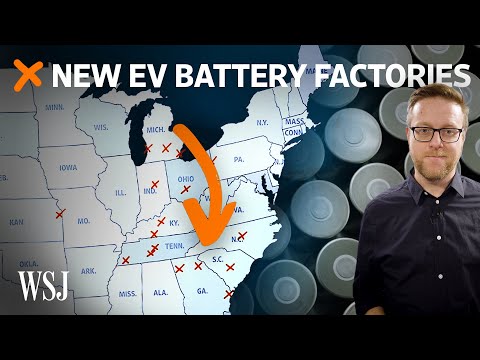
Καθώς η WSJ σημειώνει, αυτό έχει τεράστια επίδραση στις αγορές εργασίας, καθώς η τοποθεσία αυτών των εργοστασίων είναι “…μετακινώντας την αυτοκινητοβιομηχανική καρδιά της Αμερικής πιο νότια, αναδιανέμοντας χιλιάδες θέσεις εργασίας στη διαδικασία.”
Η WSJ επίσης σημειώνει τους ακόλουθους παράγοντες που παίζουν ρόλο στο γιατί η ζώνη μπαταριών έχει εδραιωθεί εκεί που είναι, κυρίως στην νοτιοανατολική περιοχή.
- Γεωγραφική τοποθεσία σε εργοστάσια κατασκευής ηλεκτρικών οχημάτων (η κοντινή απόσταση σημαίνει μειωμένα κόστη μεταφοράς για βαριές μπαταρίες)
- Συνδεσιμότητα με δίκτυα μεταφοράς (σιδηρόδρομοι και λιμάνια)
- Χαμηλότερο κόστος ηλεκτρικής ενέργειας
- Υπάρχουσες τοποθεσίες ‘κλειδί-παράδοση’ έτοιμες για ανάπτυξη
Ανεξάρτητα από το πού θα εγκατασταθούν αυτά τα εργοστάσια, η τάση προς τα ηλεκτρικά οχήματα είναι πιο σαφής από ποτέ, καθώς κάθε ένας από τους μεγαλύτερους κατασκευαστές αυτοκινήτων του κόσμου επενδύει δισεκατομμύρια στην ανάπτυξη και υιοθέτησή τους.



